Ancient Civilization
Turkish Archaeologists Claim Kekova Wreck Is World's Oldest Shipwreck; Age Rests on Pottery
By Darrell Wallen
Would you prefer to listen?
Archaeologists at Akdeniz University say a wreck about 30 metres down off Kekova Island, Turkey, is 4,400 to 4,700 years old, which would make it the oldest known shipwreck. The date is a claim: it rests on pottery style, no wood survives, and outside experts say it is not yet proved.
§ 1What was reported
Archaeologists in Turkey announced on October 14, 2026, that a wreck on a rocky slope off Kekova Island, near Antalya, is the oldest known shipwreck. Turkey's Culture and Tourism Minister, Mehmet Nuri Ersoy, wrote on social media that the country was bringing to light "traces of the world's oldest shipwreck," according to Euronews. The excavation is led by Hakan Öniz of Akdeniz University in Antalya.
The team dates the wreck to the Early Bronze Age. The BBC reported an age of between 4,400 and 4,700 years. New Scientist and The Conversation gave the same range as about 2700 to 2400 BCE. That is roughly the era when the Great Pyramid at Giza was built, as the BBC noted.
No timber from the ship survives. What remains on the seabed is cargo: more than 30 large pottery storage jars, called amphorae, and stone anchors. The date comes from the style of the jars, not from a laboratory measurement of the ship itself.
This story is therefore filed as a claim. The label Claimed. appears in the text wherever a statement rests on the excavation team's own interpretation. The label Confirmed. is used only for what is documented in a published source. The label Interpretation. marks reasoning that goes beyond the documented finds.
Confirmed. A team from Akdeniz University found and excavated a site of ancient pottery and anchors off Kekova Island, and Turkey's culture minister announced it on October 14, 2026. A preliminary report on the site was published in the Journal of Maritime Archaeology on July 24, 2026, according to Crossref and Guinness World Records.
Claimed. The wreck is 4,400 to 4,700 years old, which would make it the oldest known shipwreck in the world. Outside archaeologists quoted by New Scientist and The New York Times say the age is not yet proved.
§ 2The site and the finds
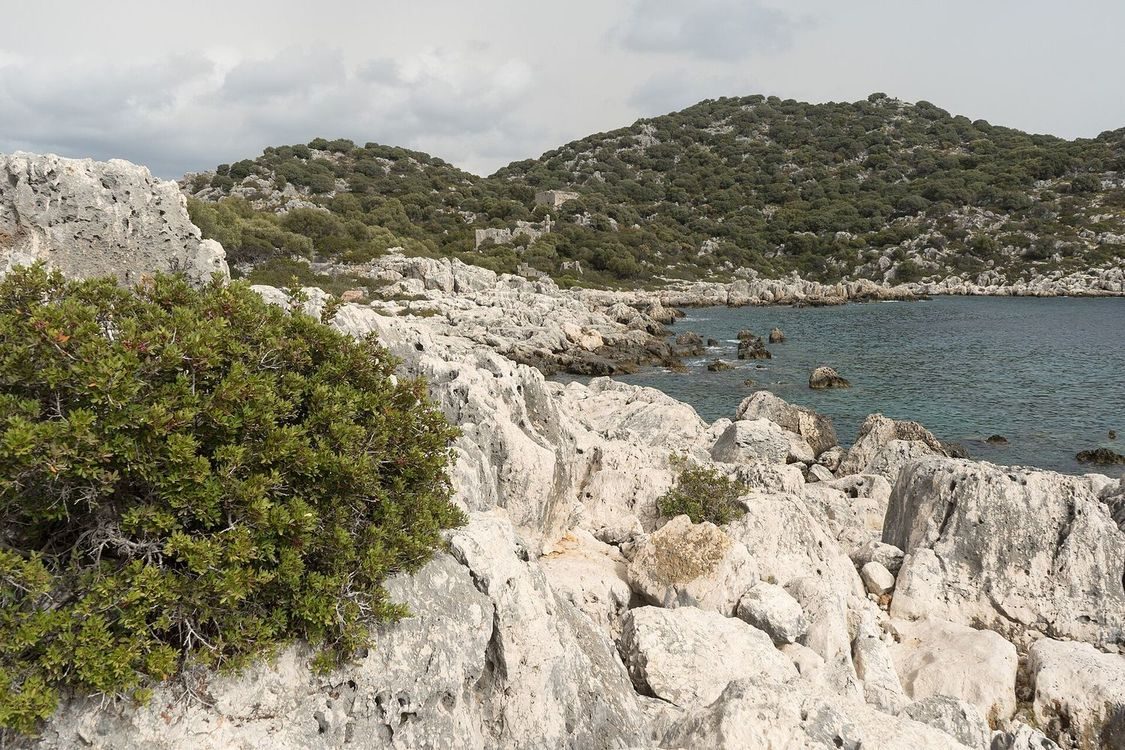
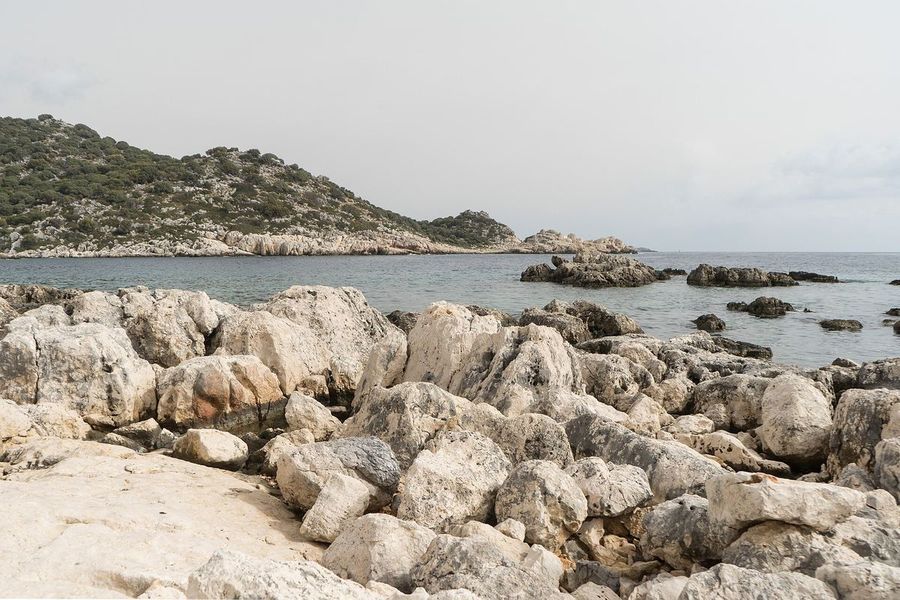
Kekova Island lies off the coast of Demre district in Antalya Province, on the southern coast of Turkey. The wreck sits about 30 metres below the surface. The BBC reported that the artefacts are scattered across an underwater slope and that divers could spend only 30 minutes at a time at that depth.
The BBC reported that Öniz led the Mediterranean Archaeology Association expedition to the site. In The Conversation, Karin Sowada of Macquarie University in Australia wrote that Öniz found the wreck in shallow water in 2024, acting on clues from local seafarers. She wrote that he asked her earlier this year to help date some of the pottery. New Scientist reported that the team first saw the wreck in 2024 during an underwater survey of the Turkish coast.

The cargo was raised in stages. The preliminary report says one amphora was recovered in 2024 and another in 2025. The excavation season of 2026 recovered the cargo. New Scientist reported that excavations completed in early October retrieved around 30 storage jars from the seabed. Sowada wrote that divers worked for four months to extract pottery from barnacles on the rocky slope.
The count of jars is reported differently. The BBC and New Scientist gave "more than 30" and "around 30." The New York Times, writing on October 16, said more than a dozen jars were found. The reports may reflect different stages of recovery. The numbers have not been reconciled in any source reviewed for this story.
The jars share a form. The BBC described them as having two handles, a ridge around the middle and a flat base. Sowada described them as large ovoid, flat-based jars with two handles, many with a raised horizontal clay belt around the widest part. New Scientist reported that the jars show minor variations, which Öniz said suggest they came from different workshops and probably different settlements. Öniz also told New Scientist that as international trade became established, traders switched to jars with tapered, carrot-shaped bottoms, because they pack more efficiently onto ships.
The preliminary report, as summarized in its abstract, says the amphorae resemble Early Bronze Age types from the Levant, with side handles and flat bases. It says the recovered jars differ from each other in technical characteristics, clay composition and probable use. One recovered jar has two parallel lines incised with a pointed tool on its upper part and a zigzag pattern around the middle.
There are also three stone anchors. The preliminary report says two have three holes and one has a single hole. The abstract states that it is not yet known which of the anchors, if any, belong to the wreck. The abstract says the three-holed anchors resemble Bronze Age examples from Minoan, Cypriot, Anatolian and Levantine contexts. It says the single-holed anchor resembles Bronze Age examples from the Anatolian and Levantine coasts.
New Scientist reported that the anchors were lying some distance from the wreck, which Öniz said suggests they may have been thrown overboard when the ship got into trouble in a storm. The BBC wrote that the divers found three stone anchors and that ships carried spares on long voyages. That sentence is a BBC photo caption and not a finding from the report. The abstract's wording is more cautious: it says the link between the anchors and the wreck is not yet known.
Confirmed. The site lies at about 30 metres depth off Kekova Island. It includes a scatter of Early Bronze Age style amphorae and three stone anchors, according to the BBC, New Scientist and the preliminary report's abstract.
Claimed. The anchors belong to the same ship as the jars. The report's own abstract says this is not yet known.
§ 3How the date was reached
Wrecks can be dated in several ways. They can measure organic material, such as timbers, with radiocarbon or tree-ring methods. They can read dates from inscriptions or datable objects in the cargo. Or they can compare the shape and decoration of the pottery with vessels from dated sites on land.
At Kekova the first method is not available. The BBC reported that because none of the ship's wood remained, radiocarbon dating could not be used on the ship. New Scientist reported that no organic material survives at the site. The team used the third method.
The BBC reported that Öniz said the design of the jars matches amphorae found in Egypt and the Middle East that are known to be 4,400 to 4,700 years old. He told the BBC, "Comparing the decoration techniques… we can definitely say our wreck is Early Bronze Age. This is 100%."
Sowada took a more measured line in The Conversation. She wrote that the team has "tentatively dated" the wreck to around 2700 to 2400 BCE. She wrote that "the precise dating is still under consideration" and that earlier or later dates on either side of that range are also possible. She told The New York Times that the team is "reasonably confident" the wreck is an Early Bronze Age ship.
Öniz told The New York Times that skepticism is the rule in his field. He noted that the team recently published an article in a scientific journal, adding, "we have more data now and we are sure for dating."
Claimed. The wreck dates to between about 2700 and 2400 BCE. This range rests on pottery typology. It has not been checked against a physical dating method.
What could not be read
The full text of the preliminary report was not available for this story. The report is titled "Preliminary Report on the Early Bronze Age Shipwreck in the Kekova Region of Antalya." It was written by Öniz and Ceyda Öztosun and published in the Journal of Maritime Archaeology, volume 21, issue 3. Crossref lists its online publication date as July 24, 2026, and 62 references.
The Springer page for the article answered automated requests with a browser challenge instead of the article. The abstract was read from a record on the Akdeniz University research database, AVESİS. The reporting below treats the abstract as the only part of the paper that was read.
Several points follow from that gap. The abstract names the period as the Early Bronze Age. It does not state a calendar range in the text that could be read. The abstract's description of the cargo, which says two jars were recovered by 2025, predates the 2026 excavation that raised the larger group. The abstract also contains a gap where a number of visible amphorae should appear. The details of the typological comparisons, including which dated sites the jars were matched against, could not be checked.
A statement in The Conversation adds a further wrinkle. Sowada wrote on October 14 that a paper outlining the results had yet to be published in a peer-reviewed journal. The preliminary report had been published in July. The two statements can both be true if the results she meant are those of the 2026 season. That reading is an interpretation, and no source reviewed says so directly.
The jar comparisons that the team cites also could not be checked independently. The BBC said the design matched amphorae from Egypt and the Middle East. The Akdeniz University announcement, in Turkish, says similar examples have been found around the pyramids of Giza, Saqqara and Abusir, at Troy and on Crete. No catalogue of those comparisons was available.
§ 4What outside experts say
Several archaeologists who were not part of the project have spoken on the record. Their comments are consistent in one respect: they find the discovery important and the age claim not yet proved.
Jon Henderson of the University of Edinburgh called it "a fascinating and potentially very important discovery," in New Scientist. He said he would like to see published evidence before "crowning it the world's oldest shipwreck." He noted that dating by pottery comparison is not always accurate, because similar forms and decorative features can occur over long periods. He said radiocarbon data would help, but no organic material survives at the site.
Justin Leidwanger, an archaeologist at Stanford University, told The New York Times, "Is this the oldest? Maybe. We're all excited by 'maybe,' but the burden of proof is pretty high archaeologically." The Times reported that Leidwanger found the Turkish team's scenario plausible, and that he said there were many questions and other possibilities. He said, in the Times account, "Where exactly this thing was coming from — until we have more archaeology to complete the picture we're somewhat in the realm of guesstimation."
Sean Kingsley, a marine archaeologist, raised a different question. The New York Times reported that without pieces of hull for carbon dating, some experts raised the possibility that the amphorae fell or were tossed overboard. Kingsley said, "You have to ask the question of whether this could be a jettison site, or did they just park the ship and it just kind of fell over the side as it got hit by a big wave?"
The Times also reported that outside experts pointed to other possible dates. One expert said that two wrecks found in the 1980s appeared to hold amphorae similar to those at Kekova, but those wrecks were estimated at the 12th to 15th centuries BCE. Another expert suggested that the Kekova jars bear a strong resemblance to amphorae from a medieval Byzantine-era wreck. The Times did not name either expert in the text reviewed.
Those two comments describe a general concern about typology. A jar form can persist, or return, across centuries. The Times also reported that the evidence at the site is limited to the jars and three anchors, and that experts said the anchor designs span many eras and are hard to date.
On whether the site is a wreck at all, the Times reported that Leidwanger and others were confident that it is. It said the Turkish team pointed to calcium carbonate tubes, which it described as the telltale secretion of shipworms. Shipworms bore into wooden hulls. The Times did not report the size or number of the tubes.
Confirmed. Outside archaeologists have publicly said the age claim is unproven and that pottery dating can be imprecise. Henderson, Leidwanger and Kingsley are on record in New Scientist and The New York Times.
Interpretation. The jettison idea is a possibility raised by Kingsley, not a finding. Leidwanger and others told the Times they were confident the site is a wreck. The Times did not report any evidence that the site is a dump of cargo or debris.
One note on sources: the jettison remark appears in The New York Times, not in New Scientist. Both outlets reported the experts' caution. The text of the Times article was read from a syndicated republication, because the Times page itself did not open for automated reading.
§ 5The jars and what they held
The BBC reported that some jars were intact and still held a viscous, glossy residue. Sowada told the BBC she was surprised at how much remained. She said, "I looked inside and nearly fainted. I could not believe how much [residue] was visible." She described a "black glossy coating" to The New York Times.
The team has not yet identified the material. Sowada told the BBC that it could be olive oil, wine or tree resins. She also cautioned that the residue could be the result of reuse. She said the jars are huge and people would have emptied them on arrival and possibly used them for many years. In The Conversation, she wrote that scientific analyses are pending.
That caution matters for the story. A jar's last contents are not necessarily its first. If the jars were reused, the residue could say something about trade, or about household use, or about both. The New York Times reported that experts said the substance could be tree resin, a kind of oil, or a mix of materials as the jars were emptied and refilled. It also reported that it is not clear whether any of the remaining material can be radiocarbon dated. If it can, the residue could provide a date for the contents. It would date the contents, which is not necessarily the same as dating the ship.
New Scientist reported Öniz's reading of the cargo. He said the ship was about 10 metres long and departed from a harbour on the eastern Mediterranean coast. He said the crew sailed along the coast, picking up jars of olive oil or wine from different villages. He said the ship was probably bound for the Minoan civilisation on Crete or for Troy in north-western Turkey when it sank.
Interpretation. The ship's length, its route, its cargo of oil or wine, and its destination are inferences by the excavation team. None can be read directly from scattered jars.
A claim of a different kind came from the Turkish side. The Akdeniz University announcement, and the minister's post as reported by Anadolu Agency and Euronews, describe one amphora with nine marks and two holes in its body. They say it may have been a churn for making cheese or butter. The university's text goes on to suggest that Early Bronze Age sailors may have carried live goats on long voyages and made dairy products on board. That is a suggestion from the university. No analysis supporting it was available.
Claimed. One jar was a churn, and sailors made dairy on board. The university's text says the identification came from initial examinations, and no published analysis was found.
The origin of the jars is described in more than one way. The Akdeniz University release and the minister's post, per Anadolu Agency, say clay analysis points to workshops in the Jordan Valley. Sowada wrote that her best assessment at this stage is that some of the belted jars, or the clays used to make them, may have originated in the Central Jordan Valley. The New York Times reported that the team believes the jars came from somewhere in the region of modern Lebanon. The three accounts overlap but are not identical.
§ 6Dokos and the question of "oldest"
Until October, the usual answer to the question of the oldest shipwreck was Dokos, a small island between Hydra and the Argolid coast of Greece. The Hellenic Institute of Marine Archaeology describes the site on its own website, in Greek. It says Peter Throckmorton found a large concentration of prehistoric pottery fragments on the seabed of Skindos bay at a depth of 20 metres on August 23, 1975.
The Institute, directed by archaeologist Giorgos Papathanasopoulos, made a survey in 1975 and another in 1977. It says the pottery was scattered between 15 and 32 metres and was part of the cargo of a ship of the Early Helladic II period. It says that made it the oldest known shipwreck in the world at that time. Systematic excavation took place in four seasons, from 1989 to 1992.
The Institute dates the Dokos cargo to the late Early Helladic II period, around 2200 BCE. It describes two stone anchors found close to the main concentration of pottery. It says their position and characteristics make it very likely that they are linked with the cargo. That is the same question the Kekova team has left open for its own anchors.
New Scientist gave the Dokos date as 2700 to 2200 BCE, a range that overlaps the Kekova range of 2700 to 2400 BCE. Henderson told New Scientist that Öniz argues Kekova is older than Dokos, but the two wrecks could in fact be contemporary. He said what excites him is not whether one wreck is a century or two older than another. He said it is that we are looking at a snapshot of Mediterranean maritime trade more than 4,000 years ago.
The Times added that some archaeologists are now unsure whether Dokos is in fact a shipwreck, a sunken settlement or something else. That comment is the Times's account and is not attributed to a named person in the text reviewed. The Hellenic Institute describes Dokos as a shipwreck. Guinness World Records now lists the Kekova site as the oldest known shipwreck, with an estimate of 4,400 to 4,700 years. That entry follows the excavation team's estimate and does not independently test it.
The BBC placed the oldest known intact shipwreck, where the wood is preserved, in the Black Sea off Bulgaria. It said that wreck dates to about 2,400 years ago. The Kekova claim concerns age and not preservation.
Confirmed. The Dokos site was found in 1975 and excavated from 1989 to 1992. The Hellenic Institute dates its cargo to about 2200 BCE.
Claimed. Kekova is older than Dokos. Henderson says the two could be contemporary.
§ 7What the better preserved Bronze Age wrecks show
Shipwrecks of the Late Bronze Age give a sense of what a well-documented wreck looks like. They also show how much the Kekova site lacks.
The Uluburun wreck lies off the southern coast of Turkey, near Kaş. The Institute of Nautical Archaeology says a Turkish sponge diver found it in 1982 after seeing what he described as "metal biscuits with ears." The Institute excavated it over 11 seasons from 1984 to 1994, with more than 22,000 dives. It dates the wreck to about 1320 BCE, give or take 15 years.
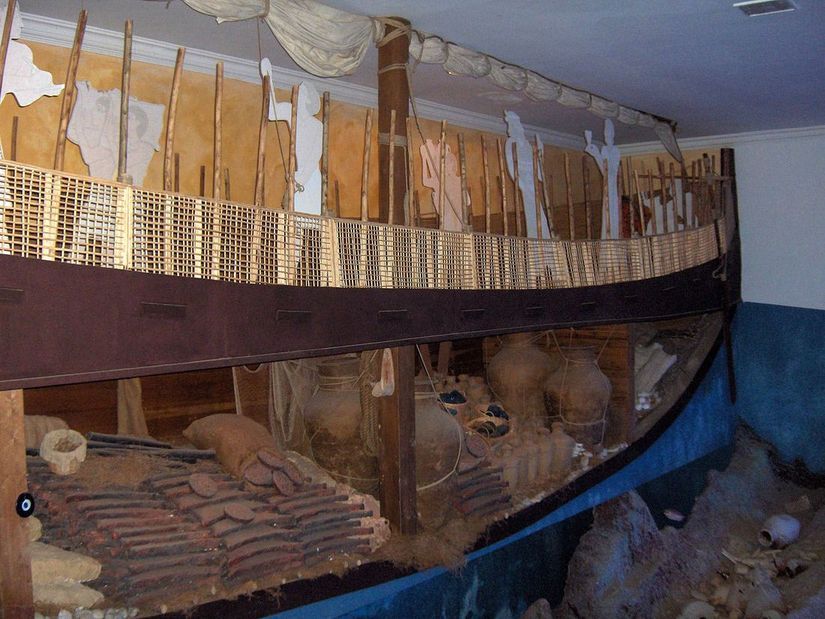

The Institute says the ship carried a bulk cargo of copper and tin ingots in the usual ratio of 10 to 1 for making bronze. It lists ivory, jewellery of gold and semi-precious stones, glass ingots, elephant tusks and ostrich eggshells among other cargo. It says at least 149 Canaanite jars were found, mostly filled with terebinth resin. New Scientist, for its part, described the Uluburun wreck as sinking around 1300 BCE with ebony, ivory, ostrich eggs and jewellery from cultures across the Mediterranean.
The Institute also says a small amount of the hull remained, and the ship was built of Lebanese cedar with pegged mortise-and-tenon joints. That surviving timber let archaeologists study the ship's construction. The Institute's bibliography also lists a 2009 study by Manning and colleagues titled "Absolute Age of the Uluburun Shipwreck." No comparable timber or other organic remains have been reported at Kekova.
Cape Gelidonya, also off Turkey, is better known for its place in the history of the discipline. The Institute says a sponge diver, Kemal Aras, found the main concentration of cargo in 1954. Throckmorton located the site in 1959. George Bass directed the excavation in 1960. The Institute says it was the first shipwreck excavation carried out to completion on the sea bed, and the first conducted to the standards of excavation on land. It dates the wreck to about 1200 BCE and says the main cargo was copper and tin ingots and scrap bronze tools, some from Cyprus.
Both wrecks are some 1,000 years or more later than Kekova's claimed date. Both carried metal. Both preserved some hull. The Kekova site, by contrast, carries pottery and stone only, so far as reported. Its significance, if the date holds, would come from its age and from what it adds to a thinly documented period.
New Scientist reported that hundreds of ancient shipwrecks have been found along Turkey's Mediterranean coast, most from the Roman and Byzantine periods, and a handful from the Bronze Age. It said Öniz has found two other Bronze Age wrecks in recent surveys, one from the Middle Bronze Age and one from the Early Bronze Age. Earlier surveys near Kekova found other wrecks entirely. A 2010 article in the International Journal of Nautical Archaeology reported two early Archaic wrecks of the seventh to early sixth century BCE at Kekova Adası and Kepçe Burnu. Those wrecks are separate from the new site and nearly two thousand years younger than its claimed date.
§ 8Seafaring before the great trade wrecks
The Early Bronze Age was not a time without ships. The evidence for them is mostly indirect.
Sowada wrote in The Conversation that trade and exchange in the eastern Mediterranean in the third millennium BCE, from 3000 to 2000 BCE, is poorly understood compared with later periods. She wrote that voyages in that period are known from Egyptian texts, pottery vessels and raw materials from ancient tombs. She wrote that around the time the Kekova ship went down, the ancient Egyptians were trading in the eastern Mediterranean through the port of Byblos in Lebanon. She listed cedar, tin or lead, oils, tree resins, lapis lazuli and silver among the imports of the Egyptian state.
She added that recent scientific research shows silver was acquired by the Egyptian state around 2600 BCE, and that analyses showed it came from the Lavrion mines east of Athens. She wrote that it is unlikely Egyptian ships made that journey, and that boats like the Kekova ship may have used the route as part of an extended international maritime network. That final point is her interpretation.
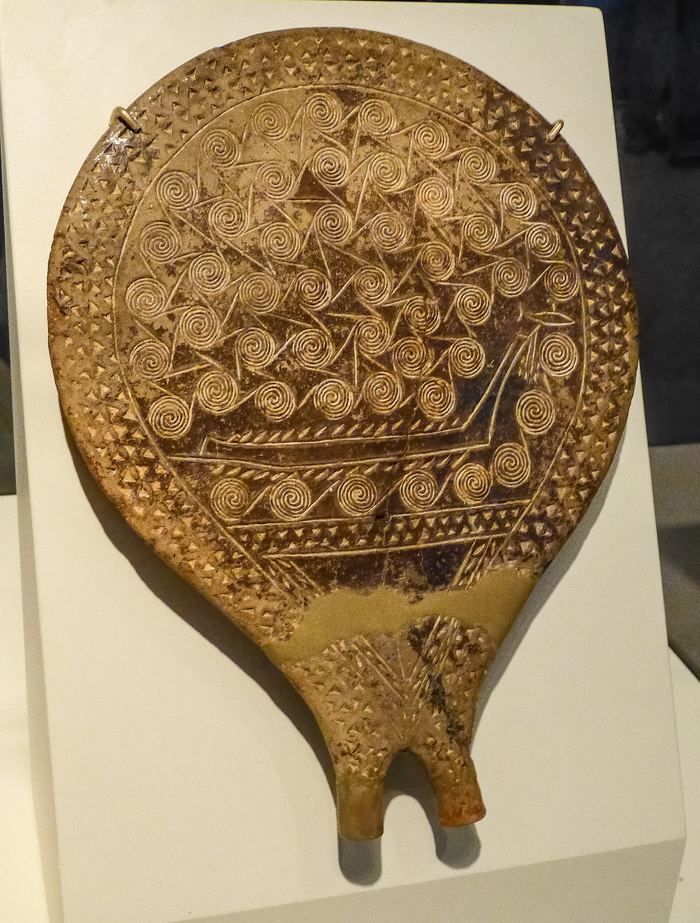

In the Aegean, the best known images of ships from the period come from small clay vessels. The National Archaeological Museum in Athens describes a "frying pan" from the Early Cycladic II cemetery at Chalandriani on Syros, dated to 2800 to 2300 BCE. A craftsman incised a ship with 28 oars on its underside. The museum's curator, Katia Manteli, writes that the pans form a small fleet of ships without masts, with 24 to 28 oars. She writes that with ships 15 to 20 metres long the inhabitants of the Cyclades pioneered the trade of metals across the Aegean and the eastern Mediterranean. The length and the claim about metals are the museum's reading of the images.
On Crete, the INSTAP Study Center for East Crete describes Mochlos, an islet and adjacent plain in the east of the island. It says excavation has revealed occupation throughout the Bronze Age. By Early Minoan II to III, it says, the island settlement had become a large village with houses, streets and workshop areas for making gold jewellery, stone vases and obsidian blades. It says later finds, including a Syrian cylinder seal and imported pottery, suggest that the site continued to be a major port.
None of these sources describes a ship on the scale of a loaded ocean trader. They show settlements and communities in contact by sea. They show people who could build and sail boats of some size. They leave the cargo ships themselves largely unrecorded. That absence is why the Kekova claim, if it holds, would be useful. Henderson told New Scientist that finding physical remains of this kind of trade is "extraordinarily rare."
The Kekova site also does not need to be the oldest to be useful. If it is a wreck of the Early Bronze Age, or close to it, it adds a rare physical record to a period known mainly from texts and tombs. If it is a later wreck, or a dump site, it adds a different record. Either way the cargo is now conserved and under study.
§ 9What remains open
Several questions are open. They are listed here in the order they are likely to be answered.
The first is the date. The team says it has more data than it published in July, and Öniz told the Times that the team is sure of the dating. The data have not been published in a form that could be reviewed for this story. A full account of which jars were compared with which dated finds, and what dates those comparisons yield, would let outside specialists test the range. Residue from inside the jars may also be datable, though the Times reported that this is unclear.
The second is the site itself. The anchors may or may not belong to the wreck. The shipworm tubes that the team cites point to a wooden vessel. Whether the pottery was carried by a vessel that sank, or tipped from one that did not, is a question for further excavation. The preliminary report's abstract says further remains are likely to be uncovered at deeper points on the seabed.
The third is what the jars held. Sowada said analyses are pending. The results could show a mix of oil, wine and resin, or evidence of reuse. They could also bear on the origin of the jars, which different accounts place in the Jordan Valley or in the region of Lebanon.
The fourth is the record. Whether Kekova displaces Dokos depends on the date range that is finally published. Henderson thinks the two may be contemporary. Until the Kekova dating is published in full and tested by others, the accurate statement is the one used by New Scientist in its headline: the wreck is claimed to be the world's oldest.
The BBC reported that the artefacts that have been recovered will go on display in the new Mediterranean Underwater Archaeology Museum in Antalya, which is due to open in the coming months. The BBC also reported that the shipwreck is owned by the Turkish Ministry of Culture.
Öniz told the BBC that when he dives on the wreck, his first thoughts are about the people who were connected with the vessel. "We are the first humans who [have] touched these objects after 5,000 years," he said. That remark is a statement of feeling, not a measurement of age, and the BBC's own figure for the age is 4,400 to 4,700 years.
Summary of status. The site, the jars and the anchors are documented. The date of about 2700 to 2400 BCE is a claim based on pottery style. The idea that the site is a wreck rests partly on shipworm tubes. The ship's size, route, cargo and destination are the team's interpretation. The identification of a churn is a preliminary claim. The position that Kekova is the world's oldest shipwreck has been challenged by outside experts and is not established.
Watch & Listen
Hear this entry read aloud. Coming soon — the channels are not live yet.
Sources
The Kekova claim: report and coverage
- Journal of Maritime Archaeology – Hakan Öniz and Ceyda Öztosun, "Preliminary Report on the Early Bronze Age Shipwreck in the Kekova Region of Antalya," vol. 21, no. 3 (published online July 24, 2026). Full text not read; the publisher page answers automated requests with a browser challenge: doi.org/10.1007/s11457-026-09532-3
- Akdeniz University research database (AVESİS) – record and abstract of the same report, the only part of it read for this story: avesis.akdeniz.edu.tr/yayin/a64debbb-dc64-471b-9d6f-740ca395b…
- BBC News – Alison Francis, Rebecca Morelle and Kevin Church, "World's oldest shipwreck found off coast of Turkey" (October 14, 2026): bbc.com/news/articles/c6gr80rk1yyko
- New Scientist – Jo Marchant, "Ancient shipwreck discovered off Turkey claimed to be world's oldest" (October 14, 2026; the site blocks automated checks with HTTP 406, but the page opens normally in a browser): newscientist.com/article/2593986-ancient-shipwreck-discovered…
- The Conversation – Karin Sowada, "World's oldest shipwreck discovered off coast of Turkey" (October 14, 2026): theconversation.com/worlds-oldest-shipwreck-discovered-off-co…
- The New York Times – Alan Yuhas, "The World's Oldest Shipwreck? Maybe, but 'We're All Excited by Maybe.'" (October 16, 2026). The Times page returned 403 to automated checks, probable bot blocking, and was read from the syndicated copy listed next: nytimes.com/2026/10/16/world/middleeast/oldest-shipwreck-amph…
- DNYUZ – republication of the New York Times article above (October 16, 2026): dnyuz.com/2026/10/16/the-worlds-oldest-shipwreck-maybe-but-we…
- Anadolu Agency – "4,700-year-old amphorae discovered near Türkiye's Kekova Island" (October 14, 2026): aa.com.tr/en/culture/4-700-year-old-amphorae-discovered-near-…
- Euronews – Buse Keskin, "World's oldest shipwreck off Turkey: 4,700-year-old amphorae discovered" (October 14, 2026; the site blocks automated checks with HTTP 406, but the page opens normally in a browser): euronews.com/2026/10/14/worlds-oldest-shipwreck-off-turkey-47…
- Akdeniz University (in Turkish) – "Akdeniz Üniversitesi'nden Dünya Arkeoloji Tarihine Geçecek Keşif" (October 15, 2026): akdeniz.edu.tr/tr/haber/akdeniz_universitesinden_dunya_arkeol…
- Guinness World Records – "Oldest shipwreck": guinnessworldrecords.com/world-records/oldest-shipwreck
Background: earlier wrecks and Early Bronze Age seafaring
- Hellenic Institute of Marine Archaeology (in Greek) – "Dokos Shipwreck" (Early Helladic II wreck, about 2200 BCE): ienae.gr/en/dokos-shipwreck/
- Institute of Nautical Archaeology – "Uluburun Late Bronze Age Shipwreck Excavation": nauticalarch.org/projects/uluburun-late-bronze-age-shipwreck-…
- Institute of Nautical Archaeology – "Cape Gelidonya Late Bronze Age Shipwreck Excavation": nauticalarch.org/projects/cape-gelidonya-late-bronze-age-ship…
- INSTAP Study Center for East Crete – "Mochlos": instapstudycenter.net/archaeological-projects/ascsa-projects/…
- National Archaeological Museum, Athens – Katia Manteli, "Dominating the sea…" (Exhibit of the month, January 2016): namuseum.gr/en/monthly_artefact/dominating-the-sea/
- International Journal of Nautical Archaeology – "Two Early Archaic Shipwrecks at Kekova Adası and Kepçe Burnu, Turkey" (2010; publisher page blocks automated checks with HTTP 403; abstract read through a search result): doi.org/10.1111/j.1095-9270.2010.00265.x
Image sources
- Wikimedia Commons – Kekova Island, 2023-11-05 (Alexkom000, CC BY 4.0): commons.wikimedia.org/wiki/File:2023-11-05_Kekova_Island_10.jpg and commons.wikimedia.org/wiki/File:2023-11-05_Kekova_Island_13.jpg
- Wikimedia Commons – Uluburun ship replica, Bodrum (Georges Jansoone, CC BY-SA 3.0): commons.wikimedia.org/wiki/File:Turkey.Bodrum091.jpg
- Wikimedia Commons – Cycladic "frying pan" with ship, National Archaeological Museum, Athens (Mary Harrsch, CC BY-SA 4.0): commons.wikimedia.org/wiki/File:Clay_%22frying-pan%22_%28%22s…
