SpaceX-Tesla
SpaceX Catches a Returning Starship for the First Time
By Darrell Wallen
Would you prefer to listen?
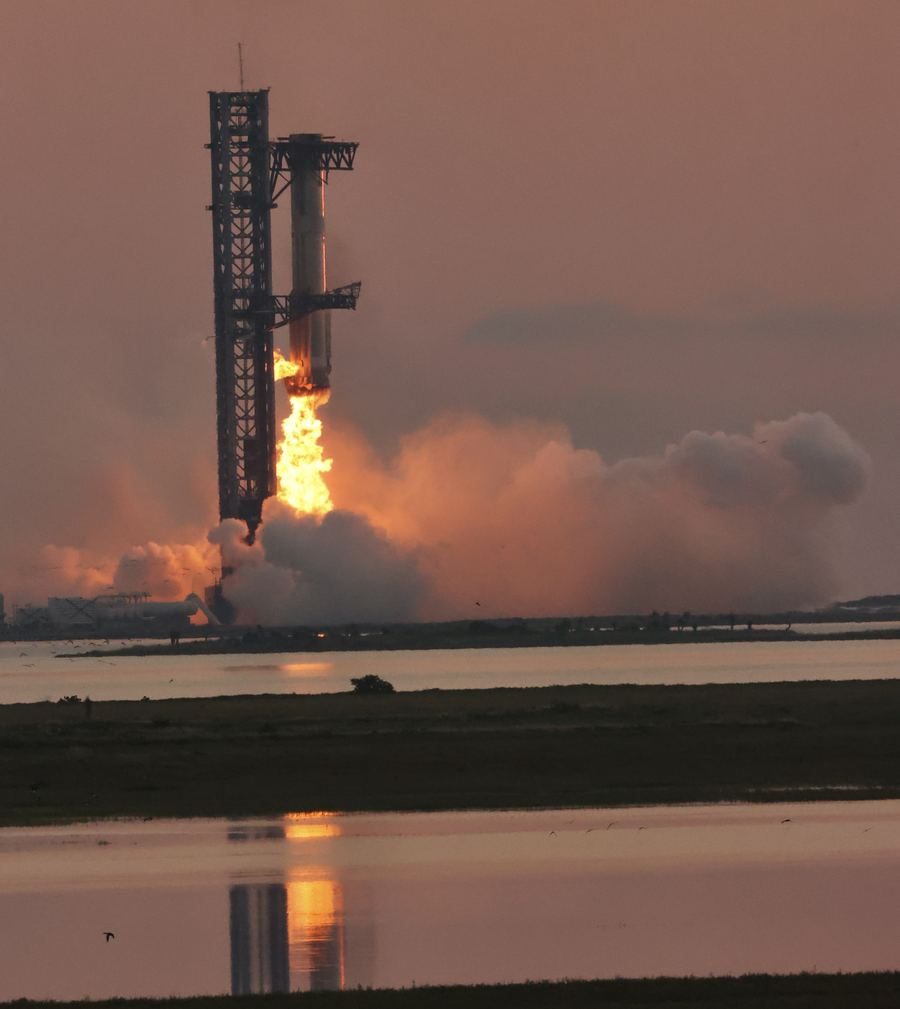
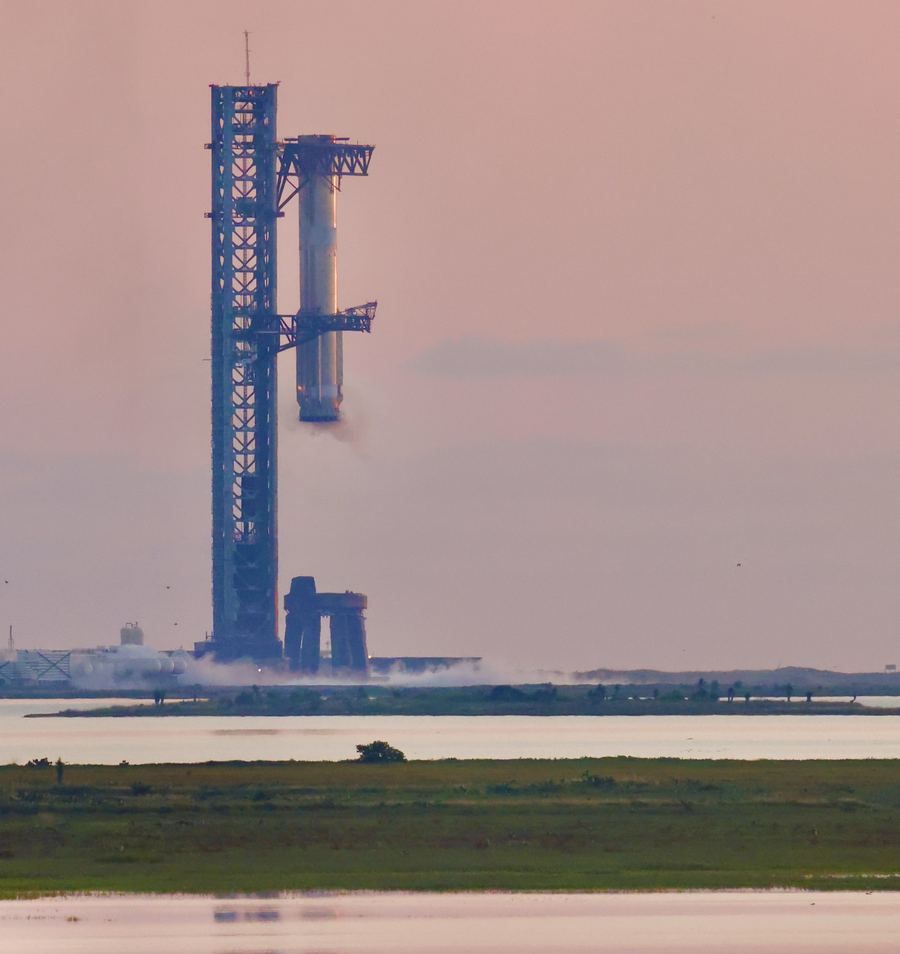
SpaceX caught the top half of its giant Starship rocket as it came back from space on Saturday, November 14, 2026. The ship flew into a pair of huge metal arms on the launch tower in South Texas. It landed at the same pad it had left about 22 and a half hours earlier. It was the first time the company has ever caught the upper stage, the part it calls the Ship. The bottom stage, called the Super Heavy booster, did not make it back to the tower on Friday and was lost over the Gulf.
§ 1The Catch
The catch happened at about 4:20 p.m. Eastern Time, which was 3:20 p.m. in Texas, Space.com and The Verge reported. SpaceX said the ship had been gone for 22 and a half hours.
Workers at the Starbase site went outside to watch, Space.com said. The ship dropped through the clouds. Three engines fired. The ship flipped upright and slowed down. The tower arms, which SpaceX calls "chopsticks," closed around it.
"Mechazilla catches Starship!" SpaceX wrote on X right after the landing. Mechazilla is the company's nickname for the launch and catch tower. "Congratulations to the entire SpaceX team on this incredible achievement!" the company added.
Later on Saturday, SpaceX posted a longer update and linked to its mission page. "On Friday, November 13, Starship lifted off from Starbase, Texas on its 15th flight," the company wrote. "On Saturday, November 14, Starship returned to Starbase, Texas, and changed everything."
Dan Huot, a SpaceX commentator on the landing webcast, was clearly moved, Space.com reported. "That was the missing link," Huot said. "That was the holy grail of spaceflight, plummeting through fire to be snatched out of the air by steel. We caught a Starship, and now everything changes."
Jessie Anderson, another SpaceX commentator, also spoke on the stream. "This is so incredible to see," she said, according to Space.com. "One of the most incredible and historic engineering feats of all time has just happened right in front of our eyes."
Space.com said the song "Baby Come Back" played on the webcast as the ship settled into the arms. Staff at the site cheered, the BBC reported. The Associated Press also reported the Saturday landing, calling it the first capture of a Starship flying back from space.
The ship on this flight was Ship 42. SpaceX posted images of it moving to the pad before launch and used that name. Elon Musk, the company's chief executive, also called it Starship 42 on X.
§ 2Friday's Launch and the Lost Booster
The flight started on Friday evening, November 13. SpaceX said a 75-minute launch window opened at 4:45 p.m. Central Time, or 5:45 p.m. Eastern. The BBC said the rocket lifted off at 4:47 p.m. local time. The stacked rocket stands about 407 feet tall, or 124 meters, according to the BBC.
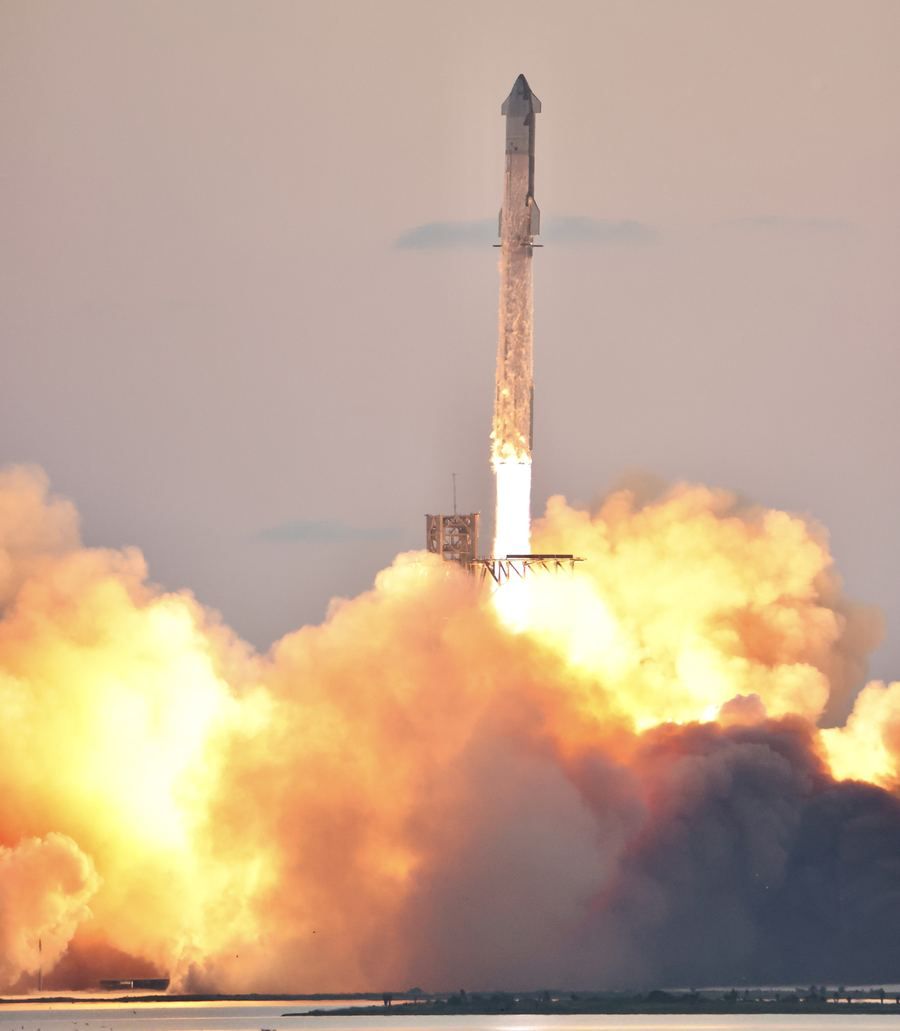
The booster, Super Heavy Booster 22, rose from Pad 2 at Starbase on 33 Raptor engines, SpaceX said. After a few minutes, the two stages split in a move called hot-staging. That means the ship's engines light while it is still attached, and then the stages come apart. SpaceX said the ship's six engines then pushed it on toward space.
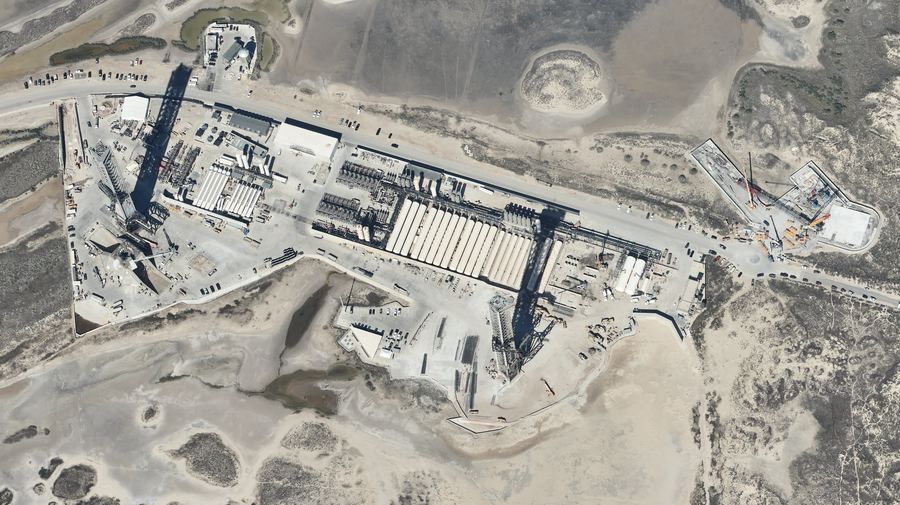
The booster was supposed to flip around and fly back to the same tower for a catch of its own, only minutes after liftoff. SpaceX had hoped to catch both stages on the same flight for the first time. Before launch, the company called recovering the whole vehicle "the holy grail of rocketry."
That first catch did not happen. SpaceX said the booster relit 32 of the 33 engines it had planned to use for the burn that would send it back toward Texas. That burn ended early because of a "low fuel mass" alarm. The company said the root cause is still under investigation.
The booster's guidance system then triggered an automatic abort during the coast back, SpaceX said. The booster steered itself to a backup landing spot over the water. It fired its engines for a landing burn and shut them off while hovering over the Gulf. After the engines stopped, a safety system called the flight termination system was triggered. That system is designed to destroy a rocket if needed for safety.
SpaceX confirmed the change of plans in a post on Friday: "Super Heavy has diverted to an offshore splashdown in the Gulf." A later post called it "Landing burn and splashdown for Super Heavy Booster 22."
§ 3What SpaceX and Musk Say Happened
SpaceX has not yet finished its review of why the booster ran low on fuel. Company commentators added some detail on the webcast, Space.com reported.
On Friday, Huot first said a guidance issue appeared to be the cause. On Saturday, he took that back. "I did a disservice to our booster GNC guys last night," Huot said, according to Space.com. GNC stands for guidance, navigation, and control, the system that steers the rocket. "It was not a GNC issue that caused us not to come back. GNC triggered that abort; it was doing what it was supposed to do." He said the system saw that the booster was not in the right place for a catch, so it sent the booster out over the water instead.
Kate Tice, another SpaceX commentator, said early signs showed the boostback burn ended early because of a low fuel mass alarm, Space.com reported. She said the team was still investigating the root cause.
Musk offered his own account on X on Saturday afternoon, before the ship catch. "Booster was slightly low on fuel," he wrote.
In a longer follow-up, Musk said engines on the flight had slightly underperformed. He said the booster is meant to land with only a tiny amount of fuel left. He wrote that the company is working on more consistent engines, a version he called Raptor V3.2. He also said flight software could be changed so the booster shuts down its ascent engines about one second earlier, to leave more fuel for the trip home.
Musk said these early ships and boosters are already being replaced by newer designs. "This booster loss does not change our timeline to reach high volume, fully reusable Starship flights," he wrote. That is Musk's claim, not a completed company investigation.
He also explained why SpaceX would rather lose a booster than risk the tower. In a reply on X, he said the next booster was almost ready to fly, "but losing the tower or launch mount would potentially cost us 2 to 3 months."
On Saturday, SpaceX said recovery teams went to the splashdown area to make the site safe. The company said its environmental health and safety team was working to recover any debris that washed onshore.
§ 4How the Tower Catch Works
Most rockets that land, including SpaceX's Falcon 9 booster, put down on legs on a pad or a ship at sea. Super Heavy and Starship are designed to skip those legs. Instead, they hover next to the tower and let the arms grab them.
The idea is simple, even if the flying is hard. Catching the rocket at the pad means it can be checked, refueled, and flown again without a long trip back from a landing zone. SpaceX says that kind of reuse is the key to flying often and cutting the cost of reaching space.
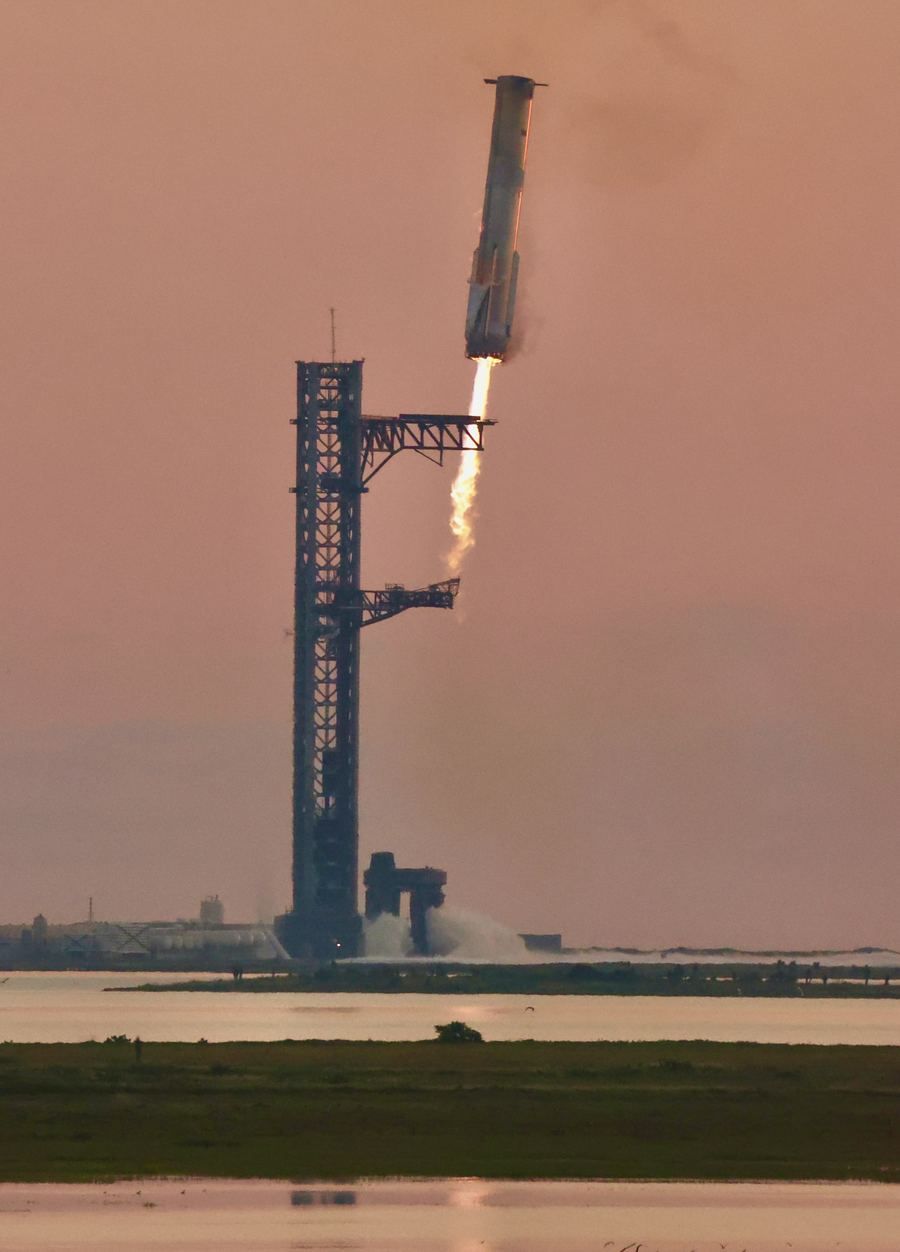
The ship is a tougher target than the booster, Space.com noted. The booster comes back only a few minutes after launch, and from a much lower flight. The ship goes all the way to orbit. It stays in space for many hours. It has to fire an engine to drop out of orbit, survive the heat of reentry, and then hit a narrow target at the tower.
SpaceX said it would try the ship catch only after watching the vehicle in space. If something looked wrong, the company planned to send the ship to a splashdown in the ocean instead, the BBC reported.
On Saturday, SpaceX said teams "have polled go to return Starship to the launch site at Starbase." An earlier update said the ship was still looking good and that "Pad and tower systems are go for catch."
§ 5The First Booster Catches
Saturday's ship catch stands on earlier work with the booster. SpaceX has now caught a Super Heavy booster on three test flights. After the ship landing, Musk summed up that record in a short post: "Three booster catches and a ship."
The first booster catch was on Flight 5, on October 13, 2024. "And on our first try, Mechazilla caught the booster," SpaceX wrote at the time. The ship's upper stage on that flight splashed down in the Indian Ocean.
The second booster catch was on Flight 7, on January 16, 2025. SpaceX said the booster returned to the tower for a successful catch. The ship was lost during ascent. SpaceX said early data pointed to a fire in the back of the ship.
The third booster catch was on Flight 8, on March 6, 2025. SpaceX again caught the booster. The ship had what the company called an "energetic event" during ascent, and the flight ended early.
After those three catches, later flights often sent boosters to planned splashdowns in the Gulf while SpaceX tested new hardware. Flight 15 was the first time the company tried to catch both stages on one mission. It got the harder one, the ship, and missed the booster.
§ 6A Long Flight From Orbit
The ship had a lot to do before that catch. After the booster turned away, the ship finished its climb and made a short coast. SpaceX then gave a "go for orbit." The company said the ship fired a single Raptor engine and entered an orbit about 275 kilometers high, or about 171 miles.
It was only the second time a Starship had reached orbit. The first was Flight 14, on September 28, 2026. On that flight, SpaceX said, the ship also deployed 26 Starlink V3 satellites. The company then brought the ship home early and splashed it down in the Pacific Ocean after a landing burn.
Flight 15 repeated the satellite drop. SpaceX said the ship deployed 26 Starlink V3 satellites, a process that took about 42 minutes. The company later said it made contact with every satellite. It said the satellites were already starting to raise their orbits to join the Starlink network. Starlink is SpaceX's system for beaming internet service from space.
Musk said on Saturday that the ship was "currently completing 14 orbits of Earth" before the attempt to come home. The BBC later reported that the ship completed 14 orbits before it returned to the tower. SpaceX said it watched the ship's systems for more than 20 hours in space before the flight control team prepared to bring it home.
SpaceX said the ship then relit a single sea-level Raptor engine and performed a deorbit burn. That is the short firing that pulled it out of orbit. "Good deorbit burn," the company posted. "Starship is on course to reenter Earth's atmosphere ahead of a planned catch at Starbase in ~1 hour."
The official flight recap says the ship then flew back toward the east coast of Texas, made a final turn out over the Gulf, and came through the clouds toward the tower. Three engines lit for the landing flip. The engines then dropped from three, to two, and then to one, before shutdown and the catch, according to SpaceX's timeline of the flight.
§ 7Why This Matters
SpaceX is trying to make both parts of Starship fully reusable. If a rocket can fly, come home, and fly again quickly, each launch can cost much less. That is the company's long-stated goal, and it is why this test was designed as a "double catch."
The company did not get that full recovery on Flight 15. It did prove that a Starship can come back from orbit and be caught at the pad. It also showed, again, that the booster can abort a catch on its own when something is off, at the cost of losing the booster.
Prof. Malcolm Macdonald, president of the Royal Aeronautical Society, told the BBC that missing the first stage was a setback, but not the end of the story. "They have recovered Super Heavy before and so successfully returning and recovering the Ship, is a substantial step forward," he said. "They have demonstrated the two halves of the recovery challenge, just not yet on the same flight. The next milestone would be stitching those achievements together and then proving they can do it reliably, repeatedly and economically."
The BBC also noted that NASA is watching. SpaceX has a NASA contract to turn a version of Starship into a lander that would carry astronauts to the surface of the Moon. The BBC said that work is tied to NASA's hope of landing people on the Moon later this decade, and that the timeline is ambitious. Those Moon plans still depend on many future flights, not on this one test alone.
Before Flight 15, The Verge reported comments Musk made on SpaceX's third-quarter earnings call. "Success is not guaranteed on these first flights," Musk said, "but I'd say it's more likely than not that this succeeds next flight." The ship catch did succeed. The double catch did not.
§ 8What Comes Next
SpaceX has not yet announced a date for Flight 16. Musk said a new booster was almost ready, and that losing this booster does not, in his view, change the company's timeline. Those are his statements. The company itself said the booster's fuel problem is still being investigated.
Teslarati reported on November 13 that the Federal Aviation Administration had granted the license for Flight 15, after a wait that lasted into Friday. The flight then went ahead under that license. This story could not independently retrieve the FAA license document itself.
What is confirmed is the result. Ship 42 came back from orbit and was caught. Booster 22 was not. The first catch of a Starship is now a matter of record, written in SpaceX's own words: the arms "closed to catch Starship for the very first time."
SpaceX has now shown that it can catch both halves of its giant rocket, but not yet on the same flight. On Saturday, the hard one came home. The ship that left Starbase on Friday returned from orbit and settled into the tower's arms. It was a first that the company itself said changed everything. The next tests will show whether SpaceX can catch the booster and the ship together, and then do it again and again.
Watch & Listen
Hear this entry read aloud. Coming soon — the channels are not live yet.
Sources
- SpaceX: Starship Flight 15 mission page
- SpaceX on X: Mechazilla catches Starship! (Nov 14, 2026)
- SpaceX on X: Friday liftoff and Saturday return "changed everything" (Nov 14, 2026)
- SpaceX on X: Super Heavy diverted to an offshore splashdown in the Gulf (Nov 13, 2026)
- SpaceX on X: Landing burn and splashdown for Super Heavy Booster 22 (Nov 13, 2026)
- SpaceX on X: Recovering the entire launch vehicle is the holy grail of rocketry (Nov 13, 2026)
- SpaceX on X: 75-minute launch window opens at 4:45 p.m. CT (Nov 13, 2026)
- SpaceX on X: Go for orbit, about 275 km (Nov 13, 2026)
- SpaceX on X: Deploying 26 Starlink V3 satellites (Nov 13, 2026)
- SpaceX on X: Contact and coast update, early deorbit options (Nov 13, 2026)
- SpaceX on X: Flight 15 update, pad and tower go for catch (Nov 14, 2026)
- SpaceX on X: Recovery teams on site after booster splashdown (Nov 14, 2026)
- SpaceX on X: Teams polled go to return Starship to Starbase (Nov 14, 2026)
- SpaceX on X: Good deorbit burn, catch in about one hour (Nov 14, 2026)
- SpaceX on X: Ship 42 moves to the Starbase pad (Nov 13, 2026)
- SpaceX Flight 15 webcast on X
- Elon Musk on X: Booster was slightly low on fuel (Nov 14, 2026)
- Elon Musk on X: Engine underperformance, residuals, and timeline (Nov 14, 2026)
- Elon Musk on X: Losing the tower or launch mount could cost two to three months (Nov 14, 2026)
- Elon Musk on X: Completing 14 orbits of Earth (Nov 14, 2026)
- Elon Musk on X: Starship 42 preparing for launch (Nov 13, 2026)
- Elon Musk on X: Three booster catches and a ship (Nov 14, 2026)
- SpaceX: Starship's Fifth Flight Test (Oct 13, 2024)
- SpaceX: Starship's Seventh Flight Test (Jan 16, 2025)
- SpaceX: Starship's Eighth Flight Test (March 6, 2025)
- SpaceX: Starship Flight 14 mission page (Sept 28, 2026)
- Space.com: SpaceX catches Starship upper stage for first time (Nov 14, 2026)
- Space.com: SpaceX still investigating Flight 15 booster abort (Nov 14, 2026)
- BBC: SpaceX catches Starship rocket upper stage from space (Nov 14, 2026)
- The Verge: SpaceX executes the first chopstick catch of Starship (Nov 14, 2026)
- AP: SpaceX's Starship returns from orbit and is captured by launch pad arms (Nov 14, 2026; returns 403 to automated checks, likely bot blocking)
- Teslarati: Starship Flight 15 how to watch, FAA license granted (Nov 13, 2026)