The Weird
The Boom Heard Across New England: A Cape Cod Fireball and the Long History of Skyquakes
By Darrell Wallen
Would you prefer to listen?
§ 1The boom that had an answer
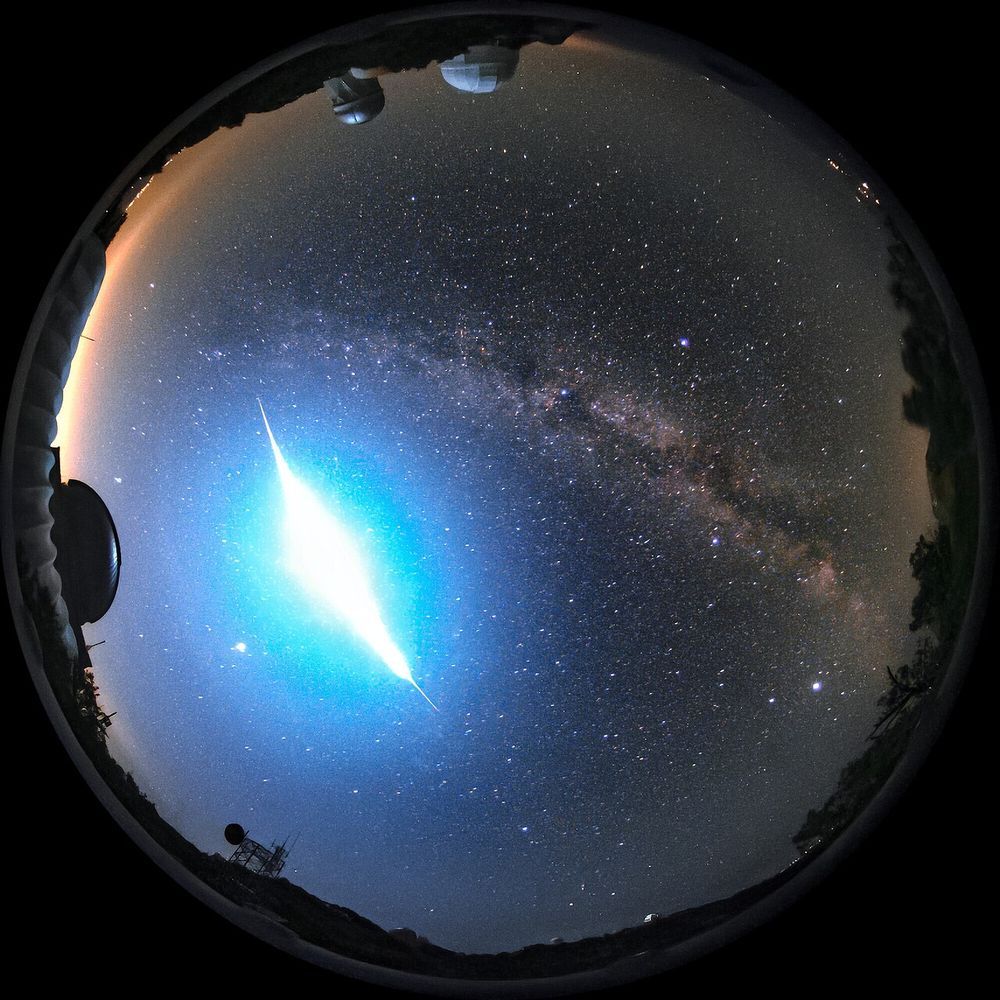
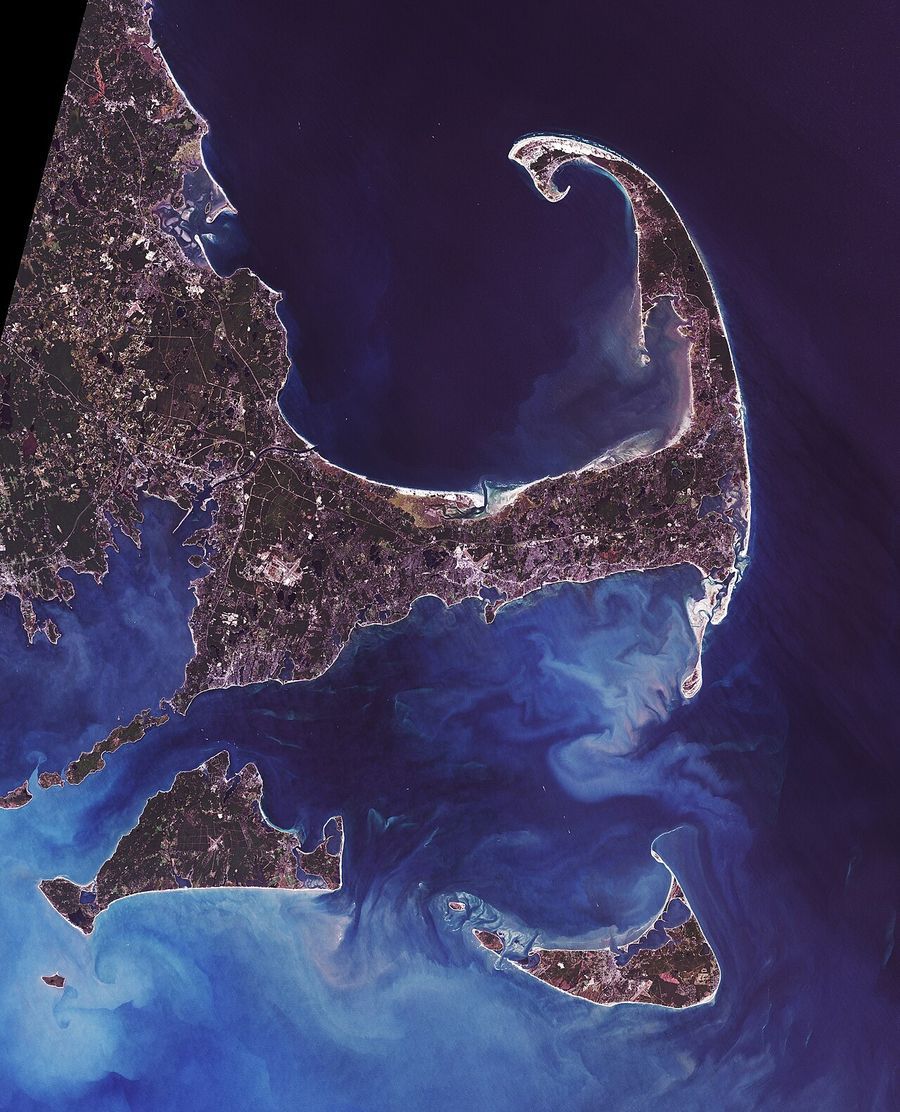
CONFIRMED: At about 2:06 in the afternoon on Saturday, May 30, 2026, a boom rolled across eastern Massachusetts and beyond. It shook houses. It set off at least one dog. It sent police agencies and others scrambling to work out what had happened, according to NBC Boston. Within hours the answer came from the sky: a meteoroid had entered near the Massachusetts and New Hampshire border, broken apart high above the coast, and dropped what was left into Cape Cod Bay.
That makes it unusual in the history of unexplained sounds. Many loud booms are never traced to anything. This one was caught by a weather satellite, by radar, by seismometers and by infrasound sensors, and NASA put numbers on it within days. This report walks through what is confirmed about the Cape Cod fireball, where the experts disagree, and what still rests on preprints rather than peer-reviewed papers. Then it turns to a bigger question: if a mystery this loud can be solved this fast, what about the booms that never are? Those have a name, skyquakes, and a long paper trail.
In this report, CONFIRMED means documented by a primary source or a credible outlet. CLAIMED means asserted, proposed or estimated, but not verified. Where a number comes from a paper that has not completed peer review, the text says so.
§ 2What people heard and felt
CONFIRMED: In an Associated Press report carried by NBC Boston, Robert Lunsford of the American Meteor Society said the group received dozens of reports from Delaware to Montreal, from people who heard a double boom, felt the ground shake, or saw the fireball. NASA, according to NBC Boston, later counted more than 71 fireball reports from nine states and two Canadian provinces.
The accounts from the ground are the part worth reading aloud. A viewer in Melrose, north of Boston, wrote to WCVB that "the whole house, actually all houses in the neighborhood shook. Much louder than a transformer exploding and definitely not an earthquake." Another, in Newtonville, said the sound "was enough to set off the dog and make me think a big tree had come down because of the wind." The Massachusetts Office of Public Safety and Security posted that it did not yet know the cause and did not believe there was a public safety threat.
Keep that in mind. The sound was the first evidence, and for many people the only evidence. A Harvard-affiliated paper discussed below says it was heard by hundreds of people.
§ 3NASA's numbers, and how they changed
CONFIRMED: The first estimates were rough, and they moved. The American Meteor Society initially said the object was about three feet wide. NASA's first public figures, as relayed by NBC Boston, were a speed of about 75,000 miles per hour, a breakup about 40 miles above northeast Massachusetts and southeast New Hampshire, and energy of about 300 tons of TNT.
Then NASA revised. NBC Boston and the Boston Globe reported a body about five feet, or 1.6 meters, across, with a mass of 5.6 metric tons, entering the atmosphere at roughly 42,000 miles per hour. It traveled about 26 miles through the air, NASA said, and broke up about 31 miles above the surface with energy equal to about 230 tons of TNT. NBC Boston added that NASA confirmed the object was natural, not a satellite or space debris, and that the meteorites fell in water about 100 feet deep. The fall is cataloged as Event 3867 for 2026. The Harvard paper cited below says that is NASA's ARES number, and the second preprint cited below credits the same number to the American Meteor Society's fireball data set.
Three feet became five. Forty miles became 31. Seventy-five thousand miles per hour became 42,000. That is not a cover-up. It is what happens when radar and satellite data arrive after the first eyewitness reports. And NASA, according to Smithsonian Magazine, has a name for a space rock landing in water: a "fishy squisher," in "uber-serious scientific terms."
§ 4What the satellite saw
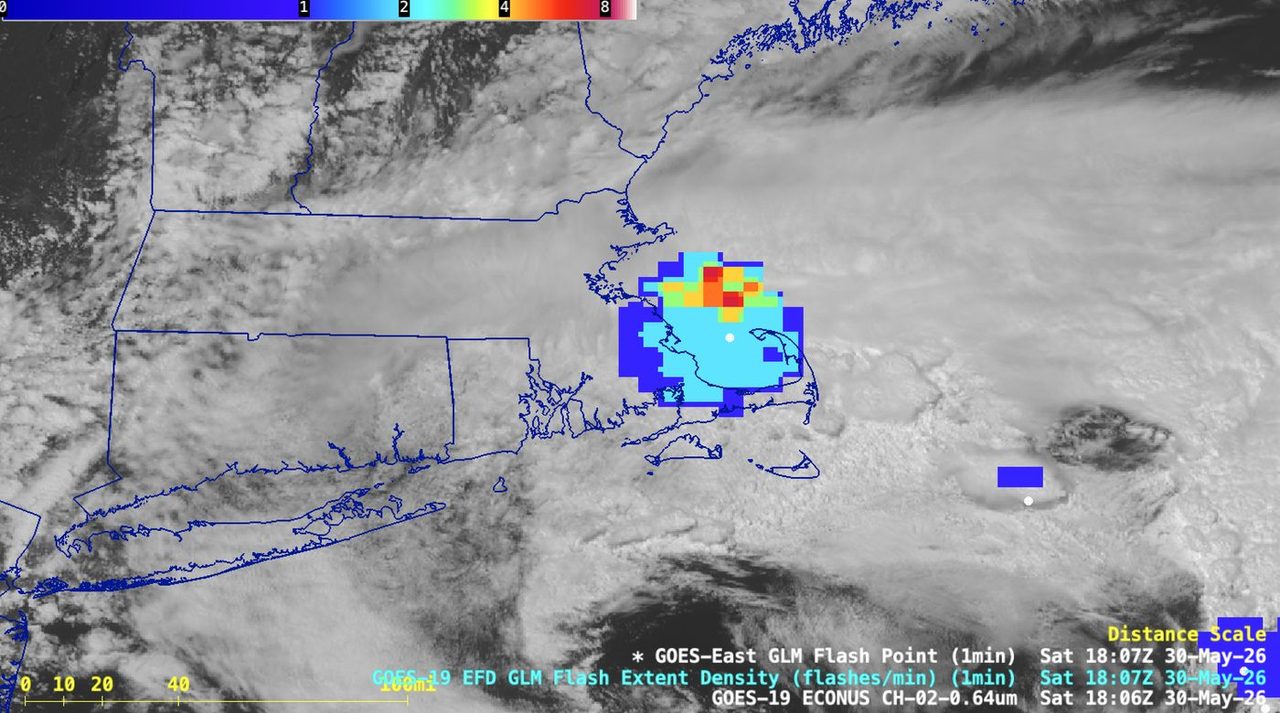
CONFIRMED: The Cooperative Institute for Meteorological Satellite Studies at the University of Wisconsin-Madison, known as CIMSS, posted the satellite view the same day. Its blog says GOES-19 showed "the signature of a high-altitude bolide that was entering the Earth's mesosphere over far eastern Massachusetts at 1807 UTC on 30 May 2026." The instrument is the Geostationary Lightning Mapper, built to spot lightning but able to catch a bright meteor. CIMSS reported a maximum flash extent density of 7 flashes per minute, a flash duration of 0.024 seconds and a flash area of 67 square kilometers. The one-minute difference from NASA's 2:06 p.m. is rounding: 1807 UTC is 2:07 p.m. Eastern Daylight Time, and the satellite data are binned by the minute.

§ 5The iron question
CONFIRMED: On June 3, NASA released new analysis suggesting the meteorite may be iron. The Boston Globe reported that "calculations from radar observations found the meteoroid broke apart at an unusually high altitude of about 31 miles and produced very few small fragments." The Globe added that researchers estimated "a density of roughly 8,000 kilograms per cubic meter, a figure consistent with iron meteorites, though NASA cautioned that the density calculation remains experimental and additional analysis is needed."
CLAIMED: The iron conclusion is an inference, not a measurement. As NBC Boston relayed it, NASA said the object was "evidently very mechanically strong" and produced very few small pieces, and that these factors, "along with the experimental density measurement, suggest it is an iron meteorite." Nobody has yet held a piece. Until someone does, "possibly iron" is the honest label.
§ 6Two preprints, two altitudes
CONFIRMED: Two scientific papers on the event are now public, and neither has completed peer review. Both are preprints, which means they are posted for other scientists to examine and may change before publication.
The first, by Juha Vierinen and twelve co-authors, was posted to arXiv on October 17, 2026, and submitted to The Astronomical Journal. It combines MIT Haystack Observatory's meteor radar network, four weather radars and infrasound. The meteor radar followed the head echo from about 90 to 71 kilometers up, then picked up plasma wake echoes down to about 30 kilometers. The authors call 33.61 kilometers the radar terminus, where breakup is expected. NASA's Center for Near-Earth Object Studies reported peak brightness at 32.0 kilometers and an impact energy of 1.1 kilotons of TNT. Infrasound from 199 sensors gave a lower estimate, about 0.5 kilotons. The paper describes the evidence as "consistent with a dense, mechanically strong meteoroid, possibly iron-rich, but the composition remains to be confirmed by recovered material or independent compositional constraints."
One detail deserves care. The authors fit an entry speed of about 26 kilometers per second, roughly 58,000 miles per hour, while NASA's later figure, as reported by the press, was about 42,000. I did not find the gap explained, so the speed is best treated as unsettled.
The second paper is by Steven Africk and Abraham Loeb of Harvard's Galileo Project. A version dated September 24, 2026 was submitted to the journal Sensors. It analyzes seven Raspberry Boom infrasound sensors around Boston, which are citizen-science devices that listen below the range of human hearing. They recorded a pulse of about one and a half cycles at 0.4 hertz. From the timing, the authors conclude the infrasound came from the fireball blast "at between 40 and 50 km in altitude." They rule out a sonic boom as the source of the infrasound, "although one was heard in the audio range."
CLAIMED: Put the altitudes side by side and there is a gap. Radar and NASA's optical detection put the main breakup near 32 to 34 kilometers. The Harvard analysis says 40 to 50, and says the entry altitude "has been revised to 50 km" from an earlier estimate of 32. These are different instruments measuring a flash of light, a plasma trail and a pressure wave, so they need not agree to the kilometer. The fair summary is a breakup somewhere between about 30 and 50 kilometers up, with the better-instrumented estimates toward the low end.
§ 7Where the pieces are
CONFIRMED: The fall zone is Cape Cod Bay. The Vierinen paper's estimate of the total mass reaching the water is wide: an illustrative 560 kilograms if iron survives at ten percent of the starting mass, or a conservative 82 kilograms from the radar data, a method the authors call unverified. Recovery looks unlikely. The Globe reported that NASA's Molly Wasser said a recovery "would require substantial resources and the ocean contaminates much of the scientific value of the meteorites." John Collins of the Woods Hole Oceanographic Institution told the Globe that seismometers there recorded the breakup: "We're quite confident that we have the signature of that disintegration event." His colleague Liam Peterson said recovery is theoretically possible. MIT's Richard Binzel was blunt: "Never say never," he said. "But the chances of success of actually recovering an actual fragment are very low." He also offered a line worth keeping about why this event stood out: "It's the classic 'tree falls in the forest and no one hears it,'" he said. "But in this case, it was over the vicinity of a large population."

That last sentence is the bridge to everything that follows.
§ 8The boom with a name
CONFIRMED: David P. Hill, scientist emeritus at the U.S. Geological Survey, wrote a 2011 opinion piece in Seismological Research Letters that explains why some booms never get solved. Meteoroids, he noted, can produce sonic booms of varying intensity. Then comes the key point: "Because of the time required for a sonic shock wave to reach the Earth's surface from the upper atmosphere, the visible trace of the meteor has usually vanished before its sonic boom is heard. Thus, particularly during daylight hours, the source of the boom may go unnoticed."
Read that with Cape Cod in mind. On May 30 the meteor came in daylight, over a densely populated region, with a weather satellite, four weather radars, a meteor radar network and about two hundred infrasound sensors pointed more or less the right way. Take away the satellite and the cameras and you have a boom, a rattled house and a rumor. Skyquakes are what is left when nobody was looking up.
The names are a delight. Near Seneca Lake in New York, they are Seneca guns. In Belgium they are mistpoeffers, which Hill translates as "fog belches." In Japan they are uminari, which Weather.com says translates to "cries from the sea." In Italy they are brontidi, which Hill glosses as "thunder-like."
§ 9The Lake Gun
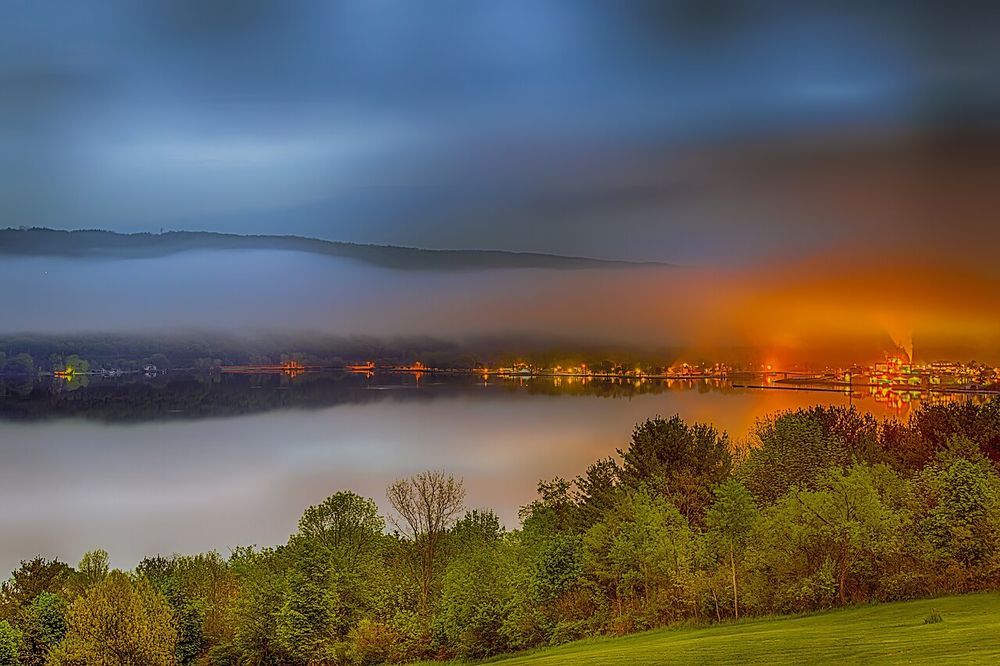
CONFIRMED: The most famous American example is old enough to appear in fiction. In 1850, James Fenimore Cooper published a short story called "The Lake Gun" about Seneca Lake in central New York. The Project Gutenberg edition, transcribed and annotated by Hugh MacDougall of the James Fenimore Cooper Society, calls the story political satire, though one based on folklore about the lake. Inside the story, Cooper wrote that the sound is "a sound resembling the explosion of a heavy piece of artillery, that can be accounted for by none of the known laws of nature." He continued: "The report is deep, hollow, distant, and imposing. The lake seems to be speaking to the surrounding hills, which send back the echoes of its voice in accurate reply. No satisfactory theory has ever been broached to explain these noises." He also dismissed the guesswork of his day: "all this is talking at random, and has probably no foundation in truth."

The USGS says Seneca guns is commonly used for booms heard near Seneca Lake in the Finger Lakes region, and also for similar sounds along the coasts of North Carolina, South Carolina and Virginia. Hill says the name has been attributed either to the ghostly bowling in Washington Irving's "Rip Van Winkle" or to Cooper's story. I found no source that settles which.

§ 10Barisal guns and the Victorian letters
CONFIRMED: The same kind of sound turns up half a world away. In 1895, George Howard Darwin wrote to the journal Nature. His note opens: "In the delta of the Ganges, dull sounds, more or less resembling distant artillery, are often heard. These are called 'Barisàl guns'; but I do not know the meaning of the term." He wanted, he wrote, "to draw the attention of the readers of NATURE to this mysterious phenomenon, and to the similar 'mist pouffers' of the Belgian coast."


It was part of a running conversation. In January 1896 Nature printed an account of sounds around Lough Neagh in Ireland, offered "as a contribution to your present correspondence on natural sounds." Victorian science was already comparing cannon-like noises in Bengal, Belgium and Ireland.


CLAIMED: What causes them is still a proposal. Hill raises the possibility that Barisal-type booms, like the mistpoeffers and the Carolina guns, might be large waves from distant storms breaking well off shore. But "the mechanisms and conditions under which big storm (or tsunami) waves generate booming sounds, however, remains unclear." Treat it as a candidate, not an answer.
§ 11Lewis and Clark's cannon
CONFIRMED: The National Park Service tells one of the best-known early American versions. Near the Great Falls of the Missouri in early July 1805, Meriwether Lewis wrote of a noise "resembling precisely the discharge of a piece of ordinance of 6 pounds at the distance of three miles." William Clark noted a "rumbling like Cannon at a great distance is heard to the west of us; the Cause we Can't account." The NPS lists later ideas, including solar mass ejections, gas from inside the earth, seismic tremors, and, with evident enjoyment, "perhaps Bigfoot sending communications via Morse-code-like sounds." It adds that several locations in New Hampshire and Connecticut have heard similar sounds, which brings us back to New England.
§ 12Moodus, the quake you can hear
CONFIRMED: Connecticut has an answer, and it is one of the cleanest. The Northeast States Emergency Consortium reports that Moodus comes from Machemoodus, a name from the local Native Americans meaning "Place of Noises," for the booms, cracking sounds and rumbles that seemed to come from beneath a hill the colonists called Mount Tom. It says that in the 1980s "scientific data confirmed that the Moodus noises are the sounds of small earthquakes that are taking place less than a mile below Mount Tom." On May 16, 1791, a larger earthquake there, estimated between magnitude 4.4 and 5.0, was felt from New York City and Albany to Boston, and it was followed by many small shocks in which the noises were heard.
A 2014 NPR and WBUR Here and Now report from Moodus gives the science and the human side. Resident Cathy Wilson said that in the early 1980s she heard something that "sounds like thunder except it's a bright, sunny, summer day." The seismologist John Ebel of Boston College's Weston Observatory explained that "sound waves in air and seismic waves in the ground are all the same kind of phenomenon," and that "the ground literally acts the way a speaker does and sends the seismic waves from the ground into the air, and that is what we hear." The Moodus earthquakes have centers about three quarters of a mile down, he said, "and that's shallow." Wilson lives about 1,500 yards from an epicenter, which explains why she was hearing noises that, as Ebel put it, nobody else in town was.
The report also covers the folklore, including an evil god named Hobomoko living in a cave with witches, and settler theories such as smoldering underground coals called carbuncles. Each theory, the report says, was debunked, "but in the end it was science that solved the puzzle."
So New England has already given us two kinds of skyquake with answers: a meteor over Cape Cod and tiny shallow earthquakes in Connecticut. That is a strong argument that there is no single mystery here.
§ 13The North Carolina study
CONFIRMED: In December 2020, researchers presented a study of the Seneca guns of coastal North Carolina at the American Geophysical Union's annual meeting, held virtually that year. It was a conference presentation, not a peer-reviewed paper. According to Live Science, the team, including University of North Carolina at Chapel Hill undergraduate Eli Bird, built a catalog of reports from local news going back to 2013 and compared them with data from the EarthScope Transportable Array, a network of 400 atmospheric sensors and seismographs.
They found no earthquake records that matched the booms. Bird told Live Science: "Generally speaking, we believe this is an atmospheric phenomenon — we don't think it's coming from seismic activity, we're assuming it's propagating through the atmosphere rather than the ground." The signals lasted from about one second to nearly ten, and the array was not dense enough to pinpoint where they came from. Bird also said, "Presumably, these are not all the same thing producing the booming sounds."
CLAIMED: Bird floated several atmospheric possibilities: bolides, ocean events such as large waves or distant thunder offshore, and military planes breaking the sound barrier. None was confirmed. The team called for more stations, running for years, to triangulate the sources.
§ 14The suspects, sorted
CONFIRMED: Meteors are a documented cause. Cape Cod proves it. Sonic booms from aircraft are another. The USGS says most booms people hear come from human activity, such as explosions, large vehicles, construction or sometimes a sonic boom. On a seismogram, it explains, a sonic boom shows as a short, high-frequency signal that does not look like an earthquake, with felt reports from a very wide area and no matching earthquake on record. In many investigations, it adds, the last step is a military official confirming that planes "might have gone supersonic." Shallow earthquakes are a third documented cause, as Moodus shows. The USGS says small shallow earthquakes can produce booms for people very close to them, and sometimes no shaking is felt at all.
CONFIRMED: Cold produces booms, too. The USGS reports that booms across the Midwest often coincide with temperatures of minus 20 Fahrenheit or colder and are sometimes called ice quakes or frost quakes, caused when shallow groundwater freezes and expands, cracking the surrounding frozen rock and soil. That explains cold-weather booms. It does not fit a coastal boom on a warm May afternoon.
CLAIMED: Gas release is a proposed cause, and a speculative one. Hill discusses the idea that explosive releases of methane might make booming sounds, crediting the astrophysicist Gold and his colleague Stephen Sorter, who called such noises "brontides" in a 1979 paper in Science. But Hill also says onshore methane bursts in developed areas "seem an unlikely explanation for booming sounds in the absence of eyewitness accounts or tell-tale signs such as craters, mud volcanoes, or maars." Science Focus lists gas escaping from lake sediments as an alternative, noting that skyquakes have also been reported away from water.
CLAIMED: Atmospheric ducting is a plausible helper rather than a cause. The USGS notes that temperature inversions and calm surface winds can make sound travel farther than normal, and Hill writes that the low-frequency part of a boom can travel as a guided wave beyond the visible range of the source. That could explain a sound that seems to come from nowhere, but not where it started.
CLAIMED: Solar flares and other space-weather ideas appear on some lists, including those of Weather.com and Science Focus. I found no source showing a measured case of a skyquake traced to one, so I am marking the idea speculative.
§ 15What remains open
What is confirmed: NASA tied the May 30, 2026 boom to a meteoroid about five feet across and 5.6 metric tons that broke up over Massachusetts, with the fall in Cape Cod Bay. Satellite, radar, seismic and infrasound data all recorded it. Cooper wrote about a "Lake Gun" in 1850, Darwin about Barisal guns in 1895, and Lewis and Clark about a distant cannon in 1805. Moodus, Connecticut, has noises that science has traced to small shallow earthquakes. The 2020 North Carolina team found no matching earthquakes, which suggests an atmospheric source for those booms.
What is claimed: That the object was iron, which rests on an experimental density figure and radar behavior. That the breakup happened at 40 to 50 kilometers, from one preprint, against about 32 to 34 from other data. That the fall mass was 560 kilograms, or 82, or something else. That any single cause explains the Seneca guns, Barisal guns and their relatives. Gas, waves and solar activity as causes remain candidates, not findings.
What would settle it is two simple things. For Cape Cod, a recovered fragment, which would show whether it was iron and calibrate the radar methods. For the other booms, a dense array of microphones and seismometers, ideally with a camera or two, running for years in a place that booms often. Hill said much the same in 2011: a local seismic network paired with infrasound sensors would quickly reveal whether a boom came from the ground or the air. The Cape Cod fireball did exactly that by accident, with a whole region as the instrument. The next time something goes boom on a clear afternoon, there is a decent chance the answer is already in somebody's data.
That is where the record stands as of October 27, 2026. Every source listed below can be read by anyone, and the preprints may change as they go through review. Until then, read the sources and weigh the evidence for yourself.
Watch & Listen
Hear this entry read aloud. Coming soon — the channels are not live yet.
Sources
The Cape Cod fireball
- CIMSS Satellite Blog, GOES-19 GLM detection of the May 30, 2026 bolide
- NBC Boston, Meteor explodes over Massachusetts: what we know
- NBC Boston, NASA's new details on the meteorite fall
- The Boston Globe, NASA analysis of the Cape Cod meteor, June 3, 2026
- The Boston Globe, Cape Cod meteor, June 4, 2026
- WCVB, Meteor and boom, May 30, 2026
- Smithsonian Magazine, A bright meteor lit up the New England sky
- NASA ARES, Cape Cod Bay, MA meteorite fall event page
Preprints (not yet peer reviewed)
Skyquakes, booms and their history
- David P. Hill, Seismological Research Letters, 2011 opinion piece on booming sounds
- USGS, Earthquake booms, Seneca guns, and other sounds
- USGS, Sonic booms
- James Fenimore Cooper, The Lake Gun (1850), Project Gutenberg
- George H. Darwin, Nature, 1895 (Barisal guns)
- Nature, January 2, 1896 (sounds near Lough Neagh)
- National Park Service, Artillery sounds heard by Lewis and Clark
- Northeast States Emergency Consortium, Connecticut earthquakes
- WBUR Here and Now, strange noises in Moodus, April 3, 2014
- Live Science, Seneca guns study at AGU (2020)
- Weather.com, America's mystery skyquakes, August 6, 2026
- Science Focus, Mystery skyquakes