The Weird
The Forest Service Bigfoot Files: Strange Tracks, Puzzled Experts and a Very Uneasy Feeling
By Darrell Wallen
Would you prefer to listen?
The U.S. Forest Service has put its own "Bigfoot/Sasquatch Records" online for anyone to read. The three files describe giant footprints in the woods of the Pacific Northwest and Montana. One is a 1982 government investigation with photos and plaster casts. The release has Bigfoot fans buzzing, because the agency had long said little about the creature.
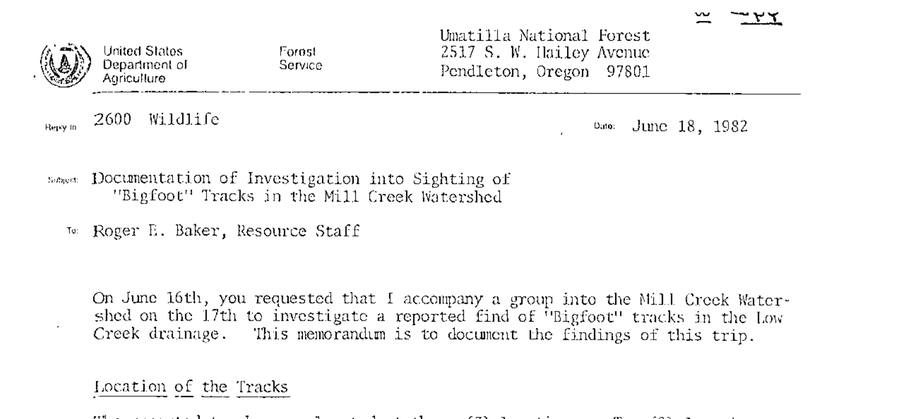
Image: U.S. Forest Service, Umatilla National Forest, June 18, 1982 memo (FOIA Reading Room). U.S. government work, public domain.
The files sit in the agency's online Freedom of Information Act Reading Room. That is a public page where the government posts records people often ask for. The Forest Service dated the Bigfoot section October 15, 2026. Most people did not notice until this week, when the Washington Post, the New York Post, NewsNation and others reported on it.
One file is a 1982 memo about tracks in the Blue Mountains. One is a 2003 Montana newspaper story. The last is a typed history of a Montana creek by a man named Leo T. Kinney.
§ 1What the Government Posted
The Reading Room lists the files under the heading "Bigfoot/Sasquatch Records." According to News9, they appear among the site's "Frequently Requested Records."
The Washington Post said the agency had been "officially mum on Bigfoot" for decades. The Post said its only comments were "the occasional cheeky social media post." It also noted that the release came while the federal government was putting out new batches of UFO files.
A Forest Service spokesman told the Post only that the Department of Agriculture, which runs the Forest Service, posts records when it expects strong public interest, according to Meridian News.
NewsNation said it is not clear whether more files are coming.
§ 2The 1982 Tracks: What the Memo Says
The biggest file is a memo dated June 18, 1982. It comes from the Umatilla National Forest office in Pendleton, Oregon. Its subject line reads: "Documentation of Investigation into Sighting of 'Bigfoot' Tracks in the Mill Creek Watershed."
A watershed is the land that drains into a stream or river. The Mill Creek Watershed is a closed area that serves Walla Walla, Washington. It sits in the Blue Mountains near the Oregon line.
Forest Service wildlife biologist Rodney L. Johnson wrote it to Roger E. Baker of the resource staff. Johnson was asked on June 16 to join a group going in the next day. Their job was "to investigate a reported find of 'Bigfoot' tracks in the Low Creek drainage."
The memo describes three spots, called Site A, Site B and Site C. At Site A, about 1.5 miles above Mill Creek, the group found six tracks in a muddy trail. They ran about 25 feet. The memo says a tracking expert in the group "could not find any evidence of tracks other than those few observed in the trail mud."
The group made plaster casts of two tracks there. One print was a right foot about 15 inches long and 7 inches wide. During the night, an elk had stepped on its heel. Another print was a left foot, about 15 inches by 6.5 inches. The memo says to "note deformation of 2nd toe," the toe next to the big toe.
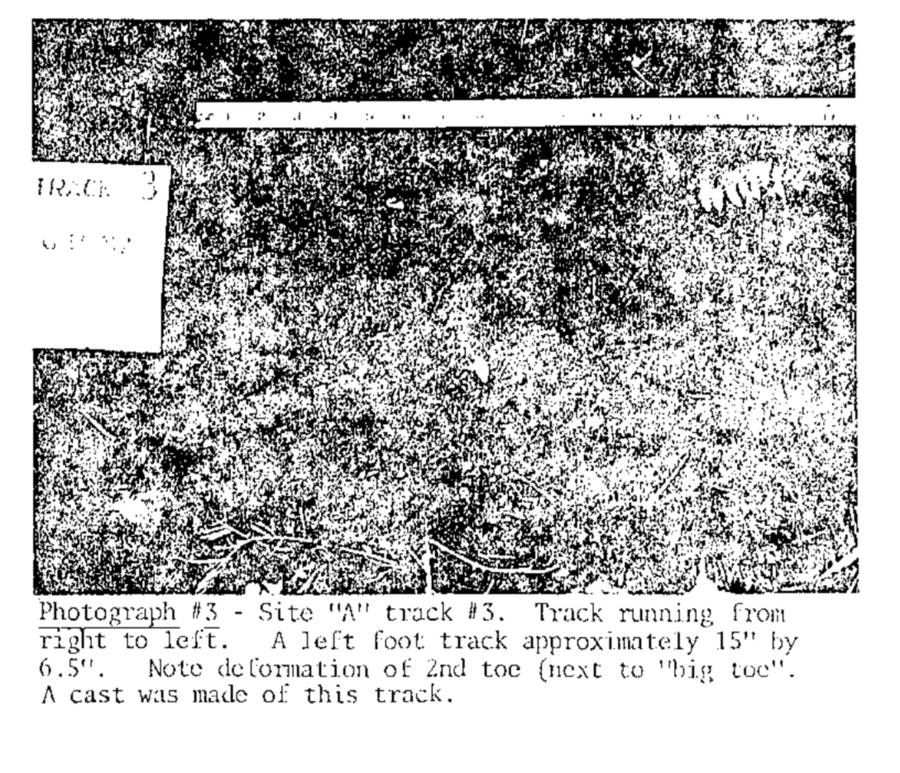
Image: U.S. Forest Service, Umatilla National Forest, June 18, 1982 memo (FOIA Reading Room). U.S. government work, public domain.
Site B was next to a bog where elk roll in the mud. It was about 2.75 miles above Mill Creek. The memo counts about 18 prints over about 40 feet. They went up a small rise and into thick plants. Johnson wrote that the plants were disturbed for another 30 to 40 feet, "indicating passage of something."
One photo in the memo shows a track next to a boot for size. The caption says the boot belonged to "Watershed rider Paul Freeman." The group never reached Site C. A watershed rider had described about 12 tracks there in a dry, open area.
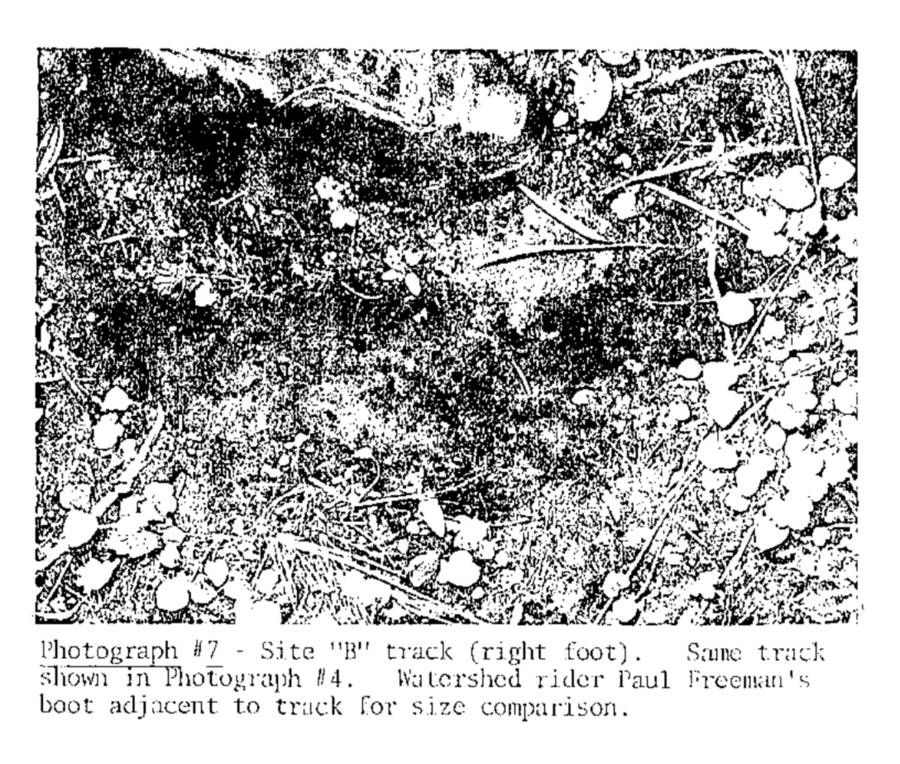
Image: U.S. Forest Service, Umatilla National Forest, June 18, 1982 memo (FOIA Reading Room). U.S. government work, public domain.
§ 3The Biologist's Verdict, in His Own Words
Johnson then gave his opinion. He wrote that the tracks at Sites A and B "were made by something other than a 300 pound plus two footed being."
He listed eight reasons. He said the stride, or the length of each step, stayed at about four feet whether the ground was flat or steep. He said the group's boots sank deeper into the mud than the tracks did. He said the tracks had "a definite beginning and an end," while nearby bear trails "could very easily be followed."
He also wrote that fallen needles looked "brushed aside" before one track was made. He saw no slipping on steep slopes.
Then Johnson wrote the lines that drew the most attention this week. Here they are exactly as typed.
"If the tracks were faked, someone went to a great deal of trouble and detail," he wrote. "The 'print' marks on the foot would have to be very hard to duplicate. They appear very natural. I would almost suspect a cast made of an actual foot would have had to be used to make the 'fake' feet. If this were the case though, the other creases in the foot should have shown."
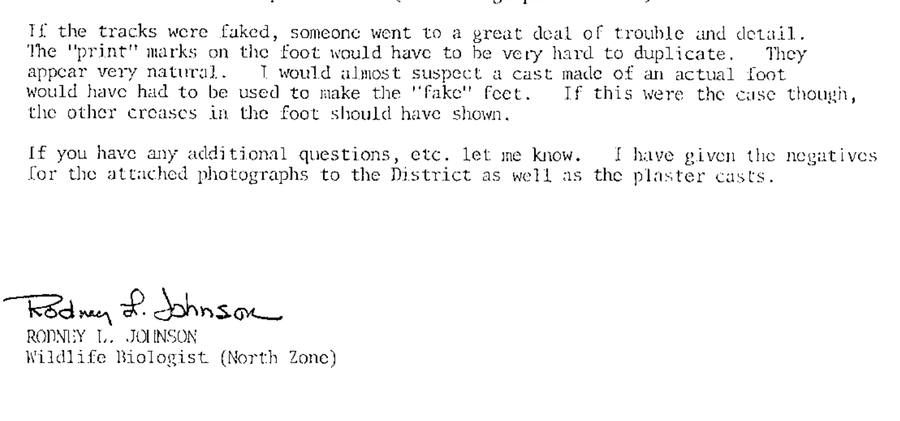
Image: U.S. Forest Service, Umatilla National Forest, June 18, 1982 memo (FOIA Reading Room). U.S. government work, public domain.
§ 4The Border Patrol Tracker
The file has one more memo. It is dated late July 1982 and comes from Joel Hardin, an experienced U.S. Border Patrol tracker from Bellingham, Washington. He wrote to Wayne Long, district supervisor of the Walla Walla District.
Hardin said he looked at the tracks on June 17. His view was blunt. "My opinion is that the tracks were a very clever attempt to perpetrate a hoax, involving your office or agency, in order to lend authenticity or credibility to the general public," he wrote.
Hardin believed the tracks were "man made by using some type of soft plaster or rubber coated foot." He hoped his memo would "suffice to close this 'Bigfoot' case."
So the file holds two official opinions that the tracks were faked. It also holds a note that faking them would have taken great skill. No one in the file names a culprit.
§ 5The Man Who Said He Saw It
On June 12, 1982, United Press International reported that a Forest Service worker "swore he saw a tall, reddish-brown 'bigfoot' creature." That worker was Paul Freeman, a watershed rider. He said it gave off a "rank odor." UPI said Freeman described it as ape-like and covered with reddish-brown hair, except for its face. He said it walked on its hind legs the whole time.
Freeman pushed back against the hoax claims. The Walla Walla Union-Bulletin quoted him on June 20, 1982. "I'm just as much of a professional tracker as he is," Freeman said of Hardin. "He's good at tracking people, but I've been tracking animals for 20 years."
The paper reported that Hardin saw fine lines, "similar to the lines in a fingerprint," on the tracks. Hardin felt a creature that went barefoot all its life should have smooth, worn spots there. Freeman said he answered by showing Hardin a bear track with lines in the same places. "Now you have to agree that bears go barefoot, too," Freeman said.
Freeman told the paper he still believed he saw Bigfoot. "I don't think these were a hoax either," he said. He thought officials "just wanted to keep things quieted down."
§ 6A Scientist Who Called the Tracks the Best Evidence Yet
Those fine lines soon became the center of the debate. Scientists call them dermal ridges. They are the tiny lines in skin, like the ones that make fingerprints.
In October 1982, UPI reported on Grover Krantz, an anthropology professor at Washington State University. Anthropology is the study of humans and their ancestors. UPI reported that Krantz called two sets of footprints from the Freeman case, found near the Washington-Oregon border, "the best evidence yet to prove the existence of the elusive Sasquatch."
"We've got over a thousand cases of Sasquatch sightings and plaster casts of prints," Krantz said. "But this set had dermal ridges and that's what sets them apart." He said the ridge pattern "would be almost impossible even for the best hieroglyphics expert to fake."
UPI said police fingerprint experts had said only a master counterfeiter could forge such ridges. Krantz said the closed location, with no trace of people nearby, made Freeman's story more believable.
UPI also reported that Freeman quit about a month after the sighting, because of publicity and harassment from other forestry workers.
§ 7Snow Tracks on River Road West
The second file jumps ahead to the winter of 2003. It is a page from the Clark Fork Valley Press in Plains, a town in Sanders County, Montana. The Forest Service file name says January 13, 2003. The printed page is dated January 15, 2003.
The headline reads, "Mysterious tracks discovered near River Road West." Reporter Ed Moreth wrote that an 8-year-old boy, Austin Petersen, found the prints. He was visiting neighbor Jim Rohweder with his father, Dean Petersen, on January 3.
Rohweder was 87. He first thought the tracks came from a bear. But the paper said a "toe-like formation" made them look "more human than animal." One footprint measured 16 1/2 inches long and 8 1/2 inches wide. The prints showed an average stride of about five feet.
Neighbor Bob Mesing followed the tracks for about two hours, about 100 yards into the woods. He said there were hundreds of them. "If someone played a hoax, they did a pretty good job," he told the paper.
Dean Petersen guessed the animal weighed between 800 and 1,000 pounds. "I was skeptical, but here are the tracks in front of me," he said. "I studied them and I think they're real." His neighbor Colleen Mesing said, "I didn't believe it until I saw the tracks."
The paper said the Rohweders had lived on River Road West for 30 years. A photo caption said that when they first got there, Gladys Rohweder saw "a hairy two-legged strange looking creature."
The group also found a large pile of dung they could not identify. Bob Mesing planned to give a sample to Fish and Game, the state wildlife agency. "I hope no one does explain it because I had fun running around like a chicken with my head cut off," he said.
The 2003 article gave both sides. It said anthropologists had studied hair, photos, footprints and witness stories for decades "with no solid, conclusive evidence that Sasquatch exists." It said a California man, Ray Wallace, had faked famous prints from 1958. It also reported that scientists believe there may be thousands of undiscovered species on Earth.
§ 8Leo Kinney's Story From Petty Creek
The third file is the oldest story, though it was written later. It is called "What Do You Know About Petty Creek?: Leo T. Kinney's Version." Petty Creek runs into the Clark Fork River about two miles east of Alberton, Montana. Kinney mentions 1980 as the "present day," so he likely typed it around then.
Most of it is local history, from lost gold to runaway Texas longhorns. Then it turns stranger.
Kinney described a "creature that walked on its hind legs." He said he and three others went to carry out a six-point bull elk. When they arrived, they found only the insides of the elk. In the snow was "a large set of tracks" coming and going.
They first guessed it was a very big bear. But Kinney wrote that bears walk on their hind legs only for short distances. "Whatever it was had picked up the elk whole and clear of the ground," he wrote.
The men followed the tracks for about half a mile. The creature had stepped over a log three feet across. On top of the log, in the snow, they saw where the elk's horns had dragged.
"At this point we held a conference and decided that we were not particularly anxious to catch up to whatever it was," Kinney wrote. Later, he said, they learned "we all had a very uneasy feeling and could feel chills running up and down our backs."
The typed year is hard to read, but it begins with "194." NewsNation and the Washington Post reported it as 1941. Kinney wrote that the next year, a hunter named W.W. Schmitz found "the same type of tracks" in the upper Bills Creek area. Kinney said Schmitz smelled a strong odor and heard "a grunting type noise."
Kinney added one more detail. "At this time we had never heard of Bigfoot," he wrote.
§ 9Not the First Time Government Met Bigfoot
The Forest Service is not the only government office with a Bigfoot paper trail. The FBI keeps one in its online library, the Vault.
In 1976, Peter Byrne of the Bigfoot Information Center and Exhibition in The Dalles, Oregon, wrote to the FBI. He asked the lab to study about 15 hairs attached to "a tiny piece of skin." He called it the first hair "in six years which we feel may be of importance."
FBI official Jay Cochran Jr. agreed. He said the lab sometimes made exceptions "in the interest of research and scientific inquiry." A February 1977 FBI memo gave the answer: "The hairs were determined to be from a member of the deer family."
Local lawmakers have taken Bigfoot seriously too. In 1969, Skamania County, Washington, passed Ordinance No. 69-01. It said there was "evidence to indicate the possible existence" of the creature in the county. It made the planned killing of one a felony, with a fine of up to $10,000 and up to five years in jail. The county's own code list still names it "Sasquatch protection."
§ 10Forest Service Staff Talk Bigfoot
The files were not the agency's only Bigfoot moment this fall. On October 8, Stanislaus National Forest, near Yosemite in California, held a public talk called "Bigfoot in Your Backyard."
The Sierra Sun Times said the crowd was so big that many people were turned away.
According to Meridian News, staffer Kathy Marquez described a creature that "smells bad, screams, howls." Forest archaeologist Kathy Strain said there have been 65 recorded sightings in her part of the Sierra Nevada. She also said she saw two of the creatures herself in Oklahoma's Ouachita Mountains in 2012.
§ 11What It All Means
The U.S. Forest Service has shared three old Bigfoot records with the public. They are confirmed government files, and anyone can read them. In 1982, two officials judged one set of tracks a likely hoax. Yet the same biologist wrote that faking them would have taken "a great deal of trouble and detail." The man who reported the creature, and a respected professor, said the tracks were real. In Montana, neighbors and hunters described huge prints and chills they could not explain. What made those tracks has never been proven. The files leave that question open for every reader to weigh.
Watch & Listen
Hear this entry read aloud. Coming soon — the channels are not live yet.
Sources
Primary records
- U.S. Forest Service. FOIA Reading Room, "Bigfoot/Sasquatch Records (10/15/2026)." Link
- Johnson, Rodney L. "Documentation of Investigation into Sighting of 'Bigfoot' Tracks in the Mill Creek Watershed." Umatilla National Forest memo, June 18, 1982, with July 1982 memo from Joel Hardin, U.S. Border Patrol. U.S. Forest Service. Link
- Moreth, Ed. "Mysterious tracks discovered near River Road West." Clark Fork Valley Press, January 15, 2003 (file dated January 13, 2003). Posted by the U.S. Forest Service. Link
- Kinney, Leo T. "What Do You Know About Petty Creek?: Leo T. Kinney's Version." Typed account, about 1980. Posted by the U.S. Forest Service. Link
- Federal Bureau of Investigation. "Bigfoot." The Vault. Link
- Skamania County, Washington. Ordinance List and Disposition Table (Ordinance 69-01, "Sasquatch protection"). Link
- Sasquatch Information Society. "Skamania County Ordinance" (text of Ordinance No. 69-01, April 1, 1969). Link
Articles
- Gowen, Annie. "Bigfoot believers get a boost from an unlikely ally: The U.S. Forest Service." The Washington Post, November 20, 2026. Link (connection refused/timed out for automated checks; likely bot blocking)
- Nava, Victor. "Trump admin quietly releases government Bigfoot files: 'Very uneasy feeling'." New York Post, November 20, 2026. Link
- Whiteside, Steph. "US Forest Service quietly releases Bigfoot files, raising hopes among believers." NewsNation, November 20, 2026. Link (returns 403 to automated checks; likely bot blocking)
- News On 6. "U.S. Forest Service releases records of suspected Bigfoot tracks." News9, November 20, 2026. Link
- Meridian News. "US Forest Service quietly posts Bigfoot encounter files online." November 20, 2026. Link
- Duecy, Luke. "1982 Bigfoot investigation: Forest Service releases records of suspected Sasquatch hoax in WA." MyNorthwest / KIRO Newsradio. Link
- United Press International. "A Forest Service employee swore he saw a tall..." June 12, 1982. Link (returns 403 to automated checks; likely bot blocking)
- Ferguson, Mary. "Either the mysterious Sasquatch trod on Washington state soil..." United Press International, October 23, 1982. Link (returns 403 to automated checks; likely bot blocking)
Walla Walla Union-Bulletin. Report on Mill Creek watershed tracks, quoting Paul Freeman, Joel Hardin and Wayne Long, June 20, 1982. Print; text as clipped on NewspaperArchive.
Read next
More in The Weird
A 'Crypto-Wolf' at Skinwalker Ranch, and the Phones That Open Themselves
A biologist who works at Utah's Skinwalker Ranch made a striking claim this week. He says a dead wolf-like animal found on the land was mostly an unknown kind of wolf.
More in The Weird
Las Vegas Backyard 'Aliens' Case Goes Viral Again, Three Years Later
A strange police call from Las Vegas is racing across the internet again. In 2023, a family told a 911 operator that two giant beings, "100% not human," were standing in their backyard.

On the front page
Five Directors Are Guiding Tesla-SpaceX Merger Talks, the FT Says
The Financial Times reported on Tuesday that five independent board members, three from Tesla and two from SpaceX, are now leading talks on a possible all-stock merger of Elon Musk's two biggest companies. Reuters said it could not immediately confirm the report, and neither company commented right away.