The Weird
Giants: What Timothy Alberino Claims, and What the Records Show
By Darrell Wallen
Would you prefer to listen?
§ 1What is being claimed
Timothy Alberino, an author and lecturer who researches ancient giants, told Joe Rogan's podcast on July 23, 2026, that American newspapers of the 1800s reported giant skeletons in burial mounds, and that those reports all seem to lead back to the Smithsonian Institution. He called it the Smithsonian's "apparent cover-up of giants." The Smithsonian says no such thing happened. No physical evidence of a race of giants has ever been produced for independent study.
That is the short version, and parts of it are true. The newspaper stories are real. The Smithsonian did print a giant-sized measurement in one of its own reports. Real giants have lived, and one stood nearly nine feet tall. This report sorts the record into two piles. CONFIRMED means documented in primary sources or credible outlets. CLAIMED means asserted, but not verified.
§ 2Who Timothy Alberino is, and what he says
CONFIRMED: Alberino describes himself on his website as an author, lecturer and explorer. His book Birthright appeared in 2020. His site says he has produced and hosted documentary films, and that his research interests include megalithic builders, the legends of ancient giants and the UFO phenomenon. Rogan's show notes say his latest release is a new edition of the Book of Enoch, with an introduction and commentary by Alberino. On the show he said he and author Steve Quayle started a company called Gen 6 Productions to make documentaries about giants.
CLAIMED: Alberino's case, as he gave it to Rogan, has several parts. First, he says legends of a primordial race of giants appear in nearly every culture, and that when anecdotes are this widespread they begin to look like evidence. Second, he says newspapers from the mid-1800s to the early 1900s described giant skeletons dug from the mounds of the eastern United States, and that most of those stories somehow involve the Smithsonian. Third, he reads an Abraham Lincoln lecture fragment as a reference to those mound giants. Fourth, he says he interviewed dozens of mostly elderly people in Sardinia who told him they had found giant bones, sometimes with jewelry or Roman coins. And fifth, he told a story of a giant killed in Afghanistan, which he says came from a military pilot.
Alberino was careful in places, and that deserves mention. He told Rogan that "some of them were hoaxes. Sure, some of them were hoaxes." He said many giant stories have ordinary explanations, such as the bones of ground sloths and mastodons, and that he once made that mistake himself. He agreed that many elongated skulls in Peru are the result of deliberate head shaping. About one disputed photograph shown during the interview, he said he did not think there was any way to know whether it was a hoax. He also said that he does not think giants built all the world's megaliths.
His explanation for a cover-up is not the one many people expect. He said the idea that officials want to protect evolution, or to avoid confirming the Bible, does not satisfy him. His own view, which he called a personal theory, is that "something very sinister" is going on with the remains of giants, linked to ancient beliefs about summoning the spirits of dead giants. He presented no documents for that theory. It is a belief, and it is labeled here as one.
§ 3The oldest source: the giants of the Bible
CONFIRMED: The idea of giants in the earth is very old, and it is written down. Genesis 6:4 in the King James Version reads, "There were giants in the earth in those days." The Hebrew word is Nephilim, and it appears again in Numbers 13:33. The Encyclopedia of the Bible notes that attempts to explain the word from its roots have not produced satisfying results. Scholars do not agree on exactly what the Nephilim were, or how big.
Goliath is the best-known giant in the text, and even his height is disputed. The traditional Hebrew text gives it as six cubits and a span, about nine feet nine inches. A Dead Sea Scrolls manuscript of Samuel, some Greek manuscripts and the historian Josephus give four cubits and a span, about six feet nine inches. Both numbers are in the manuscript record, and scholars debate which is original. A six-foot-nine warrior is very tall, but not a monster.


A story in an ancient text is evidence of what ancient people believed. It is not a skeleton. People of faith read these passages as history, and that is their right. But no physical remains tied to those texts have been identified.
§ 4The Lincoln fragment
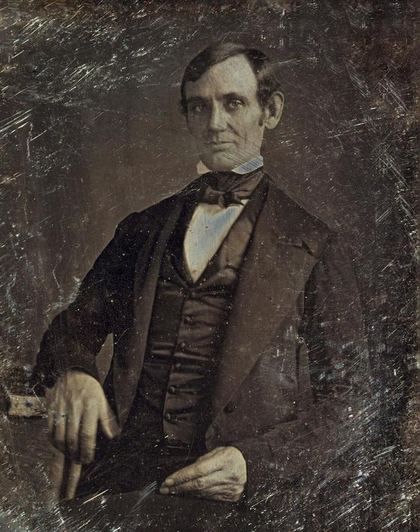
CONFIRMED: Abraham Lincoln did write the line Alberino quotes. In a short set of notes on Niagara Falls, he wrote of "that species of extinct giants, whose bones fill the mounds of America." Dickinson College's House Divided project, which transcribes the fragment from Lincoln's Collected Works, dates it to about September 25 to 30, 1848, and marks that date as uncertain. Alberino gave the year as 1845. In the same notes Lincoln also mentions the mammoth and mastodon, whose bones he says testify that they once lived.
CLAIMED: Alberino argues that because Lincoln mentions Adam, Moses and Christ just before the line, he meant human giants. Skeptics say Lincoln meant mastodons and mammoths. Alberino himself told Rogan that the reference is ambiguous and that he does not know the answer. That is a fair summary. The fragment is real, and it shows Lincoln repeating a belief that was widespread in his day. It is not evidence that the belief was correct.

§ 5Newspapers and the lost-race myth
CONFIRMED: Newspaper stories about giants are real, and they are old. Archaeology magazine, in a 2005 article by Mark Rose, traces the habit back to 1705, when the Puritan minister Cotton Mather took mastodon bones found near Albany, New York, for the remains of giants drowned in Noah's flood. In 1835 Josiah Priest published American Antiquities, which reported finds such as "several sculls, legs and thigh bones" in Indiana that supposedly showed "persons of gigantic stature."
Behind many of these stories sat a bigger idea, the myth of the mound builders. In the 1800s many Americans believed that the earthen mounds of the Ohio and Mississippi valleys could not have been built by the ancestors of living Native peoples. They imagined a vanished and more advanced race, and giant skeletons fit the story nicely.
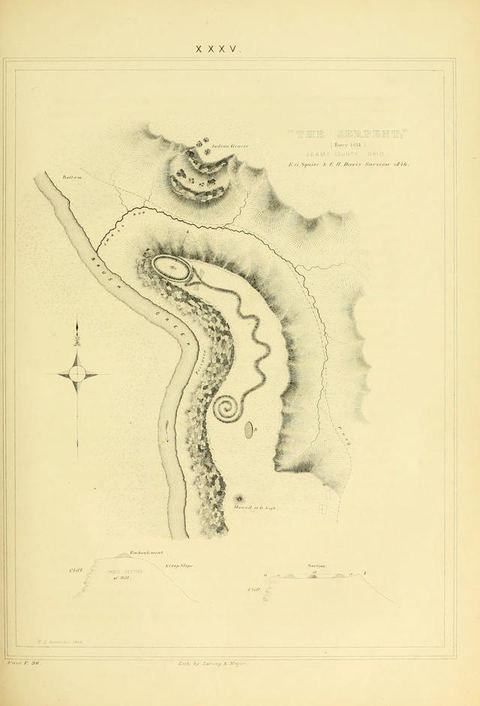

The Smithsonian entered this debate early. In 1848 it published Ancient Monuments of the Mississippi Valley, by Ephraim Squier and Edwin Davis, a survey of the mounds that included detailed plates such as the one above showing the Great Serpent in Adams County, Ohio. Later, in 1881, the Bureau of Ethnology, a Smithsonian unit, put a scholar named Cyrus Thomas in charge of a large mound survey. His report was published in 1894. The Bureau director, John Wesley Powell, wrote in the introduction that the work "seems to disprove the attractive theory" that the mounds were the remains of a people "more highly cultured" than the Indians found by Europeans. He called the lost-race idea a "romantic fallacy." The Smithsonian's own survey, in other words, ended the mystery that the giant stories had fed on.
§ 6What the Smithsonian actually published
CONFIRMED: Here is the part that is rarely told. That same 1894 volume prints a giant measurement. In his section on West Virginia, Thomas describes the digging of Mound 21 in Kanawha County. At the bottom of a timber-lined vault, he writes, was "a skeleton, measuring 7½ feet in length and 19 inches across the shoulders." He calls it "this giant frame." The skeleton lay in the remains of a bark coffin, with six heavy copper bracelets on each wrist. In the corners of the same vault, the report says, were four adult skeletons "of medium size."
So the report is public, and it is in the library. For a person who believes in a cover-up, the passage shows the Smithsonian recording a very large burial. For a skeptic, it shows the Smithsonian publishing the measurement openly, in the same book that rejected the lost-race theory. What cannot be done is to examine the skeleton. The report does not say that the bones were kept, and no record of where they are today was found. A reading of 7½ feet taken in the ground is also not the same as a laboratory measurement. Taken at face value, it would make the man exceptionally tall, but no taller than Charles Byrne, who is discussed below. It would not make him a different species.


The Smithsonian has addressed the broader claim directly. In a February 1934 article in the Science News Letter, its curator of physical anthropology, Aleš Hrdlička, explained why so many finders believed they had a giant. The estimate of stature, he said, "is usually based on the thigh bone of a man of ordinary size." The finder, he explained, holds the fossil thigh bone against the front of his own body, but the hip joint sits several inches higher than it appears, so the result is an inflated height. The magazine summarized the Smithsonian's position this way: "there was no prehistoric race of giants."
The modern "destroyed evidence" story has a different origin. A 2014 article on a website called World News Daily Report said a group called the American Institution of Alternative Archaeology had proved the Smithsonian destroyed skeletons up to 12 feet tall, and that the case reached the Supreme Court. Smithsonian Magazine, in a 2024 update of its list of persistent myths, says the website described itself as a satire publication, that the group does not exist, and that "the Smithsonian is not in the business of destroying artifacts." Alberino's interview does not cite that article, but it is the source of much online cover-up lore.
A denial from the accused is not proof. What counts more is that, after nearly two centuries of stories, no preserved specimen, no photograph that holds up and no document showing removal has surfaced.
One more case shows how these stories grow. In the late 1800s, John Everhart dug the Brush Creek Mound in Muskingum County, Ohio. He claimed to have found a slab with hieroglyphics and skeletons more than eight feet tall. PolitiFact, drawing on reporting by The Columbus Dispatch, notes that a former worker later testified in court that he had been promised $15 to carve the slab. A crew member also admitted that the skeletons were so crumbled that accurate measurement was difficult.
§ 7The legal context
Mound skeletons are no longer treated as curiosities. The Native American Graves Protection and Repatriation Act became law on November 16, 1990. The National Park Service says Congress recognized that human remains of any ancestry "must at all times be treated with dignity and respect," and that remains removed from federal or tribal lands belong, in the first instance, to lineal descendants and Tribes. The Bureau of Ethnology's 1894 conclusion was that the mounds were built by the ancestors of Native peoples. For anyone hoping to re-measure old collections, that means Tribes are part of the conversation.
§ 8The hoaxes: a short and entertaining history
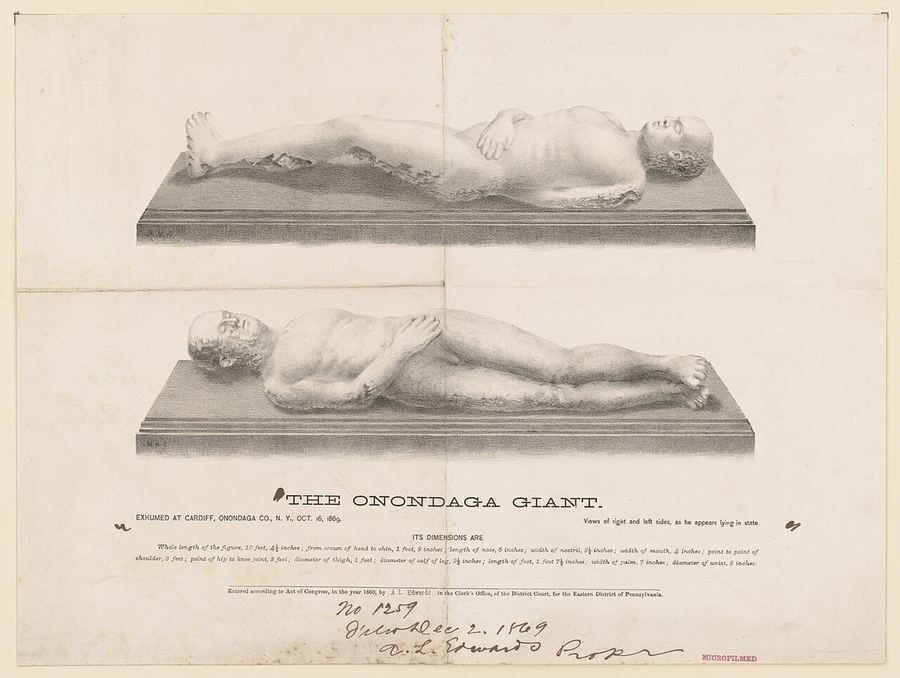
CONFIRMED: Hoaxes are the best-documented part of this story. The Cardiff Giant is the classic one. On October 16, 1869, two men digging a well on a farm in Cardiff, New York, struck a stone foot. The figure, more than ten feet long, was the work of a Binghamton cigar maker named George Hull, who had it carved from Iowa gypsum and buried the year before. Hull later recalled that the idea came to him after a night's argument with a Methodist revivalist over the Bible's giants. Andrew Dickson White, later president of Cornell, recognized it at once as a statue, yet wrote that most visitors insisted it was a petrified man. Yale paleontologist Othniel C. Marsh called it "a most decided humbug" on November 25. Hull confessed on December 10. The giant now lies in the Farmers' Museum in Cooperstown, New York.
The Cardiff Giant set off a small industry. Archaeology magazine counts at least a dozen imitators, among them the "Solid Muldoon" of 1876, which was made of rock dust, clay, plaster and ground bones, and had a tail. Mark Twain had earlier published a spoof of a petrified man in 1862, complete with a wooden leg. The magazine reports that eight of twelve newspapers that picked the story up ran it without saying it was a joke. Old clippings need that caution, since newspapers of the period printed satire and tall tales with a straight face.
Science has had its own frauds, and it caught them. The Piltdown Man, announced in England between 1912 and 1914 as the missing link between apes and humans, was a forgery. Forty years later it was shown that the pieces had been modified and planted. In 2016 the Natural History Museum in London reported that new analysis found a single orangutan specimen and at least two human specimens were used, and linked the fakes to a single forger, the amateur archaeologist Charles Dawson. Piltdown shows that fraud can enter the record, and that other scientists eventually remove it.
The modern internet has produced its own. In 2002 an illustrator who goes by IronKite took third place in a Photoshop contest on the Worth1000 site, called Archaeological Anomalies 2, with a picture of a huge skeleton. He built it from an aerial photo of a mastodon excavation in Hyde Park, New York. National Geographic reported in 2007 that the image went around the world as "Giant Skeleton Unearthed!" and was later attached to claims about India and Saudi Arabia. IronKite told the magazine, "I laugh myself silly when some guy claims to know someone who was there."
CLAIMED: The Kandahar giant belongs in this group, at least for now. Alberino told Rogan that a C-130 pilot told him of a 1,100-pound body, ten to twelve feet long, flown out of Bagram in 2005. In Alberino's telling, the pilot was relaying what Marines said they had heard, and said of the body's later destination, "I don't know. That's just what I heard." Alberino said intelligence personnel told the pilot there were to be no photographs, so none were offered. A Defense Department spokesman told Snopes in 2016, about a version of the story then circulating from a video by author L.A. Marzulli, "We do not have any record or information about a special forces member killed by a giant in Kandahar." That denial addresses the 2016 version, which placed the event in 2002, and not Alberino's exact account, so his story is unconfirmed rather than disproved. It rests on a single anonymous source, relayed second-hand.
§ 9What the fossils actually show
CONFIRMED: Real giant apes did exist. Gigantopithecus blacki lived in what is now southern China, and is estimated to have stood about three meters tall and weighed about 250 kilograms. Researchers writing in 2024 say the whole species is known from only a few thousand teeth and four jawbones, with "nothing from the neck down." A 2019 study in Nature recovered protein sequences from a 1.9-million-year-old molar and placed Gigantopithecus as a sister group to orangutans. A 2024 Nature study dated its extinction to between 295,000 and 215,000 years ago, driven by changing forests. It was an ape.
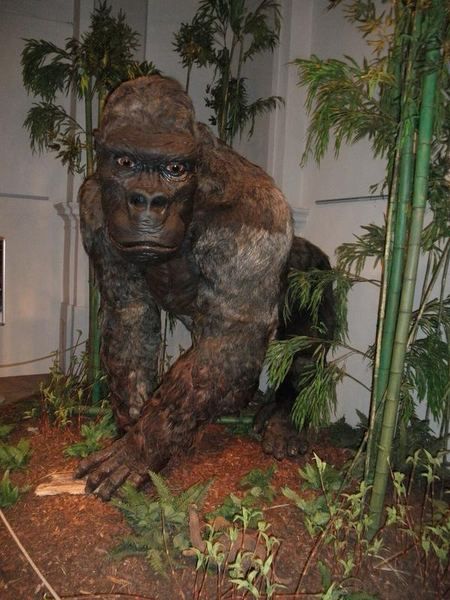

Fossils of the human lineage tell the same story. The Smithsonian's Human Origins program gives Homo erectus a height range of about 4 feet 9 inches to 6 feet 1 inch. Homo heidelbergensis males averaged about 5 feet 9 inches. Neanderthal males averaged about 5 feet 5 inches. Early humans, in short, were not taller than we are. A skeleton found on the Indonesian island of Flores, called Homo floresiensis, belonged to an adult who stood about three and a half feet tall. No fossil site on Earth has yielded a human skeleton of nine to twelve feet.
§ 10Real giants: gigantism and acromegaly
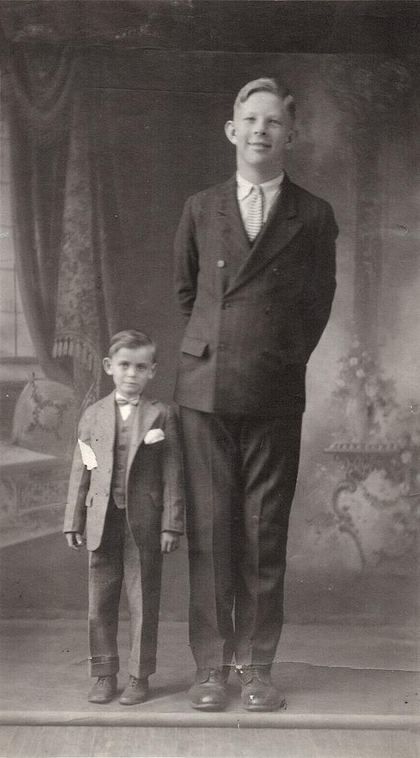
CONFIRMED: Some people do grow to extraordinary height, and medicine understands why. The tallest person in medical history, Robert Wadlow of Alton, Illinois, reached 8 feet 11.1 inches. A 1932 case report by St. Louis physicians, titled "Hyperpituitarism beginning in infancy, the Alton giant," described his case. Wadlow died on July 15, 1940, at age 22, of an infection that began with an abrasion on his ankle from a leg brace. A 2023 review in the journal Pituitary, which looked at six famous twentieth-century cases including Wadlow's, found that foot ulcers, leg deformities and nerve damage were common, and that Wadlow needed canes in his last years.

The eighteenth century produced Charles Byrne, the "Irish Giant," who was born in 1761 and grew to 7 feet 7 inches. The Hunterian Museum states that he had a benign pituitary tumor that caused acromegaly and gigantism. He died in 1783. The surgeon John Hunter bought his body for a reported £500, although Byrne is said to have wanted burial at sea. In 2011 a team at Queen Mary University of London found in DNA from two of his teeth a mutation in the AIP gene. The same mutation appears in living Irish families with pituitary tumors, and traces to a common ancestor roughly 1,500 years old. In January 2023 the museum's trustees decided his skeleton will no longer be displayed.
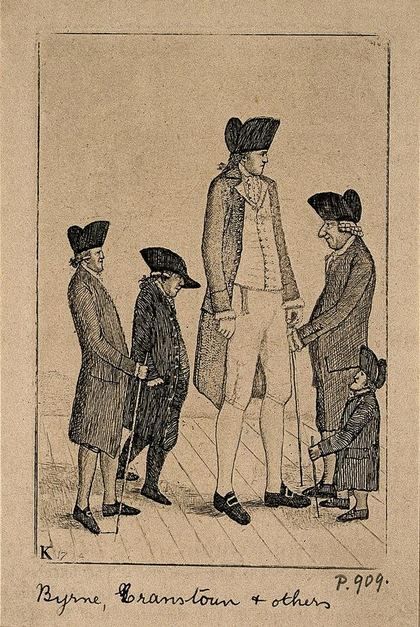

The point is not that every old giant story was a pituitary case. It is that gigantism is a known, documented and treatable condition, and a single person can be very tall without being a different people. Even so, Wadlow and Byrne were the extremes of their eras. Neither came close to ten feet.
§ 11Elongated skulls
CONFIRMED: Elongated skulls are real, and they are often linked to giants in online posts. But they are not evidence of large bodies. A review of artificial cranial deformation in the Andes, published through the National Library of Medicine, describes it as a deliberate practice carried out in the first months of an infant's life, using mechanical devices to shape the soft skull, and often tied to social identity. The Paracas skulls of Peru, one group of which is shown below in the Ica regional museum, fit that pattern. Alberino made a related point to Rogan. He said the Paracas people were small, about four feet tall by his account, and that many elongated skulls in Peru and elsewhere are the result of deliberate deformation, though he does not believe that explains every case.
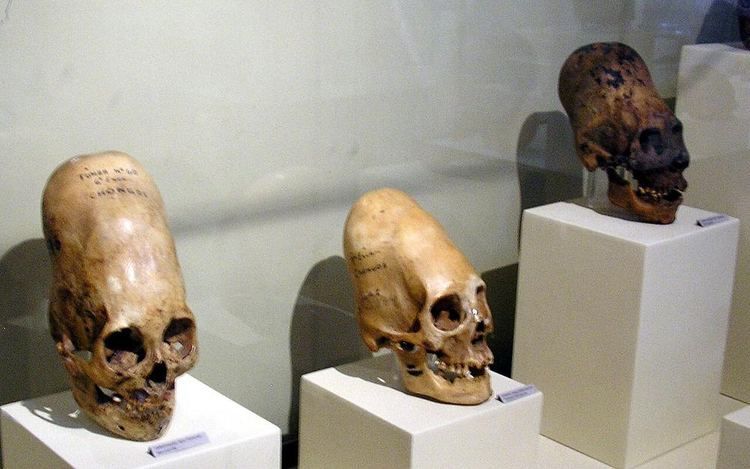

CLAIMED: Alberino argues that some skulls look to him like "a genetic alteration," and described a mummy that he believes is held in a Lima museum. He did not present measurements or published analysis.
§ 12Sardinia and the tombs of the giants
CONFIRMED: The "tombs of the giants," or tombe dei giganti, of Sardinia are real megalithic monuments, attributed to the Bronze Age Nuragic civilization. Alberino notes that the name comes from Sardinian legend. A heritage site for the island's candidacy to UNESCO, quoting the scholar Paolo Melis, says the traditional view sees them as collective burials of an entire village, and later perhaps family or clan tombs. It adds that the burial practice is still debated, and that secondary burial, in which only the bones were placed inside, is thought to have occurred.
CLAIMED: Alberino says the tombs were built over buried giants and that he measured the chambers himself. He also says elderly Sardinians told him of nine-to-twelve-foot skeletons, sometimes with jewelry, found in fields and at the Santa Anastasia church at Sardara, and that the remains were removed overnight. When Rogan asked about photographs, he said there were none, and that the men he spoke to were reluctant to talk. These are second-hand oral accounts, not documents. They cannot be checked.
§ 13What remains open
What is confirmed: Ancient texts speak of giants. Nineteenth-century papers printed giant stories, some false and some merely mistaken. The Smithsonian's own survey of the mounds ended the lost-race theory while printing, in the open, a 7½-foot measurement. People of extreme height are real, but they are individuals with a medical condition. Giant apes are real, and they were apes. The viral giant photos have been traced to hoaxes and contests.
What is claimed: that the Smithsonian or others have hidden remains, that giants of nine to twelve feet once lived, and that a cover-up continues. These claims rest on testimony, newspaper clippings and stories without preserved bones. The claim that the Smithsonian destroyed giant skeletons began as satire, and is not supported.
What would settle it is simple: a skeleton, in a collection or in the ground, available to independent labs, with dates, measurements and DNA. The tools for that are far better than anything Hrdlička had in 1934. Until then, the record shows a very old human fascination with giants, a great many honest mistakes, a smaller number of hoaxes, and a handful of real people whose bodies grew past the ordinary. That is a remarkable story on its own, and it does not need to be improved.
That is where the record stands as of October 27, 2026. Every source listed below can be read by anyone, and the claims that matter most can be tested the day a skeleton is put on a lab bench. Until then, read the sources and weigh the evidence for yourself.
§ 14Opinion: From the Editor
This section is the opinion of the editor, Darrell Wallen, and is separate from the reporting above.
Everything above is the reporting, and I stand by it. But there is something the record does not say on its own. Very few bones survive the test of time. The National Park Service says that becoming a fossil is rare for a large land animal, that the fossils we have represent only an extremely small fraction of the dinosaurs that ever lived, and that most dinosaurs are known only from single bones or partial skeletons. The Natural History Museum in London says fossilization takes a specific set of conditions. A 2006 study in the Proceedings of the National Academy of Sciences estimated that at least 71 percent of dinosaur genera were still unknown. Time and nature wear down tissue and bone. What survives was usually buried fast, in river mud or flood sediment, or sealed in exceptional places such as the asphalt of the La Brea Tar Pits or a piece of amber. A 99-million-year-old tail of a small feathered dinosaur, found in Burmese amber, is one such case. The same forces act on the remains of any living thing.
So the absence of bones may tell us as much about how little survives as about what once lived. That is not proof of anything, and I am not claiming that Timothy Alberino is right. I am saying that finding evidence may not be possible even if some of his positions were true. We simply cannot know. Should we stop looking? No. We should absolutely keep looking, and stay open to new hypotheses and theories. Not blindly accepting them, but open to them, and willing to see where the research leads. This last part is my opinion, and I know others will disagree: I think much of mainstream archaeology and academia holds too rigidly to its orthodoxy. I would rather see ideas tested than dismissed.
Watch & Listen
Hear this entry read aloud. Coming soon — the channels are not live yet.
Sources
Claims by Timothy Alberino
- Timothy Alberino, official website
- The Joe Rogan Experience #2530, Timothy Alberino, July 23, 2026 (transcript)
The Smithsonian, the mounds and the record
- Smithsonian Magazine, Busting 13 of the Smithsonian's most persistent myths (2024 update)
- Science News Letter, Measure Your Giant Carefully and His Size Will Shrink, February 24, 1934
- Cyrus Thomas, Report on the Mound Explorations of the Bureau of Ethnology (1894), Internet Archive
- Library of Congress, Ancient Monuments of the Mississippi Valley (Squier and Davis, 1848)
- PolitiFact, No bones about it: persistent rumors of giant remains, September 30, 2022
- National Park Service, Native American Graves Protection and Repatriation Act
- National Park Service, NAGPRA: the law
Texts and old documents
- Dickinson College, House Divided, Abraham Lincoln, Fragment on Niagara Falls, circa September 25-30, 1848
- Encyclopedia of the Bible, Nephilim (BibleGateway)
- Crossway, How Tall Was Goliath? A Textual Dilemma
Hoaxes and viral claims
- Archaeology magazine, Archaeological hoaxes: giants
- Central New York history, The Cardiff Giant, October 2014
- National Geographic, Skeleton giant photo hoax
- Natural History Museum, Piltdown Man hoax findings: Charles Dawson the likely fraudster, 2016
- Snopes, Did U.S. Special Forces kill a giant in Kandahar?
Fossils and human origins
- Nature, Welker et al., Gigantopithecus enamel proteome, 2019
- Nature, Gigantopithecus extinction study, 2024
- Southern Cross University, Solving the mystery of extinct giant apes, 2024
- Smithsonian Human Origins Program, Homo erectus
- Smithsonian Human Origins Program, Homo heidelbergensis
- Smithsonian Human Origins Program, Homo neanderthalensis
Gigantism, skulls and tombs
- Hunterian Museum, statement on the skeleton of Charles Byrne, 2023
- Queen Mary University of London, Genes of an 18th century giant, 2011
- Pituitary, review of famous cases of gigantism, 2023
- Guinness World Records, The tragic death of Robert Wadlow
- National Library of Medicine (PMC), Artificial cranial deformation in Tiwanaku, Bolivia
- Sardegna verso UNESCO, The burial in the tombs of the giants
Opinion section
- National Park Service, Dinosaurs in the Fossil Record
- National Park Service, Taphonomy: Death and Decay
- Natural History Museum, London, How are dinosaur fossils formed?
- Wang and Dodson, Estimating the diversity of dinosaurs, PNAS, 2006 (PubMed Central copy)
- La Brea Tar Pits and Museum, La Brea Tar Pits and Hancock Park
- A feathered dinosaur tail with primitive plumage trapped in mid-Cretaceous amber, Current Biology, 2016 (PubMed)
Image credits
- Onondaga Giant (Cardiff Giant) print, 1869 (Library of Congress, Popular Graphic Arts, public domain)
- David with the Head of Goliath (Caravaggio, Kunsthistorisches Museum Wien, public domain)
- Abraham Lincoln, 1846 (attributed to Nicholas H. Shepherd, Library of Congress, public domain)
- Great Serpent Mound plan, Plate XXXV (Squier and Davis, 1848, public domain)
- Smithsonian Institution Building, "The Castle" (Another Believer, CC BY-SA 3.0)
- Gigantopithecus blacki restoration (Michal Maňas, CC BY 4.0)
- Robert Wadlow with Ray Carter, about 1928 (Kopp Photography Studio, public domain)
- Charles Byrne, the "Irish Giant," etching (J. Kay, Wellcome Collection, CC BY 4.0)
- Paracas elongated skulls, Museo Regional de Ica (Marcin Tlustochowicz, CC BY 2.0)
