The Weird
The Serpent Over Cusco: Did an Inca-Era Monster Story Record an Earthquake?
By Darrell Wallen
Would you prefer to listen?
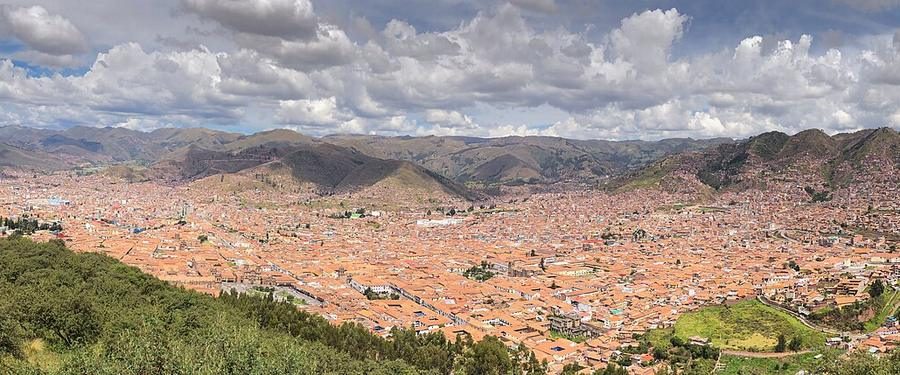
Sometime in the 1400s, according to a chronicle written down nearly two centuries later, word reached the Inca ruler Pachacuti that something monstrous had appeared near his capital. A creature the chronicle calls an amaru, a serpent half a league long, with ears, fangs and a beard, had come out of a mountain east of Cusco and slid into a lake. Then fiery shapes with wings and spiked backs streaked away across the sky.
It is easy to read that passage as a portent, a piece of royal legend, or simply one more strange episode in a strange book. A small group of geologists in France and Peru now argue that it may be something more useful: an indirect account of a large earthquake that tore open the ground in the hills above Cusco during the Inca period. If they are right, it would be among the oldest earthquakes in South America for which any written record survives.
The idea is not new this month. It was first laid out in a peer-reviewed paper in 2020, and the same team brought an updated version to the European Geosciences Union's General Assembly in Vienna this spring under a title that sounds more like a pun than a paper: "When Faults Wriggle." What has changed is the company the idea keeps. In the past few weeks a doctoral thesis from Australia has made a similar case for Aboriginal stories of a volcanic eruption about 7,000 years ago, including a story in which a great serpent appears where lava once ran. Taken together, the two projects show where the field of geomythology is heading, and also where it has to be careful.
Throughout this story, items marked CONFIRMED are documented facts we could check in the published record. Items marked CLAIMED are statements made by researchers or historical sources that have not been independently established. Items marked INTERPRETATION are readings of the evidence, including the central earthquake hypothesis itself.
§ 1What the chronicle actually says
CONFIRMED: The passage comes from a work usually known as the Relación de antigüedades deste reyno del Piru, attributed to an Indigenous Andean author, Juan de Santa Cruz Pachacuti Yamqui Salcamaygua. The manuscript survived among the papers of Francisco de Ávila, a Spanish priest known for campaigns against Andean religious practice, who added notes to it. It was first printed in Madrid in 1879 by Marcos Jiménez de la Espada in a collection called Tres relaciones de antigüedades peruanas.
CONFIRMED: English readers met the text earlier, in an 1873 translation by Clements Markham for the Hakluyt Society, published under the title Narratives of the Rites and Laws of the Yncas. Markham thought the author "may have written in about 1620," and he valued the work for a specific reason. "It is curious and valuable," he wrote, "because it gives the traditions of Ynca history, as they were handed down by the grandchildren of those who were living at the time of the Spanish conquest, to their grandchildren."
CONFIRMED: In Markham's translation, the serpent episode is set during the career of the ruler the chronicle calls Pachacuti Ynca Yupanqui. While he was away from Cusco, at a hot valley the translator identifies as the valley of the Pampas River, his eldest legitimate son was born. The text continues: "Here the news arrived of a miracle at Cuzco. A yauirca or amaru, a ferocious creature, half a league long and two brazas and a half wide, with ears, eye-teeth, and a beard, had come forth from the mountain of Pachatusan, and entered the lake of Quichuipay. Then two sacacas (comets) of fire came out of Ausancata, and went towards Arequipa; and another went towards some snowy mountains near Huamanca. They were described as animals with wings, ears, a tail, and four legs, with many spikes on their backs; and from a distance they appeared to be made of fire."
CONFIRMED: The son born that day is named in the same passage as Amaru Yupanqui. The 2020 paper by the French and Peruvian team makes the link explicit, noting that the chronicle places the event on the day the ruler's eldest son "was born around 1440 CE, and was named 'Amaru'."
It is worth being plain about what the passage does not say. In Markham's English, there is no shaking, no collapsing buildings and no crack in the ground. There is a giant serpent, a mountain, a lake, and fiery winged things in the sky. The earthquake is not in the text. It is the researchers' explanation for the text, and that distinction runs through everything that follows.
CONFIRMED: The chronicle uses the serpent motif more than once. A few lines later, during a campaign toward the eastern forests, the same book says a local shrine "sent forth fire, and stopped the passage with a fierce serpent which destroyed many people," until an eagle seized the serpent's head and threw it to the ground. In memory of that event, the chronicle says, the ruler "ordered a snake to be carved in stone on the wall of a terrace." Serpents, in other words, are part of the author's ordinary vocabulary for dramatic events, which cuts both ways for anyone trying to read one of them as a literal report.
§ 2Who was the amaru?
CONFIRMED: In the EGU abstract, the researchers describe the amaru as "a chthonian, serpent-like deity of pre-Hispanic cosmology," a creature of the underworld that was associated with violent geological or climatic processes. Its appearance, they write, "was commonly perceived as a rupture in the equilibrium of the world, a pachacuti." That last word is doing double duty. Pachacuti is the name of the ruler in the story, and in Quechua it also carries the sense of a world-turning upheaval.
CLAIMED: The 2020 paper describes the amaru as distinct from ordinary snakes, says the first Spanish description likened it to a European dragon, and connects it with the Amazon lowlands and with a palace compound in Cusco called Amarukancha. These points come from the paper's discussion of earlier ethnographic and historical work. We have not traced each one back to its original source, so we report them as the authors' account rather than as settled fact.
The chronicle's details, including the ears, the fangs and the beard, fit that larger-than-life creature better than any real animal. The question the geologists ask is not whether a giant serpent crawled out of Pachatusan, which nobody suggests, but whether something real happened on that mountainside that people described in the only vocabulary that fit.
§ 3The earthquake hypothesis
CONFIRMED: The hypothesis was published in December 2020 in the Journal of Archaeological Science: Reports, a peer-reviewed journal, under the title "Evidence of a large 'prehistorical' earthquake during Inca times? New insights from an indigenous chronicle (Cusco, Peru)." The authors were Andy Combey, Laurence Audin, Carlos Benavente, Thérèse Bouysse-Cassagne, Léo Marconato and Lorena Rosell. The question mark in the title is the authors' own.
CONFIRMED: The paper's abstract describes the creature as "a huge animal – kilometres in length and approximately 4 m in width," roughly 13 feet wide, and states the central proposal directly: "We suggest that the underlying event was an earthquake." The authors add that "the concordance between the snake's route and the layout of a major fault complex above Cusco, as well as several ethnographic testimonies, support this hypothesis."
INTERPRETATION: The logic is geographic. The chronicle names a starting point, the mountain of Pachatusan, and an end point, a lake called Quichuipay. The serpent's size is given as half a league long, which in the Spanish measure of the day works out to a few kilometers. A surface rupture during a strong earthquake on a normal fault, the kind of fault that dominates the hills north of Cusco, can leave exactly that sort of feature: a long, narrow, freshly broken step in the ground that runs across hillsides and valleys for kilometers. Seen from a distance, or described secondhand, a raw scar snaking over the mountains might well become a serpent.
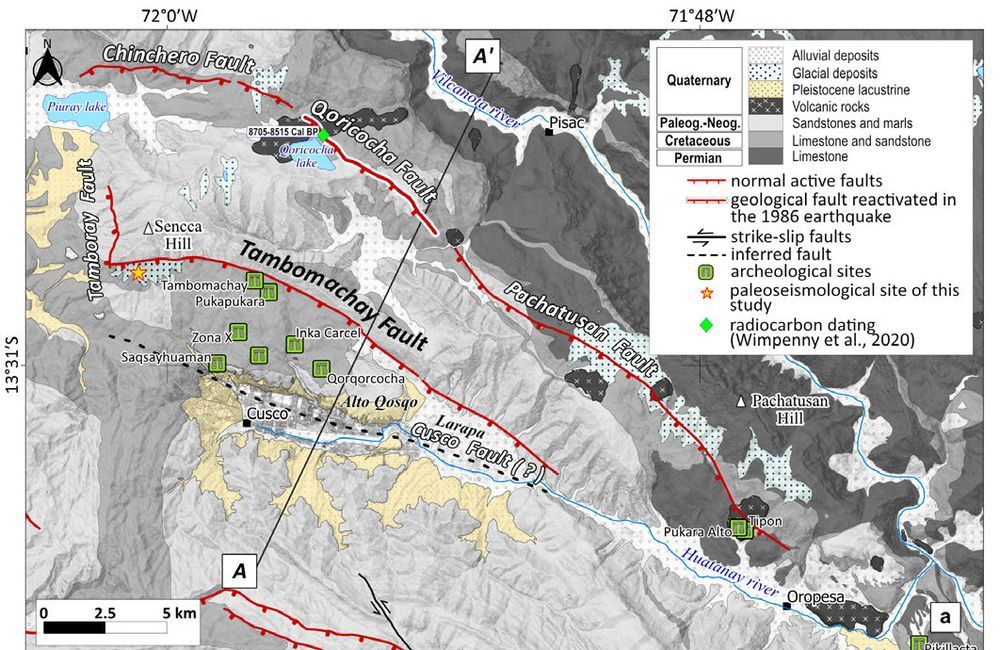
CONFIRMED: The team's newer conference abstract, presented at the EGU General Assembly in Vienna, held May 3 to 8, 2026, puts it in almost those words. "The propagation of a surface rupture across the landscape may have been perceived as the sudden emergence of a serpent-like being wriggling over the mountains and leaving an undulating surface trace," wrote Combey, now at Université Côte d'Azur, with Audin of Université Grenoble Alpes and Benavente of Peru's geological survey, INGEMMET. Through what they call "a cross-analysis of toponymic, geomorphological, and seismological data," they "suggest that the underlying event corresponds to a major earthquake during the 15th century CE."
CLAIMED: The abstract's most striking line is conditional: "If confirmed, this account may represent the oldest seismic event documented by written sources in South America."
CONFIRMED: A conference abstract is not a peer-reviewed paper. It is a short summary submitted to a meeting, and it is published so that other scientists know what will be presented. The underlying argument did pass peer review in 2020, but the 2026 abstract's framing, including the "oldest" claim, has not been through that process in this form.
§ 4A city that knows earthquakes
CONFIRMED: Cusco sits in a basin bordered on the north by a set of active normal faults. A 2023 study in the open-access journal Tektonika, led by Lorena Rosell of INGEMMET with co-authors from Peru, France, the United Kingdom, Germany and Spain, names them as the Cusco, Qoricocha, Tambomachay, Chinchero and Pachatusan faults. The study's opening line sets the stakes: the city "has been severely damaged by several major earthquakes during pre-Hispanic times, and more recently in 1650 and 1950 CE."
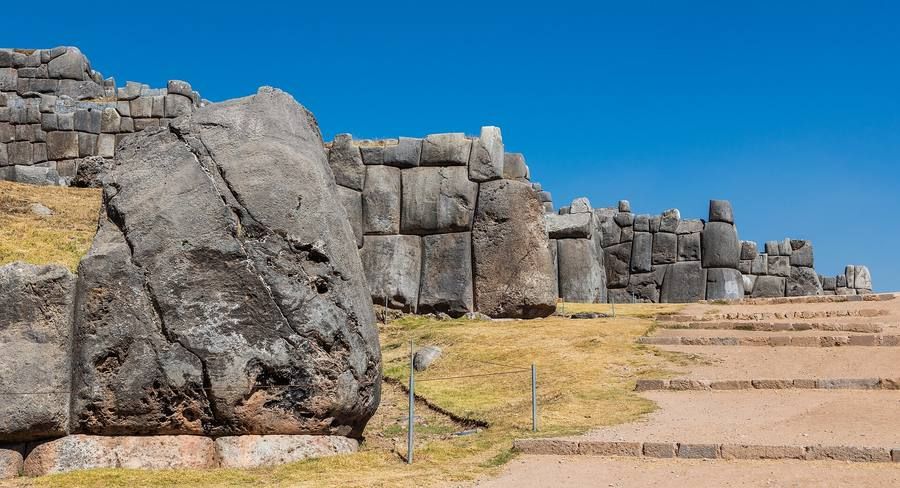

CONFIRMED: The colonial-era disaster is the one Cusco historians return to. According to the Tektonika paper, which draws on Peru's historical earthquake catalogue, a major earthquake struck on March 31, 1650. A priest in Cusco reported that "all of the temples and buildings were destroyed." The paper notes damage in towns 100 to 150 kilometers (about 60 to 95 miles) west of the city, says the shaking was felt in Lima, and cites a probable magnitude around 7.2. Because the worst damage was in Cusco itself, the authors conclude the quake was not a deep event on the subducting ocean plate but something closer to home.
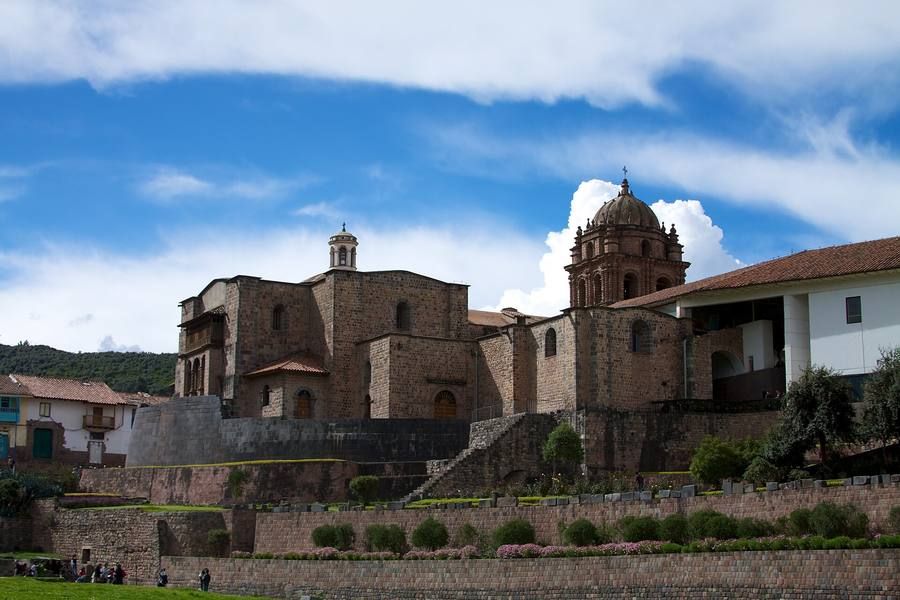
CONFIRMED: On May 21, 1950, another earthquake, estimated at about magnitude 6, caused severe damage across the city. Among the buildings that bear the marks of the city's earthquakes is the church of Santo Domingo, raised by the Spanish on top of the Inca temple complex of Coricancha. A 2012 engineering study of the church, presented at the World Conference on Earthquake Engineering, observed that its colonial tower has been destroyed by past earthquakes and rebuilt in its original form, while noting that a small part of the Inca stonework is all that remains of the original temple complex.

CONFIRMED: The most recent damaging event was on April 5, 1986, when a shallow normal-faulting earthquake of about magnitude 5.3 to 5.4 struck near the city. The Tektonika paper reports seven deaths, 80 people injured and more than 13,000 affected, and says small surface cracks about 10 centimeters (4 inches) high appeared along roughly 3 kilometers (about 2 miles) of the Qoricocha Fault north of the city.
That last detail matters for the serpent story. In 1986 a moderate earthquake on one of the faults above Cusco did leave a visible line on the hillside. A larger one, of the size the faults are capable of, would leave a much larger one.
§ 5The fault behind Tambomachay
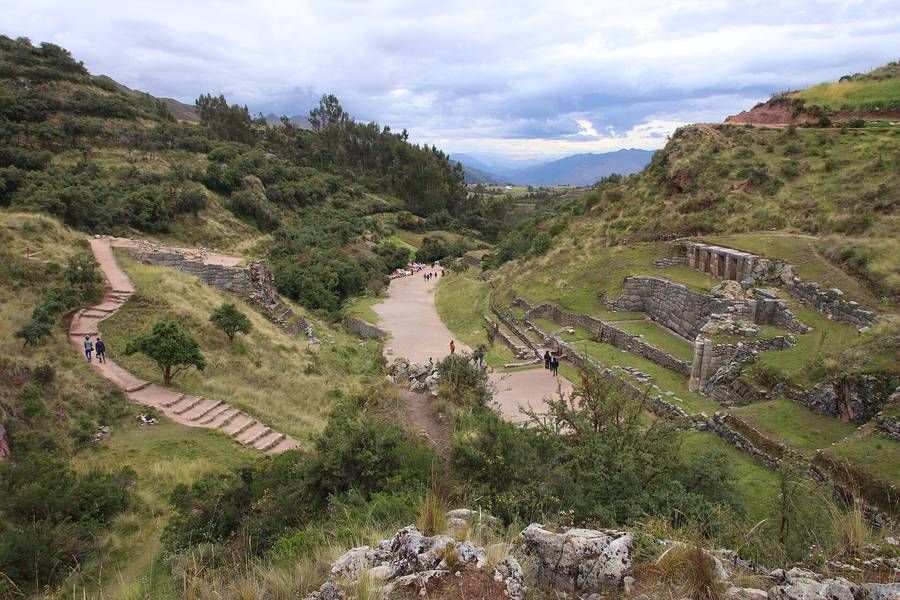
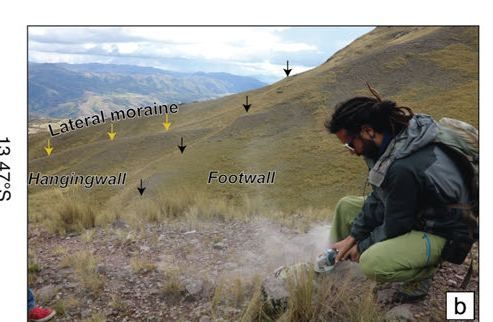
CONFIRMED: The most prominent of the faults is the Tambomachay Fault, named for the Inca water shrine that sits near it. According to the Tektonika study, the fault runs about 20 kilometers (12 miles) along the northern edge of the Cusco Basin, 2 to 3 kilometers north of the city, and is marked by triangular rock faces about 300 meters (roughly 1,000 feet) high. Where it cuts across glacial ridges left by retreating ice, it has offset them by about 4 meters (13 feet).

CONFIRMED: By digging a trench across the fault and dating the layers, the team identified three surface-rupturing earthquakes in the last 8,000 to 9,000 years: one around 8,500 to 8,300 years ago, one between 6,800 and 5,500 years ago, and the most recent between roughly 1,200 and 900 years ago. They estimate the ruptures corresponded to earthquakes of moment magnitude 6.4 to 6.9 and warn that a similar event today could severely damage a city that has grown from about 60,000 people in 1950 to around 500,000.
CONFIRMED: Here is the twist that tends to get lost when this story is retold. The same study found that none of those three ruptures happened during Inca times. "All of the ruptures predate Inca times," the abstract says, "thus historical earthquakes that affected the city of Cusco were not produced along this fault segment and may have originated from the rupture of other structures nearby." The authors name the Pachatusan and Cusco faults as the most likely alternatives, while noting that unmapped faults could also be responsible.
INTERPRETATION: That finding does not sink the serpent hypothesis. If anything, it nudges it toward the chronicle's own geography, since the serpent is said to have come out of Pachatusan, the mountain that gives its name to one of those alternative faults. But it does mean that the best-studied fault near Cusco has not supplied physical proof of a 15th-century rupture. As of now, the trench that would show such a break, dated to the right century, has not been reported.
§ 6A second account, and a caution
CLAIMED: The Tektonika paper also quotes a fuller version of the story, attributed to a 1999 book by the historian Teresa Gisbert. In that version, during the reign of Pachacutec, "the city of Cusco trembled for several minutes, remaining dark for hours; people mentioned that they saw an eagle come out of hills northeast of the city of Cusco. In it had an Amaru (snake in Inca language), which had been torn from the interior of the earth, at that moment they saw a long continuous line of ~3 leagues [~15 km] that was formed on the landscape between the Pachatusan and Sencca hills." The study's authors describe these as eyewitness reports "consistent with an earthquake rupturing the surface on a fault in the hills north of Cusco."
INTERPRETATION: This is the most earthquake-like telling of the story, and it is also the one most in need of a paper trail. The trembling, the hours of darkness and the line on the landscape do not appear in the passage as Markham translated it in 1873. They may come from another colonial source, from an interpretive summary, or from a different reading of the original Spanish. We were not able to trace them back to a 16th- or 17th-century document, and the Tektonika paper quotes them through Gisbert rather than from a primary text. Until that link is shown, the fuller version should be treated as a later retelling rather than as an independent witness.
§ 7How old is the witness?
CONFIRMED: The chronicle itself is not a simple document. Its date is uncertain. The 2020 paper gives it as "[1613?]," Markham suggested about 1620, and the 2026 EGU abstract describes it as written "in the mid-seventeenth century." A 2013 article by Clementina Battcock in the Mexican journal Latinoamérica. Revista de Estudios Latinoamericanos summarizes the scholarly debate: the French historian Pierre Duviols questioned the 1613 date and suspected a later one, the anthropologist Frank Salomon raised doubts about the identity of the author, and the historian Franklin Pease argued the text came from another hand at a later time.
INTERPRETATION: Whichever date is right, the gap is large. An earthquake around the 1440s would have been well over a century and a half old by the time it was written down. Markham's own description of the book, traditions passed from the grandchildren of conquest-era witnesses to their own grandchildren, is a reminder that this is oral history filtered through generations, then through a Christian-era author, then through a Spanish priest's annotations, and finally through translators. Every one of those steps is a chance for details to drift. That is not a reason to dismiss the passage. It is a reason to expect that the specifics may be garbled even if the core memory is real.
CONFIRMED: The researchers acknowledge that the timing rests on the narrative. Their 2020 abstract says "little is known about pre-1532 CE seismicity" in the region, and argues that "the current tectonic settings of the Cusco area point to seismic awareness of the Incas." It also makes the broader case for this kind of work: "In Peru, without pre-Hispanic written sources, the oral folklore and traditions preserved in Spanish chronicles offer a relevant, but still underexploited resource for identifying paleo-extreme events."
§ 8Serpents and shaking ground elsewhere
CONFIRMED: The Cusco team frames the amaru as one example of a widespread pattern. "A recurrent expression of this association is the link between snakes and earthquakes in human folklore," their abstract says. It cites the Chumash people of southern California, who, it says, "attributed the frequent ground shaking along the San Andreas Fault to the movements of underground serpents," and the Mapuche of Patagonia, whose story of a struggle between the serpents Trentren and Caicai the authors read as "embodying tectonic uplifts and subsidence associated with subduction earthquakes."
CONFIRMED: The team is not treating this as a purely academic exercise. According to the abstract, "within the framework of a French–Peruvian initiative, this cultural narrative has been adapted into an illustrated book to raise awareness of seismic risk among younger generations." The details of that book, including its title and publisher, are not given in the abstract.
§ 9A serpent made of lava
CONFIRMED: The newest entry in this field comes from Queensland, Australia. A doctoral thesis by Leigh Franks at the University of the Sunshine Coast, supervised by Patrick Nunn and Adrian McCallum, was added to the university's research repository in October 2026 under the title "From Oral Traditions to Geoscience: Australian Indigenous ways of knowing volcanism through Gugu Badhun stories of the Kinrara eruption ca 7,000 years BP."
CONFIRMED: The thesis examines "Gugu Badhun stories that plausibly recall the Kinrara eruption" in northern Queensland, "an event some 7,000 years BP that demonstrably altered river systems, wetlands and dryland landscapes." According to its abstract, the traditions "appear to recall eruptive phenomena including maar formation, lava flows, ash clouds, ground cracking, fires associated with volcanic activity, toxic gases and abrupt hydrological change." It concludes that Aboriginal traditions "can be treated as authentic archives of invariant environmental knowledge."
CONFIRMED: The underlying work was published in 2025 in the peer-reviewed journal Geoheritage by Franks, Nunn, Adrian McCallum and Janine Gertz, in a paper titled "Stories in Stone: Aboriginal Oral Traditions of Volcanic Impacts in Northeastern Australia." It cites a dating study that places the Kinrara eruption at about 7,000 years ago, give or take 2,000 years, and describes lava flows that ran for tens of kilometers along the valleys. The stories it analyzes were recorded in 1970 by the linguist Peter Sutton from a Gugu Badhun speaker, Dick Hoolihan.
CLAIMED: One of those stories concerns Yamani, the Rainbow Serpent, and the creation of a lagoon whose name the paper translates as "eel's tail." The authors interpret the serpent's path as a memory of a lava flow. They also quote the researchers Bindon and Raynal, who wrote in 1998 that "the lava flows winding their way along watercourses and valleys were compared by Aboriginal observers to giant snakes."
INTERPRETATION: It is hard to miss the parallel with Cusco. In both places researchers are proposing that a long, sinuous, sudden scar across a landscape was remembered as a serpent. In Queensland it would have been a river of molten rock. In Cusco it would have been a fresh fault break running across the hills. The image is a natural one, and that is both its strength and its weakness: a natural image can arise from a real event, but it can also arise simply because serpents are a natural way to talk about anything long and dangerous.
CONFIRMED: The Australian researchers are aware of that problem. Their Geoheritage paper is careful to call its readings plausible rather than proven, and it notes that the 2,000-year uncertainty in the eruption date makes assigning ages to the stories "somewhat conjectural." Another Gugu Badhun story they analyze, called the Bad Time, describes a witch doctor who split the ground and raised so much dust that people died and would "get lost in the dust," which the authors read as a possible memory of ash and toxic gas. The same paper discusses Wolfe Creek Crater in Western Australia, a meteorite crater about 120,000 years old, as a cautionary case. The crater formed long before people reached the continent, so stories about its origin are best read as later explanations of a landform rather than memories of its creation.
§ 10What would settle it
INTERPRETATION: For the Cusco serpent, three kinds of evidence could move the idea from plausible to probable. The first is physical: a trench across the Pachatusan Fault, or another fault between Pachatusan and the lake the chronicle names, showing a surface rupture dated to roughly the 15th century. The Tektonika team says the Pachatusan and Cusco faults have no trenching results yet, which makes them the obvious next places to look.
The second is archaeological. The 2020 paper's authors point to studies of earthquake damage at Machu Picchu as evidence that a major regional earthquake struck during the Inca occupation. If damage of the right age turns up at sites closer to Cusco, especially ones the Inca rebuilt or repaired, it would fit the story. It would not prove that the shaking came from the fault under Pachatusan, but it would show that a strong 15th-century earthquake is more than a guess.
The third is documentary. If the fuller version of the story quoted through Gisbert, with its shaking and darkness and a 15-kilometer line on the landscape, can be traced to a specific colonial source, that would add a second, more explicit witness. If it cannot, the hypothesis rests on the single passage in the Relación.
INTERPRETATION: Even in the best case, the result is likely to remain a probability rather than a proof. Oral traditions do not come with timestamps, and a story told across six or seven generations before anyone wrote it down is not a seismograph. What the geomythology approach offers is a way to ask better questions of the rocks, and to check whether a story and a fault happen to line up in a way that is hard to explain by chance.
§ 11What remains open
The serpent of Pachatusan has been read as a portent, as royal legend and as a fantasy. The geologists' reading is that it may also be a description, filtered through a century or more of retelling, of a real earthquake that ripped across the hills above the Inca capital. That reading has passed peer review as a hypothesis. The specific fault, the date and the size of any such earthquake have not been established, and the best-studied fault near Cusco has ruled itself out for the Inca period. The fullest, most earthquake-like version of the story still needs a documented source.
That is where the record stands as of October 29, 2026. The faults above Cusco are real and active, the city has been badly damaged by earthquakes at least three times since the Spanish arrived, and somewhere in the hills between Pachatusan and the old lake there may be a scar in the soil that matches a serpent in a book. Nobody has dug it up yet.
Watch & Listen
Hear this entry read aloud. Coming soon — the channels are not live yet.
Sources
Books
Narratives of the Rites and Laws of the Yncas, by Clements R. Markham. ISBN 9781108010603
The new conference abstract
- Combey, Audin and Benavente, "When Faults Wriggle. Geomythological Evidence of a Pre-Hispanic Earthquake in Cusco, Peru," EGU General Assembly 2026, abstract EGU26-7009
- DOI for the same abstract
The peer-reviewed earthquake hypothesis
- Combey et al., "Evidence of a large 'prehistorical' earthquake during Inca times? New insights from an indigenous chronicle (Cusco, Peru)," Journal of Archaeological Science: Reports 34 (2020)
- IRD Horizon catalogue record with abstract
Faults and earthquake history of Cusco
- Rosell et al., "Holocene Earthquakes on the Tambomachay Fault near Cusco, Central Andes," Tektonika (2023)
- Article page at Tektonika
- "Seismic Vulnerability of Santo Domingo Church, Cusco, Peru," 15th World Conference on Earthquake Engineering (2012)
The chronicle and its authorship
- Markham's 1873 translation, digitized at the Internet Archive
- Cambridge University Press reissue page
- Clementina Battcock, "Santa Cruz Pachacuti: mitos fundantes y elementos simbólicos en el relato de una guerra," Latinoamérica. Revista de Estudios Latinoamericanos (2013)
Gugu Badhun traditions and the Kinrara eruption
- Leigh Franks, "From Oral Traditions to Geoscience: Australian Indigenous ways of knowing volcanism through Gugu Badhun stories of the Kinrara eruption ca 7,000 years BP," doctoral thesis, University of the Sunshine Coast
- Thesis record at the University of the Sunshine Coast
- Franks, Nunn, McCallum and Gertz, "Stories in Stone: Aboriginal Oral Traditions of Volcanic Impacts in Northeastern Australia," Geoheritage (2025)
Image sources
- Panorama of Cusco from Sacsayhuaman (cropped), Brian Jeffery Beggerly, CC BY 2.0
- Tambomachay, 2023 (08), Draceane, CC BY-SA 4.0
- Sacsayhuamán, Cusco, Perú, 2015-07-31, DD 05, Diego Delso, CC BY-SA 4.0
- Peru - Cusco 023 - Qorikancha, McKay Savage, CC BY 2.0
- Figures 2a and 5b, Rosell et al., Tektonika (2023), CC BY 4.0
