Ancient Civilization
A Lost Cathedral Bigger Than the White House Is Rising From the Sand in Sudan
By Darrell Wallen
Would you prefer to listen?
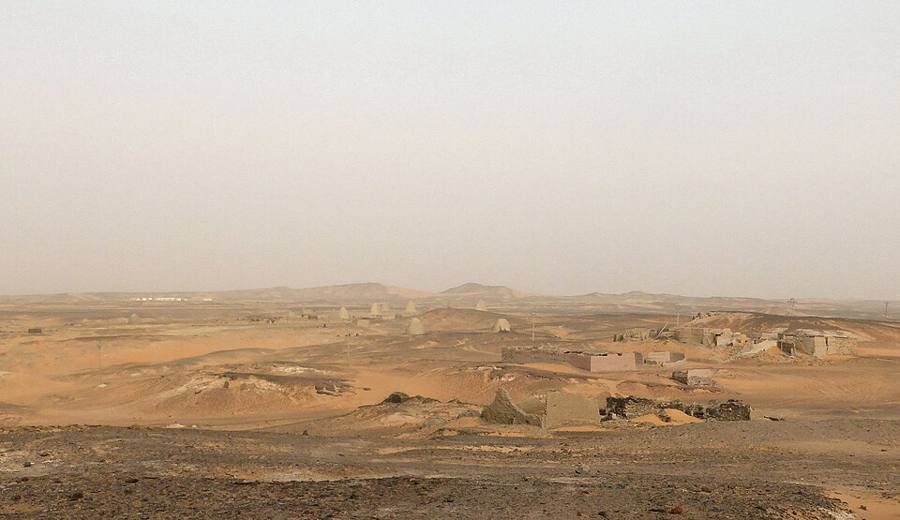
Credit: Hans Birger Nilsen, via Wikimedia Commons (CC BY-SA 2.0)
Archaeologists in northern Sudan have reached the floor of a giant medieval church for the first time. The building is called the Great Church of Jesus. It stands in Old Dongola, the old capital of a Christian African kingdom called Makuria. The team says the church was about 154 feet wide and 187 feet long, and it may have stood close to 70 feet tall. Its leader says that makes it bigger than the White House. Most of it is still buried, and that is what has people talking.
The work is led by Professor Artur Obłuski. He directs the Polish Centre of Mediterranean Archaeology at the University of Warsaw. His team digs with Sudan's National Corporation for Antiquities and Museums, the country's antiquities office. The University of Warsaw shared the new results on November 10, 2026. Science sites picked up the story in early November. The Associated Press then carried it to readers around the world, and it spread widely on X this week.
§ 1What the Team Found
During the latest dig season, the team uncovered a huge staircase that leads into the church. They also found buttresses, which are thick support walls, holding up the apse. The apse is the rounded end of a church, where the altar stood. Most important, the diggers finally reached the church's original floor. That is the ground where worshippers walked many centuries ago.
So far, they have reached that floor in only one spot, at the foot of the staircase. "The staircase is the only area where we have managed to reach the floor of the building," Obłuski said in the university's statement.
The walls around those stairs still stand about 36 feet high. That is roughly the height of a three-story house. It is good news, and it is also a problem. The walls are so well kept that the team has to dig much deeper than on a normal site.
"Paradoxically, and fortunately for world cultural heritage, as well as the heritage of Africa and Sudan, the greatest challenge in excavating the church is its remarkable state of preservation," Obłuski said.
§ 2How Big Was It?
The team's best numbers today are 47 meters wide and about 57 meters long. That is about 154 feet by 187 feet. They give a careful guess of 21 meters for the height, or about 68 feet. Archaeology magazine described that as more than six stories tall.
"This was a building larger than the famous White House in Washington, D.C., and we are planning to excavate it!" Obłuski said.
The size estimate has grown as the dig has grown. When the team first found the church in 2021, the university said it was about 26 meters wide, or about 85 feet. The apse alone was about 6 meters across, or nearly 20 feet. At that time, it was already the largest apse ever found in Nubia, the old name for the land along the Nile in southern Egypt and Sudan.
The team hopes to settle the full size soon. "Next season, we hope to finally resolve the question of the church's overall size," Obłuski said.
§ 3A Hidden Church Upstairs
The dig held a second surprise. The team found another, smaller church built into a structure added onto the side of the Great Church. This one sat on an upper floor. Its walls now stand only about three feet high.
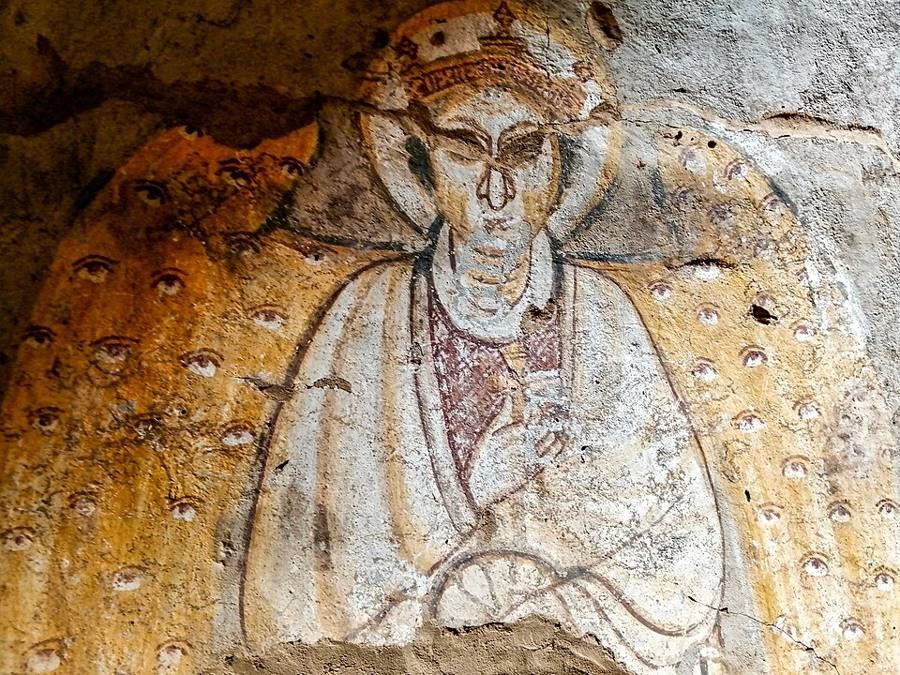
But its walls were once covered in paintings. Most of the painted plaster fell off long ago. The team gathered up the pieces from the rubble.
"We know that the paintings must have been magnificent," Obłuski said. "We now have six large shelving units filled with fragments of painted plaster."
Some of those pieces carry writing in Greek. Dr. Agata Deptuła is the team's expert on old writing. She says the words come from biblical odes. These are prayer songs that were added to the Book of Psalms.
One piece holds part of the Prayer of Hannah. In the Old Testament, Hannah is the mother of the prophet Samuel. Her prayer is a song of thanks after the birth of her son.
The letters are tiny. Deptuła said they were written "in a careful book hand, with very small letters only about half a centimeter high." That is about the width of a pencil eraser. She added that psalms are the Bible texts found most often at Old Dongola. The odes are a new find for the site.
Credit: Tanjagari, via Wikimedia Commons (CC BY-SA 4.0)
§ 4A Lost Christian Kingdom on the Nile
Many readers have never heard of Makuria. That is part of what makes this story so striking.
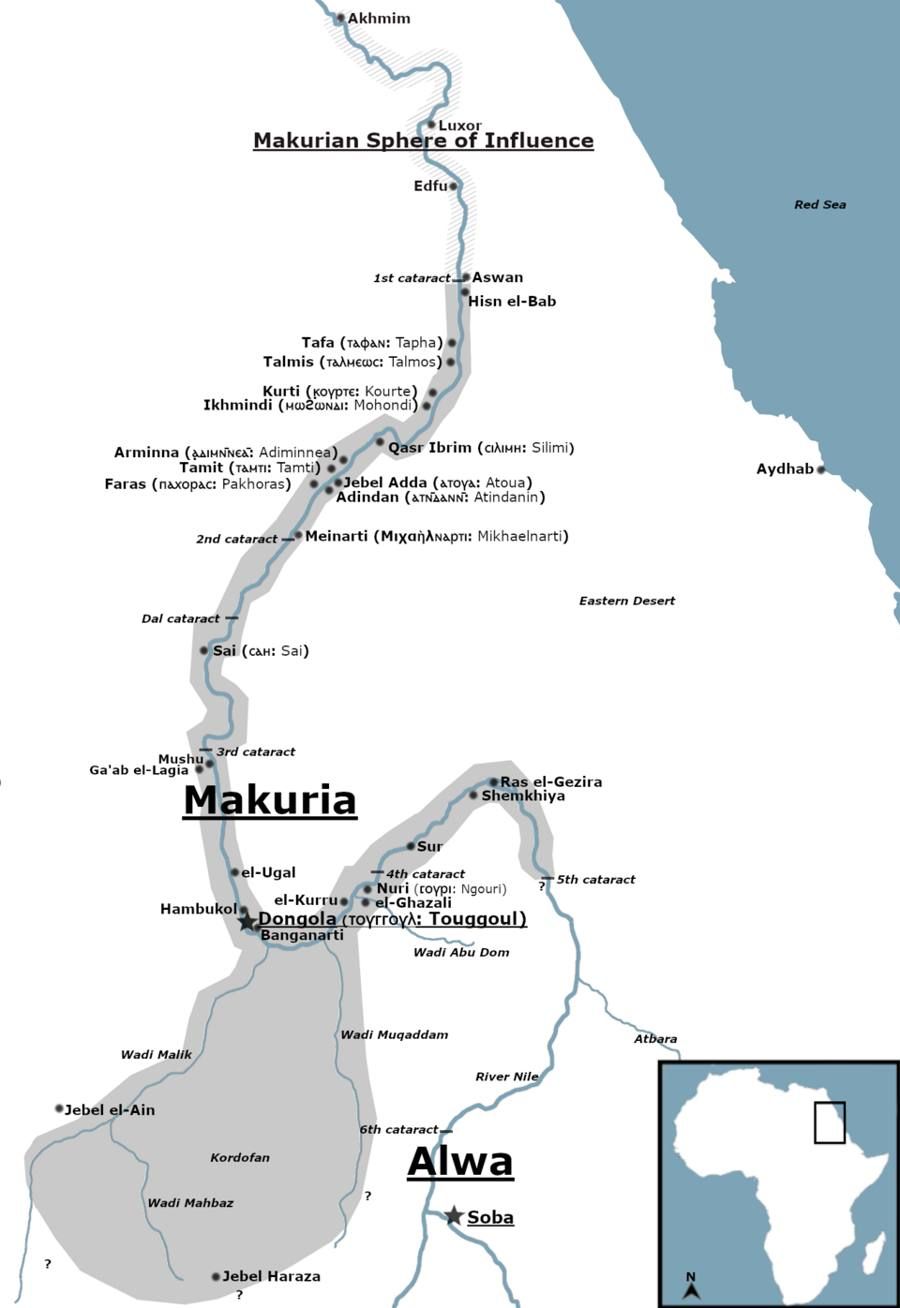
After the old Kingdom of Kush faded in the fourth century, three kingdoms rose along the Nile in what is now Sudan. Nobadia was in the north. Alwa, also called Alodia, was in the south. Makuria sat in the middle, with its capital at Dongola on the east bank of the river. That is according to an EBSCO reference article on Makuria.
Makuria became Christian in the sixth century. The same reference says a writer of that time, John of Biclarum, recorded its conversion in about the year 570. Sometime in the seventh century, Makuria and its northern neighbor joined into one kingdom. Dongola stayed the capital.
Credit: LeGabrie, via Wikimedia Commons (CC0, public domain dedication)
Then came a famous turning point. Arab armies took Egypt starting in 639 and pushed up the Nile. They attacked Makuria and laid siege to Dongola. The fighting was heavy on both sides. In 652, the king of Makuria and the Muslim rulers of Egypt made a deal known as the Baqt.
The Baqt was a peace and trade agreement. The EBSCO article says it protected Makuria as an independent, non-Muslim kingdom. It calls that "an event without precedent in early Islamic history." The deal is believed to have shaped relations between the two sides for about six centuries. During that time, a rich Nubian Christian culture grew along the Nile.
UNESCO, the United Nations' culture agency, lists Old Dongola on Sudan's "Tentative List" for possible World Heritage status. It has been on that list since 1994. UNESCO describes Dongola as the capital of Makuria from the seventh to the fourteenth century. It notes that the site has many churches, houses and mosques, and walls with "very fine frescoes," or wall paintings.
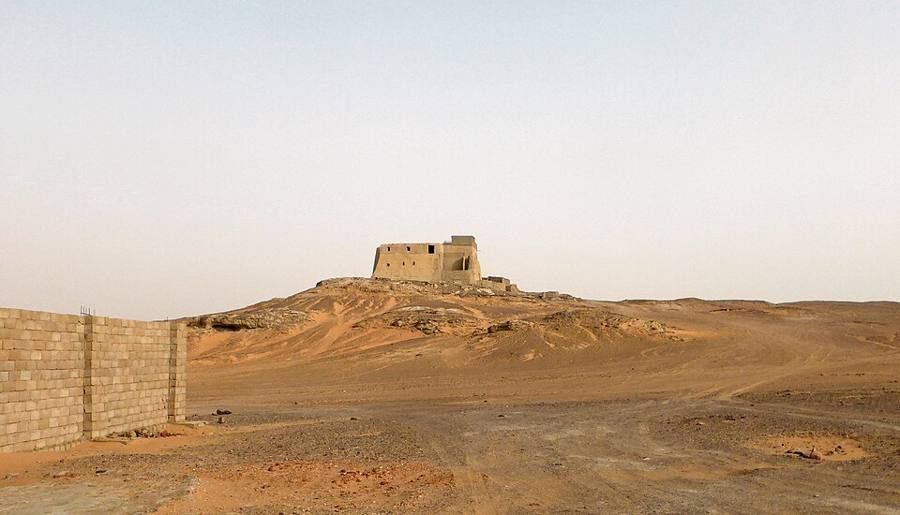
The University of Warsaw says the city covered about 200 hectares, or nearly 500 acres. The church sits in the middle of the old citadel, the city's fortress. A wall about 33 feet high and 16 feet thick surrounded that citadel. Inside were churches, a palace and large homes for church and state leaders. "The heart of the whole kingdom was beating there," the university wrote in 2021.
Credit: Hans Birger Nilsen, via Wikimedia Commons (CC BY-SA 2.0)
§ 5The Real Cathedral?
Here is where the open questions begin. For a long time, experts believed a different church was Dongola's cathedral. A cathedral is the home church of a bishop. That other church stands outside the city walls.
The new finds point another way. The University of Warsaw now calls the Great Church of Jesus "the largest and wealthiest church in medieval Nubia, according to the Arabic sources." Archaeology magazine says it likely served as the seat of the Bishop of Dongola. It calls that bishop "one of the most senior Christian figures in medieval sub-Saharan Africa."
"We will probably have to revise our understanding of the role of that building and ask what its actual function was, if it was not a cathedral," Obłuski said of the older church.
Back in 2021, the team went further. It said the new building "may have been the seat of an archbishop" who ran the church over more than 600 miles of the Nile. That idea is still a hypothesis. The team said at the time that proving it "will have significant consequences" for the study of Nubia.
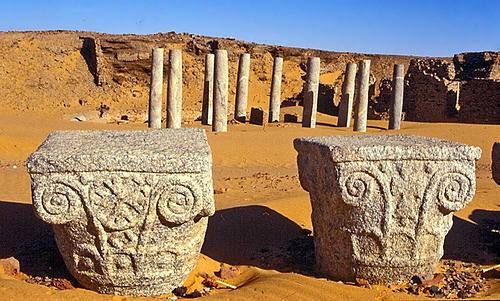
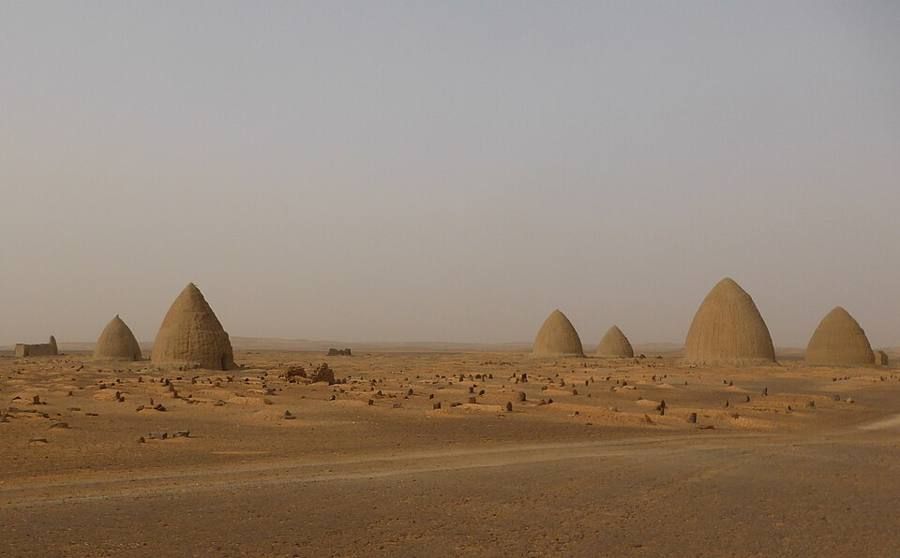
The team also pointed to a match with Faras, another great Nubian church site. Polish archaeologists led by Professor Kazimierz Michałowski found the cathedral at Faras about 60 years before. At Faras, a domed tomb of a bishop named Joannes stood beside the cathedral. At Dongola, a large domed tomb also stands next to the church. But the Faras dome is about 5 feet across. The Dongola dome is five times larger, at about 25 feet.
Credit: Lucio A, via Wikimedia Commons (CC BY-SA 3.0)
§ 6A Trendsetter Like Hagia Sophia
Obłuski has made a bold comparison. He likens the Great Church of Jesus to Hagia Sophia, the famous domed church in Istanbul, once called Constantinople.
"In the history of architecture, certain buildings emerge that, to use a modern term, become trendsetters," he said. "Hagia Sophia in Constantinople, modern-day Istanbul, is certainly one such example. The Great Church of Jesus appears to be a natural candidate for such a role in Nubia, and perhaps even in this part of Africa."
In plain words, he thinks other builders may have copied this church. Its floor plans and building methods may have spread across the region. That is his view based on the work so far. It has not yet been tested in a peer-reviewed paper.
§ 7A King, a War and a Painting
The Great Church may also tie into one of the most dramatic stories in Nubian history.
In 2023, the same team found a small, hidden room next to the church. It lay beneath the floor of a much later house. Its walls were covered with paintings. One scene shows a Nubian king bowing to Christ, who sits on a cloud. The king kisses Christ's hand. The Archangel Michael spreads his wings over them both.
The team said that scene "finds no parallels in Nubian painting." They found similar images only on Byzantine gold coins of the Emperor Michael Palaiologos, made between 1259 and 1282. A writing in Old Nubian, the old written language of the region, names a king called David several times. It also asks God to protect the city. The researchers think the city is Dongola and the painted king is King David of Makuria.
David ruled in the 13th century. He was one of the last Christian kings of Makuria. The team said that "for reasons unknown, King David attacked Egypt." Egypt struck back by invading Nubia. Dongola was sacked for the first time in its history. The team wondered whether the painting was made as the enemy army, the Mamluks of Egypt, closed in on the city.
Here is the twist. Arab writers said David's attack, which captured the Red Sea port of Aidhab and the Egyptian city of Aswan, was pushed by the Great Church of Jesus. That led the archaeologists to ask an exciting question. Did "the Archbishop of Dongola, much like Pope Urban II, incite King David to launch a crusade?" Pope Urban II is the church leader who launched the First Crusade in 1095.
That question is not answered. It is a possibility the team itself raised. Archaeology magazine named the King David find one of its Top 10 Discoveries of 2023.
§ 8A Legendary King Turns Out to Be Real
Old Dongola has been busy this year. In March 2026, three researchers from the same center published a paper in the journal Azania. They are Tomasz Barański, Artur Obłuski and Maciej Wyżgoł. The paper presents a short Arabic order written in the name of King Qashqash.
Before this, Qashqash was known only from brief mentions in a religious biography from the early 1800s. Many saw him as half legend. The University of Warsaw says the new document "confirms the existence of a ruler who had previously been considered semi-legendary." He likely ruled in the late 1500s or early 1600s, long after the Christian kingdom ended.
The order is simple. It tells a man named Khidr to exchange three units of cloth with a man named Muhammad al-Arab, for a ewe and her lamb. Barański said the note gives "a unique insight" into how the king shared goods and honor with his people.
The paper was found in a grand home that local people still call the "King's House." The team found silk, cotton and linen cloth there, as well as objects of ivory and rhino horn and more than 20 Arabic documents. The scribe's grammar was a little rough, and the paper is oddly shaped. Barański said the note may have been only a draft. Arabic was still new as a writing language there at the time.
Credit: Hans Birger Nilsen, via Wikimedia Commons (CC BY-SA 2.0)
§ 9Digging Through Floods and War
None of this work has been easy. In the autumn of 2024, Old Dongola saw its worst flooding since 1988. The flood damaged some of the roofs that protect the ruins. So the team first did repair and safety work with the Warsaw University of Technology.
Sudan is also at war. Fighting began in April 2023. IFLScience reports that UNESCO estimates more than 100 cultural sites have been damaged, looted or destroyed since then. Old Dongola has stayed out of harm's way so far, the outlet said.
The war has hurt the people who live near the site, too. The team finished a solar power system paid for by Poland's foreign aid program. It runs big pumps that bring Nile water to the homes and fields of about 10,000 people. The team also set up eight booster stations so water can reach homes on higher ground. "As a result of the ongoing conflict in Sudan, their residents had been left without access to water," Obłuski said.
The team also runs training for local people on why the site matters and how to protect it. Local residents formed their own group to help guard it. During the holy month of Ramadan, team members shared an iftar, the evening meal that breaks the daily fast, with their neighbors.
Polish archaeologists have worked in the Dongola area since 1964. The current work is part of a project called "Afropolis Tungul." Tungul is the Old Nubian name for Dongola. The European Research Council is funding the project with almost 2 million euros over five years, starting in January 2024. It aims to tell the life story of the city from the fourth to the fifteenth century.
§ 10What Is Confirmed and What Is Not
Here is what the team has confirmed. The Great Church of Jesus exists at the heart of Old Dongola. It is huge. Its walls near the stairs still rise about 36 feet. The team has reached its original floor in one place. A second painted church sat on an upper floor next to it, with Greek prayer songs on its walls.
Several big ideas are still unproven. The final size is not known yet, and the 21-meter height is a careful guess. The claim that it was the kingdom's cathedral is strong but still being tested. The archbishop idea, the Hagia Sophia trendsetter idea and the crusade question are all open. The university's November report is a news statement, not a peer-reviewed study. It does not give a date for when the church was built.
Sudan's antiquities office supports digging out the whole church. The university says it could one day become a major draw for visitors to the region.
For now, a cathedral larger than the White House waits under the sand of northern Sudan. It belonged to a Christian African kingdom that kept its freedom for centuries and painted its kings beside angels. Each new season brings up more of its walls, its words and its questions. The answers may change what the world knows about medieval Africa.
Watch & Listen
Hear this entry read aloud. Coming soon — the channels are not live yet.
Sources
- University of Warsaw, "The largest church in medieval Nubia" (November 10, 2026). en.uw.edu.pl
- Associated Press, "A hidden cathedral floor emerges in Sudan, revealing one of the biggest medieval churches" (November 2026). apnews.com (this site blocks automated link checks with HTTP 403, likely bot blocking)
- IFLScience, "Deep In The Sudan Desert, A Vast Medieval Cathedral Is Slowly Emerging From The Sand," by Tom Hale (November 4, 2026). iflscience.com
- Archaeology magazine, "Archaeologists Uncover Original Floor of Nubia's Largest Medieval Cathedral" (November 9, 2026). archaeology.org
- Polskie Radio English Section, "Polish archaeologists uncover further parts of medieval church in Sudan" (November 5, 2026). polskieradio.pl
- University of Warsaw, "Discovery of the remains of the largest church in Old Dongola" (May 28, 2021). en.uw.edu.pl
- University of Warsaw, "Unique wall paintings discovered in Old Dongola" (May 31, 2023). en.uw.edu.pl
- Science in Poland (PAP), "Archaeologists discover 'unique' paintings in Old Dongola" (April 24, 2023). scienceinpoland.pl
- Archaeology magazine, "A Painted Prayer," Top 10 Discoveries of 2023 (January/February 2024). archaeology.org
- University of Warsaw, "The existence of the king confirmed by the UW researchers" (2026). en.uw.edu.pl
- Barański, Obłuski and Wyżgoł, "The King of Nubia at work," Azania: Archaeological Research in Africa (2026). tandfonline.com (this site blocks automated link checks with HTTP 403, likely bot blocking)
- EBSCO Research Starters, "Makouria," by Cassandra Lee Tellier (2022). ebsco.com
- UNESCO World Heritage Centre, Tentative Lists, "Old Dongola". whc.unesco.org
Read next
More in Ancient Civilization
Frozen Inca Mummies Reveal What Children Were Given Before Mountaintop Sacrifices
More than 500 years ago, Inca priests led children up some of the highest volcanoes in the Andes. There, the children were sacrificed to the mountain gods. Now, a new lab study of eight frozen mummies shows what those children were given in their final weeks. Every hair sample tested held traces of coca, the sacred leaf. Some children also drank alcohol. One famous girl, known as Juanita, carried a chemical tied to ayahuasca, a drink made from an Amazon vine. The results suggest the ritual was not the same everywhere. Each mountain may have had its own recipe.
More in Ancient Civilization
A Steppe Lord's Giant Tomb in Mongolia Held a Glass Cup That May Have Come From Rome
Deep under a pine forest in eastern Mongolia, archaeologists have finished digging the largest tomb of the Xiongnu ever found in that country. The Xiongnu were horse-riding nomads who built an empire about 2,000 years ago. At the bottom of the tomb, about 48 feet down, lay a clear glass cup with a handle. The team thinks it may have been made in the Roman Empire, thousands of miles to the west. Next to it were carved jade pieces in a Chinese style and silver horse gear like pieces found in Korea. Together, the finds hint at how far one steppe noble's world reached.
On the front page
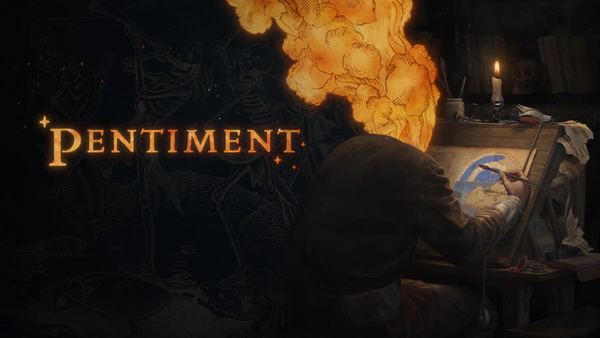
Pentiment Review: A Murder Mystery Painted Like a Medieval Book
Pentiment is a murder mystery that looks like an old, hand-painted book come to life. You play an artist in a small Bavarian town in the 1500s. A rich man is killed, your friend is blamed, and you have only a few days to find the truth. The game came out four years ago this week, on November 15, 2022. It won a Peabody Award, and it is still one of the most charming games you can play.