Ancient Civilization
A Steppe Lord's Giant Tomb in Mongolia Held a Glass Cup That May Have Come From Rome
By Darrell Wallen
Would you prefer to listen?
Deep under a pine forest in eastern Mongolia, archaeologists have finished digging the largest tomb of the Xiongnu ever found in that country. The Xiongnu were horse-riding nomads who built an empire about 2,000 years ago. At the bottom of the tomb, about 48 feet down, lay a clear glass cup with a handle. The team thinks it may have been made in the Roman Empire, thousands of miles to the west. Next to it were carved jade pieces in a Chinese style and silver horse gear like pieces found in Korea. Together, the finds hint at how far one steppe noble's world reached.
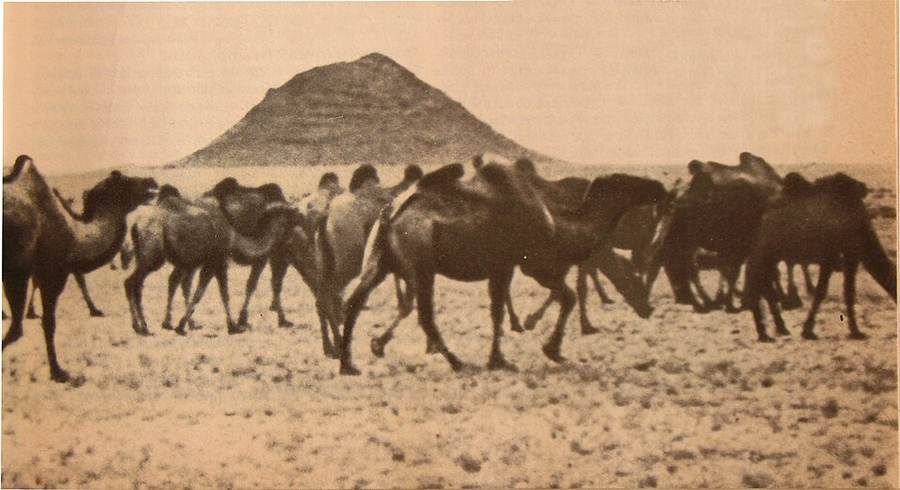
Credit: P. K. Kozlov / Vokrug Sveta, via Wikimedia Commons (public domain)
§ 1What was found
The National Museum of Korea announced the results on November 6, 2026. Its team worked with two Mongolian partners. They are the Institute of Archaeology of the Mongolian Academy of Sciences and the National Museum of Mongolia. The dig took four years. It began in 2023.
The grave is called Tomb No. 160. It sits in a cemetery called Duurlig Nars. The cemetery lies near the south bank of the Onon River, in Khentii Province. Live Science covered the find on November 18, and Archaeology magazine reported it on November 12.
The museum calls Tomb No. 160 the largest Xiongnu burial identified in Mongolia. With its long entrance ramp on the south side, it runs about 240 feet, or 73 meters. Live Science compared that to the length of the Great Sphinx of Giza.
The builders did not simply pile up a mound. According to the museum, they cut the ground down in steps. Then they filled the hole with nine separate layers of stone. The team removed all nine layers, one at a time, down to about 14.5 meters, or 48 feet. Live Science described the shape as "a kind of inverted pyramid," a pyramid turned upside down and sunk into the earth.
The museum said the team found 413 artifacts in the center of the tomb. It also said this is the first time objects of such quality have been found in eastern Mongolia.
Some numbers changed as the work went on. In July, the Korea Times reported an estimate of about 88 meters long and 18 meters deep. A UNESCO review document also gave 88 meters. The figures in the November announcement are 73 meters and 14.5 meters. The museum has not explained the change in the reports we found.
§ 2A small room under a giant roof
Here is the first surprise. The tomb is huge on the outside. But the room for the body was small and shallow.
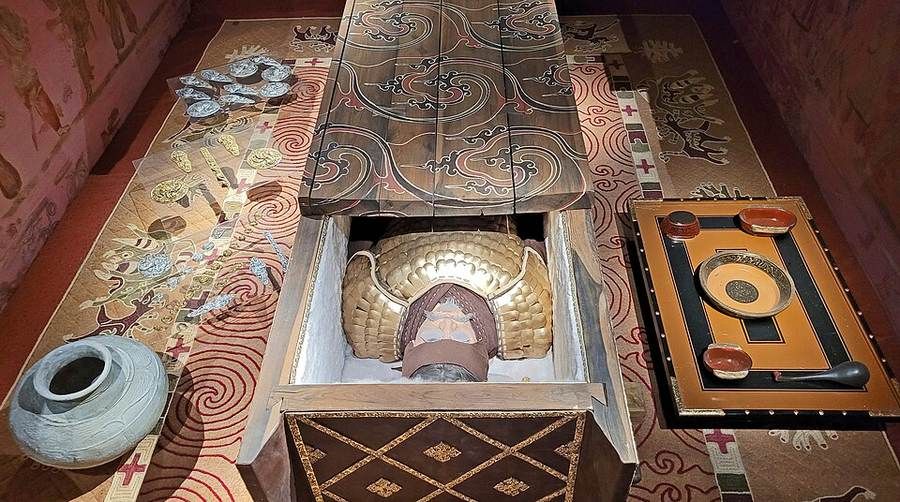
Credit: Bernard Gagnon, via Wikimedia Commons (CC0 public domain)
The museum said the central chamber holds an inner coffin. Two layers of wooden outer coffins wrap around it. Similar Xiongnu tombs in central Mongolia go down as far as 22 meters, or about 72 feet. This one stopped at 14.5 meters. The team saw the same pattern in a smaller grave nearby, which it studied in 2019.
What does that mean? The museum dates the tomb to the late first or second century A.D. That was a time when Xiongnu power was slowly fading. The museum suggests the smaller burial room may be a clue to changes in Xiongnu society at the time. That is the team's reading. It is not yet proven.
There was more above the coffin. The museum said a lacquered carriage was buried directly over the central chamber. Lacquer is a hard, shiny coating made from tree sap. Live Science reported that the team found a wheel from this carriage. A carriage like this marked a person of very high rank.
§ 3The glass cup
The find that has caught the most attention is a cup. It is clear glass and has a handle. Live Science reported that it was found broken.
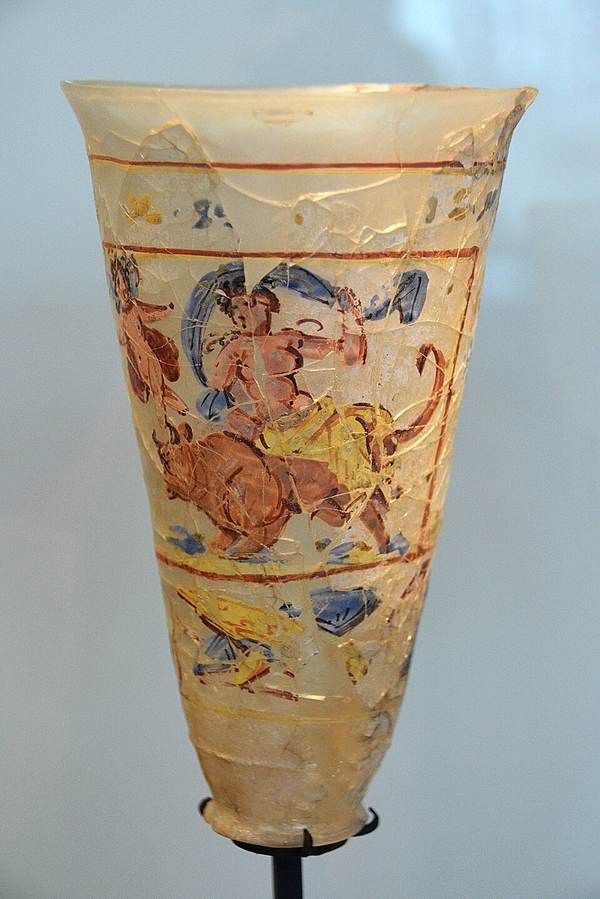
Credit: Carole Raddato, via Wikimedia Commons (CC BY-SA 2.0)
The museum said the cup may have been made inside the Roman Empire. Here the line between fact and idea matters. The cup is real, and it was found in the tomb. That part is confirmed. Its Roman origin is a possibility. The team plans to test what the glass is made of, so it can find out where the cup was made. Until those results come back, "Roman" is a working idea, not a final answer.
Why would that matter? Rome sat at the far western end of the known world, and Mongolia near the far eastern end. Goods passed from hand to hand along routes we now call the Silk Roads. A Roman cup in a Mongolian grave would be a striking sign of that long chain.
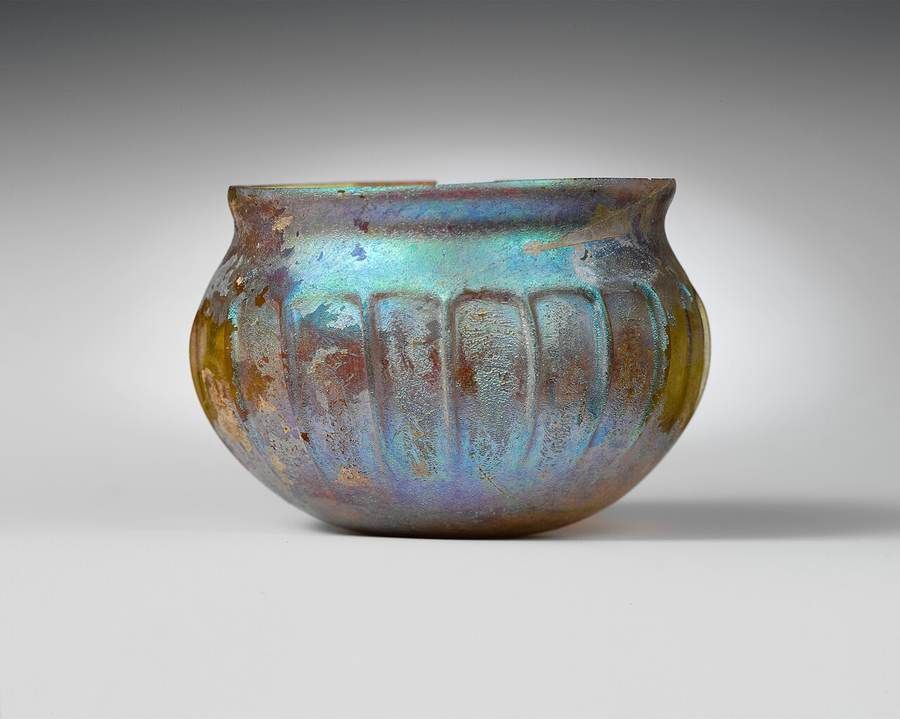
It would not be the first time. At another Xiongnu cemetery called Gol Mod II, in central Mongolia, archaeologists found a glass bowl that UNESCO's photo files label "Roman glass." A paper on the Gol Mod II digs describes it as deep navy blue with white stripes. It is about 6 centimeters tall and held about 250 milliliters, roughly a cup. The paper says it was found in a smaller grave next to a great noble tomb. A radiocarbon date from that noble tomb fell between about A.D. 40 and 80.
The same paper compares a broken pink cup from Gol Mod II to a Roman cup kept at a museum in Bonn, Germany. So the new cup joins a small set of glass that may have crossed all of Asia.
Credit: The Metropolitan Museum of Art, via Wikimedia Commons (CC0 public domain)
§ 4Jade from the Han world
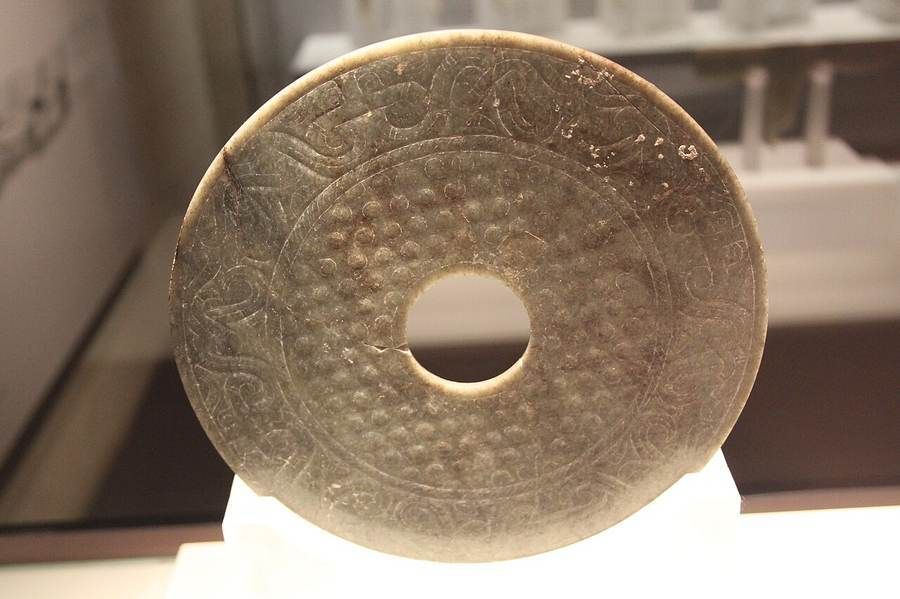
On the floor of the coffin, the team found 15 pieces of jade. They were laid flat and overlapping, like shingles.
The museum said the pieces were modeled on the "bi" disc. A bi is a flat jade ring with a hole in the middle. It was used in burials in China during the Han dynasty. The Han dynasty began around 200 B.C. and was the second imperial dynasty of China.
But these pieces are not plain copies. The museum said their shapes are uneven, not round. Their surfaces carry very fine carved designs. The team believes the Xiongnu borrowed the Han way of burying the dead, then changed the form to suit themselves.
Credit: Gary Todd, via Wikimedia Commons (CC0 public domain)
§ 5Silver and gold that glow
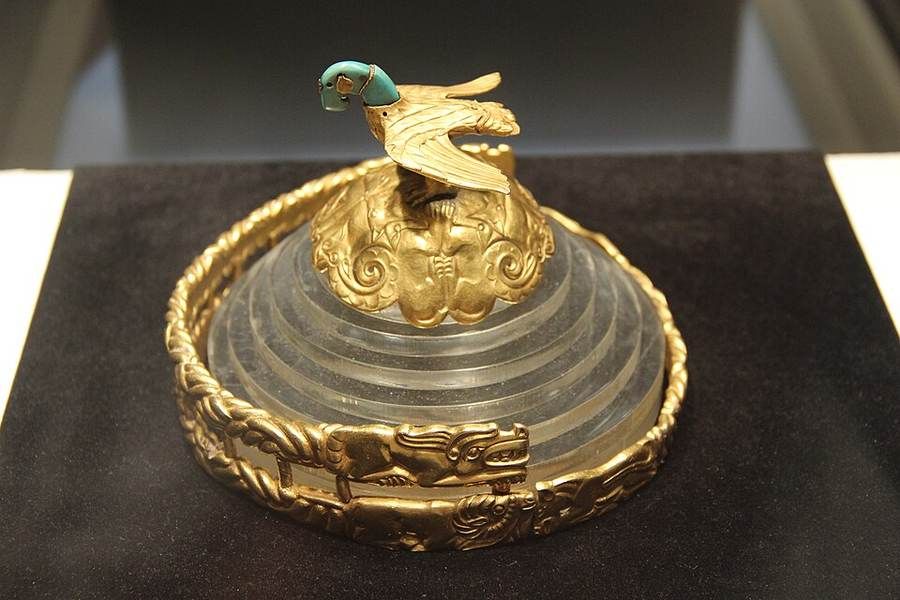
The museum singled out one object as the most notable. It is a pendant that hung from a horse's harness. A craftsman hammered a thin sheet of silver into the shape of a gourd. A clear crystal is set in the middle.
The museum said the pendant looks much like ones found in tombs of Lelang, also called Nangnang. Lelang was a Han-run district in what is now Pyongyang, North Korea. One close match comes from Tomb No. 219 at Seogam-ri in Pyongyang. That piece is held by the National Museum of Korea. It is set with agate, a banded red stone, instead of crystal.
Next to the silver pendant was a round gold ornament. Under its crystal, the maker placed gold leaf and red and blue material. Light passing through the clear stone would make the colors glow softly. The museum said ornaments like these have never before been found in a Xiongnu tomb.
Credit: Gary Todd, via Wikimedia Commons (CC0 public domain)
§ 6"From Rome to the Korean Peninsula"
The museum put its view of the finds plainly. "This excavation clearly shows that the Xiongnu of 2,000 years ago were linked to a broad exchange network reaching from Rome to the Korean Peninsula," the museum said, as translated by the Seoul Economic Daily. The paper notes that its English version was translated by machine from Korean.
Korea has a reason to care. The museum has studied the Mongolian steppe since 1997. It says knowing the Xiongnu helps explain how early Korean culture took shape. The Korea Times reported that the joint team has worked at Duurlig Nars since 2006 and has carried out 13 dig seasons there.
§ 7Who was buried here?
Nobody knows yet. The museum has not said whether the person was a man or a woman, or how old they were.
There may be an answer coming. The team recovered teeth and hair from inside the coffin. The museum said DNA tests could show the person's sex and age. They could also show whether the person was related to the people in the smaller "satellite" graves around the tomb. That could paint a much clearer picture of how Xiongnu families and ranks worked.
A UNESCO review document mentions an earlier result from this same cemetery. It says genetic tests on a man from one of the satellite graves showed "a distant Brahman lineage," meaning ancestry tied to South Asia. UNESCO's reviewers said this was evidence that Xiongnu politics and diplomacy reached across huge parts of Eurasia.
§ 8Who were the Xiongnu?
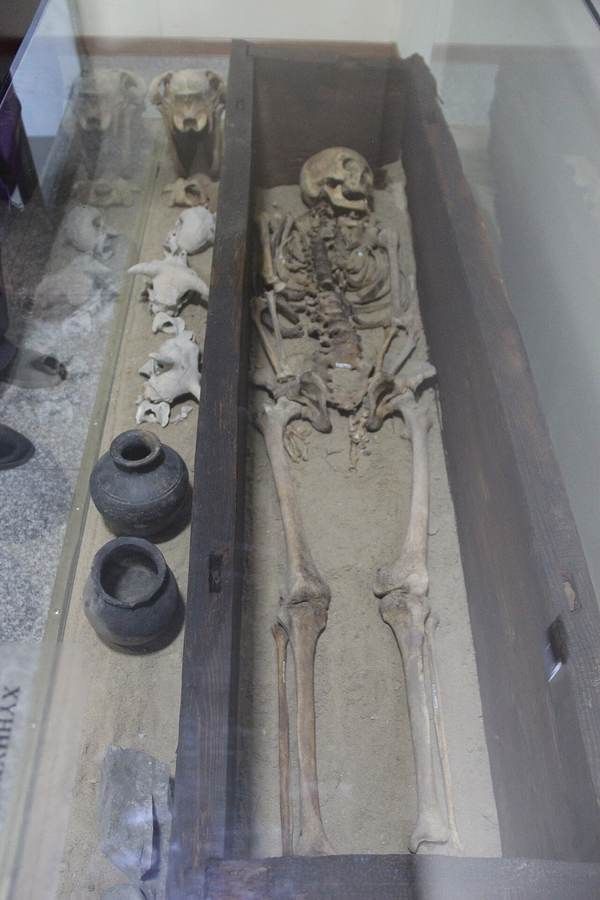
The Xiongnu left almost no writing of their own. Much of what we know comes from their graves and from Chinese records. The most famous is chapter 110 of the Shiji, or "Records of the Grand Historian." The historian Sima Qian wrote it around 100 B.C.
Credit: Gary Todd, via Wikimedia Commons (CC0 public domain)
Historian Étienne de la Vaissière tells the early story in the Encyclopaedia Iranica. The Qin dynasty of China sent a general named Meng Tian to push the Xiongnu north. Then, in 209 B.C., the tribes came together again under a leader named Maodun, also spelled Modu. Maodun beat the Han emperor Gaozu. He forced the emperor to sign a treaty in 198 B.C. that the encyclopedia calls humiliating.
The balance shifted later. Han armies drove the Xiongnu north of the Gobi Desert in 121 and 119 B.C. In A.D. 48, the Xiongnu split into a Southern and a Northern group. China later chased the Northern Xiongnu out of Mongolia. By A.D. 91, their ruler had fled west to the Ili valley in Central Asia.
UNESCO describes the Xiongnu as a powerful empire that lasted from the third century B.C. to the second century A.D. It says they dealt with Han China and controlled key points along the steppe route of the Silk Roads. Tomb No. 160 was built near the end of that span.
§ 9A new World Heritage site
The tomb sits inside a site that the world only just put on its heritage list. In July 2026, UNESCO's World Heritage Committee met in Busan, South Korea. It added "The Cemetery Complexes of the Xiongnu Nobility" to the World Heritage List.
The listing covers eight parts spread over six cemeteries across Mongolia. Duurlig Nars is one of them. UNESCO's review says the cemetery was discovered in 1974. It holds about 300 tombs, about 80 of them for nobles. It is the biggest Xiongnu cemetery in Mongolia.
UNESCO's statement says the tombs "highlight the engineering and organisational skills of this mainly nomadic culture." It also warns about grave robbers. Of the 39 Xiongnu tombs dug in the listed sites, 38 had been disturbed. UNESCO says even the looted tombs still teach a great deal.
Mongolia's leaders are paying attention. The museum said President Ukhnaa Khurelsukh visited the dig on August 21. It said that was the first time a Mongolian president had visited a dig site in person.
§ 10The Hun question
Live Science's story about the tomb notes that some Xiongnu were ancestors of the Huns. The Huns are the riders who burst into Europe in the A.D. 370s. Whether the Huns came from the Xiongnu is one of the oldest debates in the study of the steppe. Both sides have strong points.
The link has deep roots. According to the Encyclopaedia Iranica, a scholar named de Guignes first proposed in 1758 that the two peoples were the same. Later, an early letter from a Sogdian merchant came to light. It dates to the year 313. It described "Xwn" raiders sacking the Chinese city of Luoyang. Chinese records name the Xiongnu for that same attack. In 1948, a scholar named Henning treated this as strong evidence for the link.
Then came the doubts. Historian O. Maenchen-Helfen argued several times that the two groups were not related. He used both digs and close reading of old texts. The encyclopedia says his caution "has in the main prevailed" among many scholars. But de la Vaissière himself argues the other way. He says the Huns were a mix of many peoples, but that their political identity can still trace back to the Xiongnu.
DNA has now joined the debate. In 2025, a team led by researchers at the Max Planck Institute for Evolutionary Anthropology in Germany published a study in the journal PNAS. They studied the genes of 370 people. The people lived across about 800 years, in Mongolia, Central Asia and Central Europe.
The results gave something to each side. The team found no large community of East Asian or steppe ancestry among people in Hun-era Central Europe. They said the newcomers were of mixed origin. But a few Hun-period people in Europe shared long stretches of DNA with some of the highest-ranking Xiongnu elites. The study says this shows that "some European Huns descended from them."
"It came as a surprise to discover that few of these Hun-period individuals in Europe share IBD links with some of the highest-ranking imperial elite individuals from the late Xiongnu Empire," co-first author Guido Alberto Gnecchi-Ruscone said in a Max Planck release. IBD means stretches of DNA shared because two people have a common ancestor.
Co-first author Zsófia Rácz of Eötvös Loránd University in Budapest put it another way. "DNA and archaeological evidence reveal a patchwork of ancestries, pointing to a complex process of mobility and interaction rather than a mass migration," she said.
So the answer, for now, is "some." Some Huns had Xiongnu elite ancestors. Most did not. How much of the Xiongnu world rode west is still open, and each new elite Xiongnu genome adds to the picture.
§ 11What is confirmed and what is not
Confirmed by the dig team: Tomb No. 160 has been fully dug. It is about 73 meters long and 14.5 meters deep, filled with nine layers of stone. It held 413 artifacts, including the glass cup, the 15 jade pieces, the silver pendant and the gold ornament.
Not yet confirmed: the cup's Roman origin, which awaits lab tests. The idea that the small burial room reflects a fading empire is the team's reading. Who was buried there is unknown until DNA results come in.
§ 12What comes next
The artifacts will travel to South Korea by the end of the year. There, experts will clean, protect and study them. The museum said two Mongolian researchers will take part as trainees in that conservation work.
The team recorded the whole dig in 3D. The museum plans to turn those records into digital content. That way, people who cannot travel to the pine forest by the Onon River can still see inside the tomb.
The results were first presented at the 50th national meeting of the Korean Archaeological Society, held in Gangneung on November 6 and 7. A full excavation report will follow after more study.
§ 13The bottom line
A Xiongnu noble was laid to rest almost 2,000 years ago under nine layers of stone in a Mongolian forest. With them went a carriage, Chinese-style jade, Korean-style silver and a glass cup that may have come all the way from Rome. The tomb shows a world that was connected long before planes or phones. Lab tests and DNA will soon tell us more about the cup and the person buried with it. Until then, the tomb at Duurlig Nars leaves an open question about just how far the people of the steppe could reach.
Watch & Listen
Hear this entry read aloud. Coming soon — the channels are not live yet.
Sources
- National Museum of Korea, press release (in Korean), "30 years of Korea-Mongolia joint excavation: Eurasian exchange found in the largest Xiongnu tomb of 2,000 years ago," November 6, 2026. museum.go.kr
- Choi Soo-moon, "From Rome to the Korean Peninsula: Inside a Xiongnu Imperial Tomb," Seoul Economic Daily, November 6, 2026 (machine-translated from Korean by the publisher). en.sedaily.com
- Kristina Killgrove, "2,000-year-old tomb of an elite nomad in Mongolia contained a Roman glass cup and Han-dynasty-inspired jade decorations," Live Science, November 18, 2026. livescience.com
- "Monumental Mongolian Tomb Excavated," Archaeology magazine, November 12, 2026. archaeology.org
- "Fruit of 30 Years of Korea-Mongolia Joint Excavation: Evidence of Exchange Found in Xiongnu Tomb Unveiled for the First Time," SBS News. news.sbs.co.kr
- "Korea-Mongolia research leads to UNESCO recognition of Xiongnu noble tombs," The Korea Times, July 27, 2026. koreatimes.co.kr
- UNESCO World Heritage Centre, "The Cemetery Complexes of the Xiongnu Nobility." whc.unesco.org
- UNESCO World Heritage Committee, Decision 48 COM 8B.22. whc.unesco.org
- UNESCO, evaluation document, "Cemetery Complexes of the Xiongnu Nobility (Mongolia)." whc.unesco.org
- UNESCO, "Roman glass (Satellite Grave in Xiongnu Noble Tomb 1 at Gol Mod II site)." whc.unesco.org
- "Material cultural heritage of the Xiongnu Empire," CyberLeninka. cyberleninka.ru
- Étienne de la Vaissière, "Xiongnu," Encyclopaedia Iranica, 2006. iranicaonline.org
- Gnecchi-Ruscone, G. A., et al., "Ancient genomes reveal trans-Eurasian connections between the European Huns and the Xiongnu Empire," PNAS, 2025. pnas.org (returns 403 to automated checks, likely bot blocking)
- Max Planck Society, "Origin and diversity of Hun Empire populations," February 24, 2025. mpg.de
- "Ancient DNA reveals mysterious origins of the Huns who sacked Rome," Live Science. livescience.com
Read next
More in Ancient Civilization
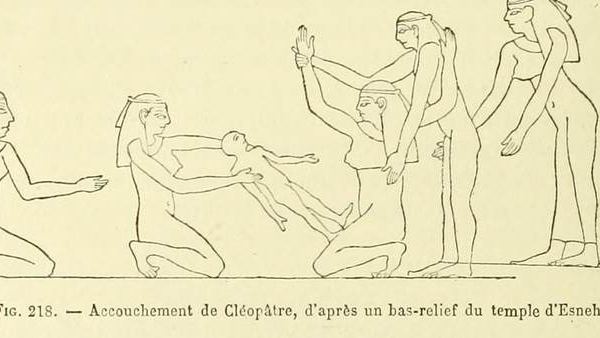
Did Women Always Give Birth Lying Down? A Post on X Sends Readers Back to Ancient Egypt
For most of the human story, women did not give birth flat on their backs. They knelt, squatted, sat on stools or stood on bricks. A post on X this week by the science account @ShiningScience put that history back in front of readers. It says lying down only became normal after doctors decided it suited them. The Ancient Sky checked the post against its own sources and the older records behind them. Much of it holds up. Some of it does not, including the most famous ancient picture in the story.
More in Ancient Civilization
Spaceships, Star Maps or Sacred Walks? The Many Theories Behind Peru's Nazca Lines
About 2,000 years ago, people in a Peruvian desert drew a monkey, a spider and a hummingbird so large that they are best seen from the sky. They left no writing to say why. For nearly a century, people have offered answers: a calendar of the stars, landing strips for visitors from space, balloon flights, maps of hidden water, and sacred walks. Now computers are finding hundreds of figures nobody knew were there, and the mystery keeps growing.

On the front page
Tesla Rolls Out FSD v15 as Italy Says Yes to Its Assisted Driving
Tesla says the new software handles dangerous moments 25 times better and redraws the road like a video game. A day earlier, Italy became the biggest European country to approve the system, with a driver still in charge.