Ancient Civilization
Noah's Ark Hunters Say Charred Wood From Turkey Is 4,300 Years Old
By Darrell Wallen
Would you prefer to listen?
A U.S. lab has dated two pieces of burnt wood dug from the Durupınar formation in eastern Turkey. The results put the wood at about 4,300 years old. Some people believe this boat-shaped hill is the resting place of Noah's Ark. That age lands right around a date many Bible readers give for Noah's Flood. The team behind the dig calls it a big step. Critics say old wood does not make an ark. Here is what is confirmed, what is claimed, and what comes next.
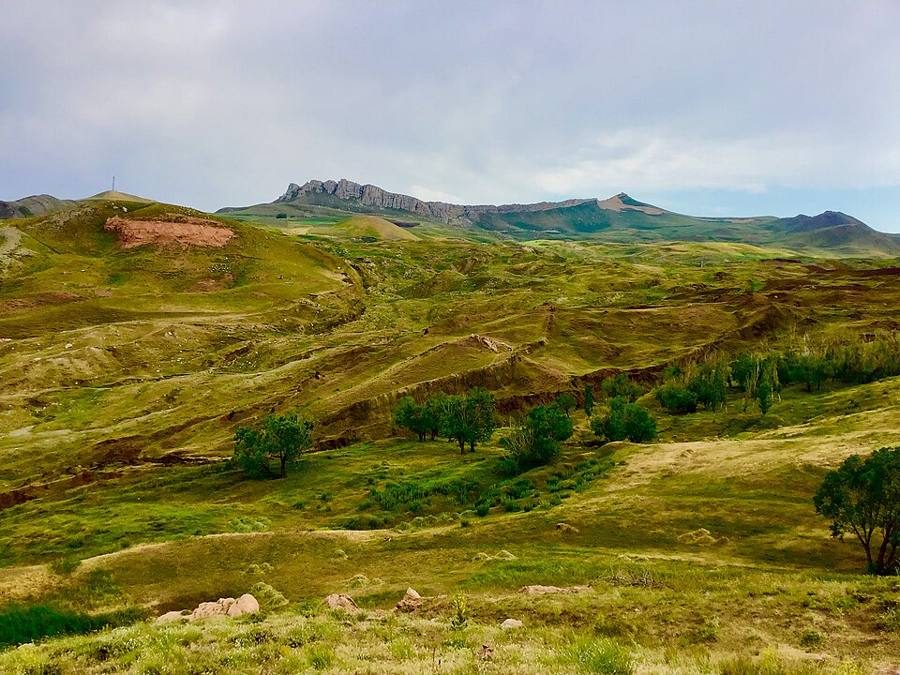
Credit: Wikkiwooki, via Wikimedia Commons (CC BY-SA 4.0)
The news broke on Saturday, November 21, 2026. Andrew Jones announced it on Fox News that morning. He founded Noah's Ark Scans, a crowdfunded group based in Vero Beach, Florida. The group supports the dig at Durupınar.
A few hours later, the group posted on X. "BREAKING: The Results Are IN!" the post began. It said both wood samples "date back to the exact same time period of Noah's Flood." By Sunday morning, that post had been seen more than 326,000 times. It had more than 11,000 likes and nearly 2,000 reposts.
Lauren Witzke, who runs marketing and fundraising for the group, went further. "This is truly the resting place of Noah's Ark," she wrote on X. Her post was seen more than 148,000 times.
Credit: Wikkiwooki, via Wikimedia Commons (CC BY-SA 4.0)
§ 1What the Lab Results Say
The two numbers come from radiocarbon dating. This test measures carbon-14, a kind of carbon that slowly fades away after a living thing dies. Scientists measure how much is left. That tells them roughly when the plant or animal stopped growing.
Graphics posted with the announcement name the lab as Beta Analytic, a private radiocarbon lab in the United States. That detail comes from the group's own graphics, as reported by the news site SachSuno. The lab itself has not made a public statement that we could find.
According to those graphics, the first sample, labeled "Ark Wood," came back at 2456 to 2203 BC. The second, labeled "Ark Wood 2," came back at 2446 to 2143 BC. Those are calibrated ranges. That means the lab turned the raw number into calendar years, and the true date most likely falls somewhere inside each window.
Both windows overlap 2348 BC. That is the Flood date worked out by Archbishop James Ussher in the 1600s. He built it by adding up the ages and generations listed in the Bible.
The project's lead archaeologist is Professor Cenker Atila of Sivas Cumhuriyet University in Turkey. He spoke to Turkish media on November 22. "According to the holy books, Noah's Flood occurred around 2300 BC," he said, in a translation published by Haberler. "Our carbon-14 dating fits exactly these dates." He called it "a very important and very interesting result."
Atila said the wood also went to labs in Switzerland and to TÜBİTAK, Turkey's national science agency. Those results are not back yet. "We will compare them all together and make a final evaluation," he said.
Here is what is confirmed so far. A charred piece of wood was found at the site. The group says a U.S. lab dated two samples to the late 2000s BC. What is not yet public is the full lab report itself. It would show the sample numbers, what was tested and how it was cleaned. No outside scientist has published a review of the find.
§ 2Where the Wood Came From
The wood was first announced in October. Atila said his team found charred, or burnt, fragments about 9 meters down. That is roughly 30 feet below the surface.
He told The Jerusalem Post the pieces came from the southern slope of the formation. He also said one piece looks like it was worked by people. "Its surface appears to have been slightly shaped and flattened using an axe or a knife," he said. "The fact that these wooden fragments were found at such a considerable depth indicates that they may belong to an ancient period."
Fox News Digital was the first American outlet to see photos of the wood, on November 10. The group's press release that day described the fragments as "darkened, cracked, and heavily charred," with visible grain and growth rings.
The group believes the burning may matter. Its October release noted that Genesis 6:14 tells Noah to cover the ark "within and without with pitch." Pitch and tree resin catch fire easily. The release suggested someone may have tried to burn the ark long ago. It also said lightning or volcanic activity could have done it. Either way, the group pointed out that charring slows rot in the ground. "It's possible that what was meant to desecrate the ark may have instead been the very thing that preserved it," the release said.
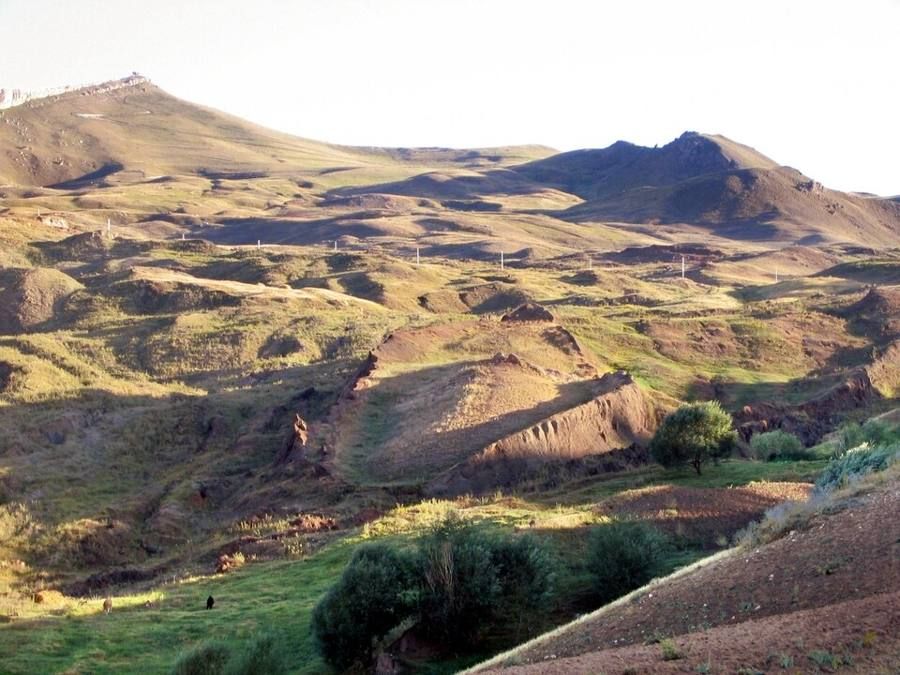
Credit: Mfikretyilmaz, via Wikimedia Commons (CC BY 3.0)
Credit: Mfikretyilmaz, via Wikimedia Commons (CC BY 3.0)
§ 3The Case the Team Is Building
The wood is only one part of this year's work. The 2026 season ran through the summer. About 20 researchers from five countries took part, according to Turkish reports. They used ground-penetrating radar, which sends radio waves into the ground and reads the echoes. They also drilled deep cores, long tubes of soil pulled up from below.
Jones told The Jerusalem Post the team drilled 12 holes inside the formation and four outside it. Some went down about 20 meters, or about 65 feet. In October, he said none of them hit bedrock. He said that would have been the sign of a natural rock formation.
The radar work was led by Dr. Khosrow Bakhtar, a longtime U.S. defense scientist who invented the system used at the site. He reported what he called organized patterns, chambers and corridors under the hill. He said his system was set up to hide natural rock signals. "This is the most significant finding of 45 years of my career," Bakhtar said, according to the group's October release. "It's not geologic related, because we masked all the geologic features."
Atila presented the findings in October at the 8th International Mount Ararat and Noah's Ark Symposium. Ağrı İbrahim Çeçen University hosted it. He said the radar shows a structure with three levels. "In our Holy Books, Noah's Ark had three levels," he told reporters. "In our radar studies, we also identified a formation with three levels."
Atila also said only about 20 percent of the radar data had been studied so far, according to Arkeonews. Soil samples from inside the hill went to several universities, including Bar-Ilan University in Israel. Jones told The Jerusalem Post a final report is expected next spring. The site is now closed for winter until the snow melts.
For supporters, the size of the hill is part of the pull. Genesis 6:15 gives the ark a length of 300 cubits. A cubit was an old measure based on the forearm. Using the royal Egyptian cubit, 300 cubits comes to about 515 feet. The project and Fox News describe the Durupınar formation as roughly 515 feet long. Genesis 8:4 also says the ark came to rest "upon the mountains of Ararat." Durupınar sits about 18 miles south of the summit of Mount Ararat.
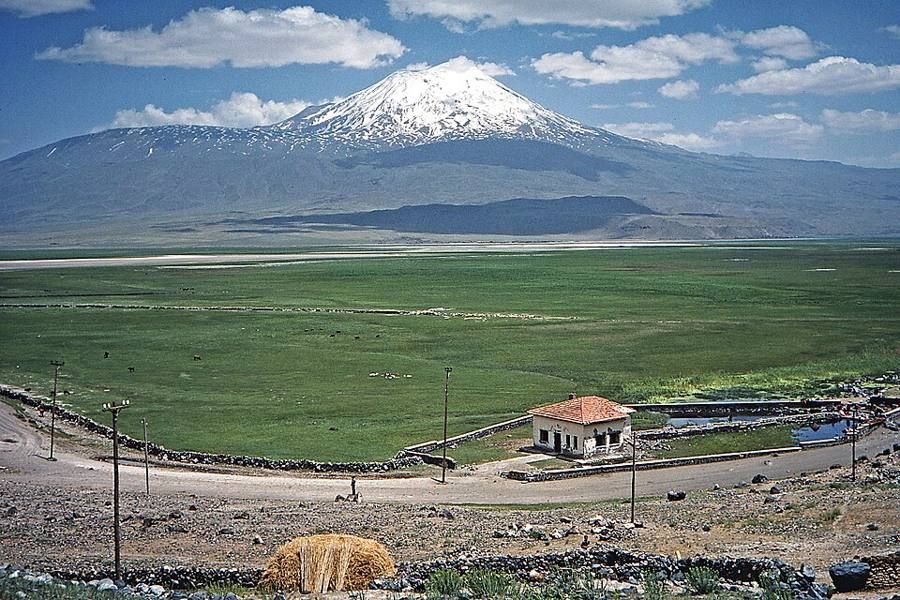
Credit: W. Bulach, via Wikimedia Commons (CC BY-SA 4.0)
Credit: W. Bulach, via Wikimedia Commons (CC BY-SA 4.0)
§ 4The Team's Own Caution
Even the people behind the dig have urged care. In October, Jones laid out both sides plainly. "It is possible that we have found the charred remains of Noah's Ark," he said. "But it's also possible that we have found the charred remains of a shepherd's campfire that he unwittingly decided to start while using the ark for shelter centuries ago."
After the new dates came in, Jones said much the same thing. Haberler reported that he called the 4,300-year age a match for some proposed Flood dates. But he also said it does not prove the structure is Noah's Ark.
The group's own graphic carries a small line that says the same. According to SachSuno, it reads: "Radiocarbon results date the tested charred material; they do not independently establish the site's identity."
SachSuno, citing the Noah's Ark Tracker website, reported that Atila told the Turkish outlet Ajans04 on November 19 that he did not rule out other sources for the wood. Those could include older settlements in the area, or natural events like earthquakes and landslides.
§ 5What Critics Say
Critics answered fast. The Freedom From Religion Foundation posted on X that "finding 4,000-year-old wood doesn't prove Noah's Ark existed." It called the project "biblical mythology masquerading as archaeology, complete with a donation link."
Another account, Gnosis Informant, asked how a worldwide flood in Turkey around 2400 BC would explain kangaroos reaching Australia.
SachSuno published the most detailed critique on November 22. Its main point is simple. Radiocarbon in wood shows when that tree ring grew. It does not show when the wood was cut, burned or buried. It also cannot show whether the wood was ever part of a boat. The site also pointed out that each date range spans about 250 to 300 years. So almost any date late in that period would look like a match.
Critics also point to the wider world at that time. The years around 2300 BC fall in Egypt's Old Kingdom, the age of the pyramid builders. They also fall in the time of Sargon's Akkadian empire in Mesopotamia, and the great Indus Valley cities. Those sites show people living there without a break, critics say.
The hill's surroundings matter too. Durupınar sits in an area of mudflows and landslide debris. Burnt wood from old fires or old villages can end up in that kind of ground. SachSuno quoted Jones telling Newsweek earlier this year that organic matter "accumulates naturally in soils and slope deposits." He said finding ancient wood "would not by itself establish human construction."
As for the radar, Arkeonews noted that natural layers and rock boundaries can also make shapes in radar images. It said Bakhtar's reading needs to be tested by independent experts.
§ 6A Long and Twisting History
Durupınar has drawn both believers and doubters for more than 60 years.
In 1959, a Turkish Army captain named İlhan Durupınar spotted it in an aerial photo during a mapping mission. The site carries his name.
A team surveyed it in 1960. After two days of digging and blasting, they found only soil and rocks. Their news release called it "a freak of nature and not man-made."
The site came back to life in 1977. That year, the amateur explorer Ron Wyatt began promoting it as the ark. In 1985, salvage expert David Fasold joined him. Fasold used radar and said he saw a regular structure inside.
Then Fasold changed his mind. In 1996, he and geologist Lorence Collins published a paper in the Journal of Geoscience Education. Its title called the site a "bogus" ark and "a common geologic structure." Collins wrote again in 2016. He said the "petrified wood" claimed at the site was really volcanic rock. He said the iron "rivets" were natural grains of magnetite, a magnetic mineral. In 2025, Turkish geological engineer Eşref Atabey of the state's mineral research agency also described the hill as a natural landslide formation.
The site has seen earlier dating claims too. In October 2023, Turkish university researchers said soil and rock samples from Durupınar were 3,500 to 5,000 years old. They pointed to human activity between 5500 and 3000 BC. Professor Faruk Kaya of Ağrı İbrahim Çeçen University said at the time that the dating alone could not show a ship was there. On November 12 this year, a local Turkish paper reported older dates for the new wood. No lab confirmed those numbers, and they do not match the ones now released.
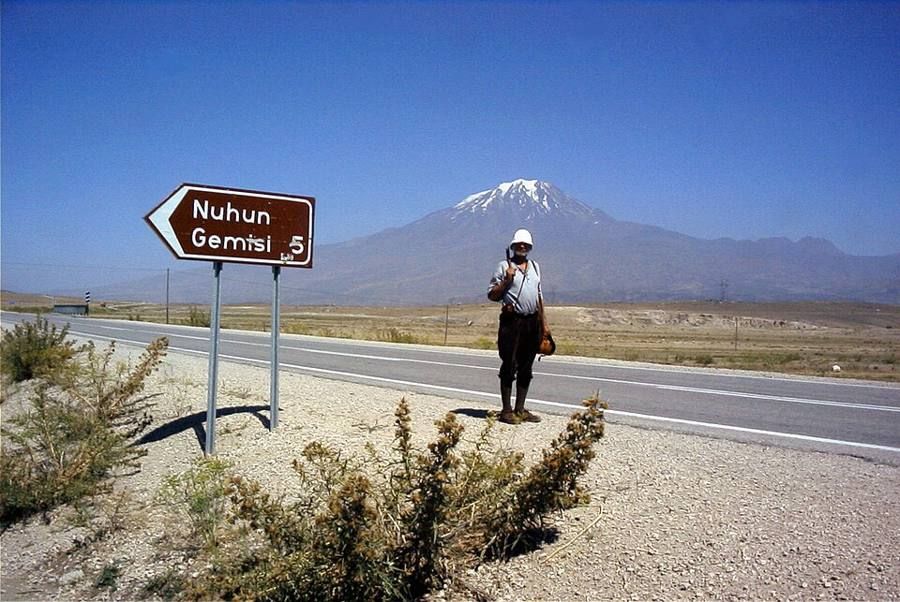
Credit: Aaboelela, adjusted by WikiPedant, via Wikimedia Commons (CC BY-SA 3.0)
Credit: Aaboelela, adjusted by WikiPedant, via Wikimedia Commons (CC BY-SA 3.0)
§ 7What Comes Next
Several things could settle the questions on both sides. The first is the full lab report from the U.S. lab. The second is the results from Switzerland and TÜBİTAK. If those match, the age of the wood will stand on firmer ground.
Next is the wood type. The team says it is testing for species and for traces of pitch or tree sap. Pitch on the wood would be a striking find. It would line up with the Genesis account, though it would still need careful study.
Then there is the location. Scientists will want to see a drawing of the exact layer the wood came from. That would show whether it was buried in place or washed in later. The group's own posts describe the find in slightly different ways. One says the pieces came from about 9 meters down on the southern slope. A post on November 22 says Atila spotted them after heavy rain on a newly exposed part of the western side.
Last is the soil and radar report expected in the spring. Atila has said most of the radar data is still being studied.
None of this has gone through peer review yet. Peer review is when other scientists check a study before a journal prints it. So far, the news has come through TV, press releases and social media.
§ 8The Bottom Line
Here is where things stand. Two pieces of burnt wood from a boat-shaped hill near Mount Ararat have been dated to about 4,300 years ago. That is confirmed by the team, though the full lab report is not yet public. The claim that the wood came from Noah's Ark is not confirmed. The team itself says the dates alone cannot prove it. Supporters see a growing pile of clues. Critics see an ordinary old hillside. More lab results, and a full report in the spring, should give everyone more to go on.
Watch & Listen
Hear this entry read aloud. Coming soon — the channels are not live yet.
Sources
- Noah's Ark Scans on X, "BREAKING: The Results Are IN!" (November 21, 2026). x.com
- Lauren Witzke on X, post on the lab results (November 21, 2026). x.com
- Freedom From Religion Foundation on X, reply to the lab results (November 21, 2026). x.com
- Gnosis Informant on X, reply to the lab results (November 21, 2026). x.com
- Haberler, "4,300-year-old result in Noah's Ark research! Wooden pieces at Durupınar dated to 2200-2400 BC" (November 22, 2026). en.haberler.com
- Son Dakika, "Durupınar'daki ahşap parçaların karbon-14 testi sonuçlandı" (Turkish, November 22, 2026). sondakika.com
- SachSuno Science Desk, "Noah's Ark Hunters Say Their Wood Dates to the Flood. The Numbers Show When a Tree Grew, Not That an Ark Landed" (November 22, 2026). sachsuno.com
- Miriam Sela-Eitam, The Jerusalem Post, "Noah's Ark researchers find possible charred wood fragments bearing tool marks at Durupinar site" (November 18, 2026). jpost.com
- Andrea Margolis, Fox News Digital, "The Noah's Ark site in Turkey has yielded charred wood fragments, researchers say" (November 10, 2026). foxnews.com
- Leman Altuntaş, Arkeonews, "Carbonized Wood Found at 9-Meter Depth in Noah's Ark Research" (November 9, 2026). arkeonews.net
Noah's Ark Scans, press release via GlobeNewswire, "Noah's Ark Scans Releases First Look at Charred Wood Recovered From Noah's Ark Durupinar Site" (November 10, 2026). GlobeNewswire blocks automated link checks (HTTP 403), so no link is given.
Noah's Ark Scans, press release via GlobeNewswire, "Charred Wood Recovered from Deep Inside Durupınar Noah's Ark Site, Radar Results Verified at Eastern Turkey Noah's Ark Symposium" (October 27, 2026). GlobeNewswire blocks automated link checks (HTTP 403), so no link is given.
- Noah's Ark Scans, official website. noahsarkscans.com
- Lorence G. Collins, "Noah's Ark near Dogubayazit, Turkey?" Perspectives on Science and Christian Faith (December 2016). asa3.org
- Wikipedia, "Durupınar site" (background and images only). en.wikipedia.org
Read next
More in Ancient Civilization
A Lost Cathedral Bigger Than the White House Is Rising From the Sand in Sudan
Archaeologists in northern Sudan have reached the floor of a giant medieval church for the first time. The building is called the Great Church of Jesus.
More in Ancient Civilization
Frozen Inca Mummies Reveal What Children Were Given Before Mountaintop Sacrifices
More than 500 years ago, Inca priests led children up some of the highest volcanoes in the Andes. There, the children were sacrificed to the mountain gods. Now, a new lab study of eight frozen mummies shows what those children were given in their final weeks. Every hair sample tested held traces of coca, the sacred leaf. Some children also drank alcohol. One famous girl, known as Juanita, carried a chemical tied to ayahuasca, a drink made from an Amazon vine. The results suggest the ritual was not the same everywhere. Each mountain may have had its own recipe.
On the front page
A 'Crypto-Wolf' at Skinwalker Ranch, and the Phones That Open Themselves
A biologist who works at Utah's Skinwalker Ranch made a striking claim this week. He says a dead wolf-like animal found on the land was mostly an unknown kind of wolf.