Ancient Civilization
Did Women Always Give Birth Lying Down? A Post on X Sends Readers Back to Ancient Egypt
By Darrell Wallen
Would you prefer to listen?
For most of the human story, women did not give birth flat on their backs. They knelt, squatted, sat on stools or stood on bricks. A post on X this week by the science account @ShiningScience put that history back in front of readers. It says lying down only became normal after doctors decided it suited them. The Ancient Sky checked the post against its own sources and the older records behind them. Much of it holds up. Some of it does not, including the most famous ancient picture in the story.
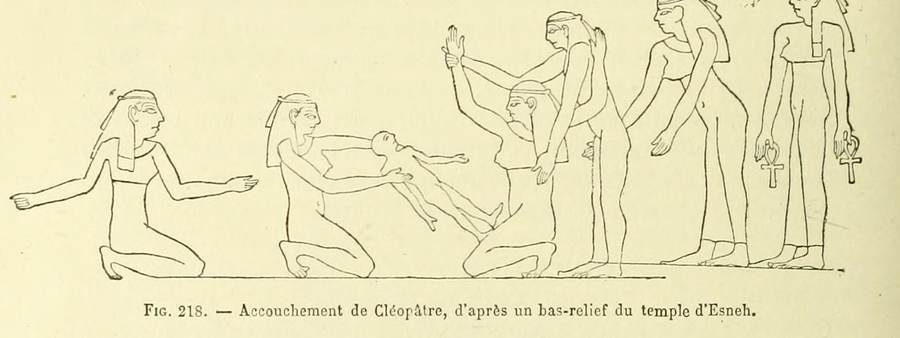
Credit: G.-J. Witkowski, Histoire des accouchements chez tous les peuples (Paris, 1887), Wellcome Library copy via Internet Archive (public domain)
§ 1The post that started the talk
On November 18, 2026, the X account Shining Science, @ShiningScience, shared a long post about how women give birth. You can read the post here. Its first line says, "For most of human history, women gave birth upright, and lying flat on the back only became the norm after doctors decided it suited them better."
The post walks from ancient Egypt to Babylon, then to France and the United States. It ends with modern medical trials. It names its two sources. One is a 1987 paper by Lauren Dundes in the American Journal of Public Health. The other is a 2017 review of medical trials from Cochrane, a group that pools the results of many studies.
Credit for bringing this old question back into public discussion goes to @ShiningScience. We read both of its sources and the older records behind them. Here is what we found.
§ 2What the 1987 paper really says
Lauren Dundes wrote the paper while she was a doctoral student at Johns Hopkins University. It ran in May 1987 under the title "The Evolution of Maternal Birthing Position."
Her main points match the post. She wrote that lying-down birth "has been widely used in Western cultures only for the last 200 years." Before that, she wrote, "the recorded history of birthing indicates upright birth postures were used extensively."
She also wrote the line the post quotes. "The adoption and use of the lithotomy position was not based on sound scientific research," Dundes wrote. The lithotomy position means lying on the back with the legs raised in stirrups. So the quote is real. It is aimed at that one position, not every kind of reclining.
Dundes blamed a fight between midwives and male surgeons over who would deliver babies. She also saw a link to a bladder-stone operation, also called lithotomy, popular in 17th-century France. She said forceps and anesthesia came too late to explain the switch.
§ 3A world survey of 76 cultures
The post says that "in a 1961 survey of 76 traditional cultures, only 14 had women give birth lying down." That number is real.
Dundes credits it to a 1961 study by Frieda Naroll, Raoul Naroll and Forrest Howard. It appeared in the American Journal of Obstetrics and Gynecology under the title "Position of Women in Childbirth." Dundes wrote that in only 14 of the 76 cultures, or 18 percent, did women "assume either a prone or dorsal birthing position." Dorsal means on the back. Prone means face down.
So the post's number is confirmed.
§ 4The Cleopatra picture: a famous mix-up
The post says, "A temple relief at Esna in Egypt shows Cleopatra kneeling as attendants help her." That line comes straight from Dundes. Her paper says a carving "at the Temple of Esneh in Egypt depicts Cleopatra (69?-30 BC) in a kneeling position, surrounded by five women attendants, one of whom delivers the child." Esneh is an old spelling of Esna, a town on the Nile in southern Egypt.
Dundes's photo notes say the picture also appeared in an 1887 French history of childbirth by Gustave-Joseph Witkowski. We found that book in a public online library. On page 344, the drawing carries the caption "Accouchement de Cléopâtre, d'après un bas-relief du temple d'Esneh." In English, that means "Cleopatra giving birth, after a carving at the temple of Esneh."
Now compare that drawing with a much older plate. In the 1840s, a Prussian team led by Karl Richard Lepsius copied carvings all over Egypt. One plate shows a birth scene from the temple at Armant, an old town south of Luxor. The Greeks called it Hermonthis.
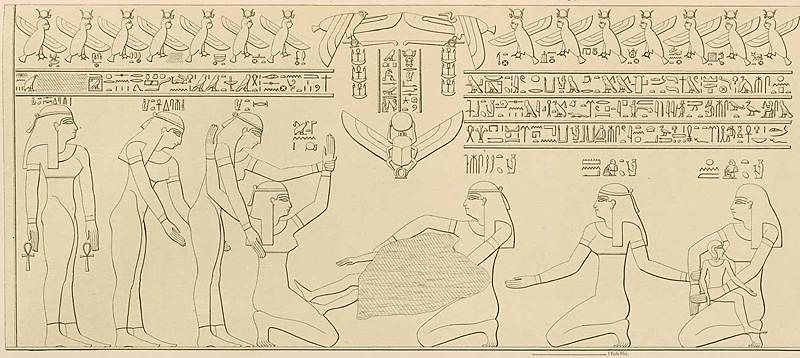
Credit: Karl Richard Lepsius, Denkmäler aus Aegypten und Aethiopien, Part IV, plate 60a, via Wikimedia Commons (public domain)
When The Ancient Sky placed the two pictures side by side, they showed the same scene. The figures line up one for one, flipped left to right. A woman kneels with both arms raised. A helper behind her holds up her arms. A kneeling midwife pulls the baby free. Standing goddesses watch from one end.
Experts on Egypt connect this scene to Armant, not Esna. Susanne Töpfer of Heidelberg University wrote about it in the journal Dynamis in 2014. She placed it in the birth-house at Armant, "around 50 BC," a building "destroyed in the 19th century." She wrote that the woman in labor "is kneeling on the earth; there is no bed or throne."
The Egypt Exploration Society says the Armant birth-house was "completely dismantled in 1861–1862 to build a sugar cane factory." Today it is known only from drawings, notes and a few early photos.

Credit: Félix Teynard / The Metropolitan Museum of Art, via Wikimedia Commons (public domain)
§ 5Is it Cleopatra, or a goddess?
That part is still debated, and both sides have a case.
Cleopatra VII built the Armant birth-house. Many people tied it to the birth of her son Caesarion, whose father was Julius Caesar. The Egyptologist E. A. Wallis Budge took the plain reading in his 1904 book, The Gods of the Egyptians. He wrote that the wall showed "the great queen" "in the act of giving birth to her son Caesarion." In his reading, a goddess holds up the queen's arms while a divine midwife receives the boy.
Later scholars read the scene as a sacred story. The Egypt Exploration Society calls the building a birth-house for "the local young god Harpre." Historian Joyce Tyldesley writes in her biography of Cleopatra that the mother "is clearly identified as Rat-tawi," a goddess, with Cleopatra among those present. She adds that the carvings tied Cleopatra to the goddess and Caesarion to the divine child.
So here is where it stands. The kneeling scene is real. It was carved in Cleopatra's time, about 50 BC, by her order. It is best known from Armant, not Esna. Whether the woman giving birth "is" Cleopatra depends on how you read Egyptian royal symbols. Budge said yes. Many later experts say she is a goddess who stands in for the queen.
§ 6The picture on the post
The post itself carries a different image. It shows a woman sitting upright on two blocks marked with the Eye of Horus. A baby comes out beneath her, and two women help.
We could not match that image to any known ancient carving, and the post does not say where it came from. Readers should treat it as a modern illustration until a source turns up.
§ 7Bricks, chairs and goddesses
An Egyptian story called Papyrus Westcar dates to around 1600 BC. In it, a group of goddesses act as midwives for a woman named Reddedet. "Isis placed herself in front of her, Nephthys behind her, and Heket hastened the childbirth," the story says. That is the same layout as the Armant scene, with one helper in front and one behind. Afterward, the baby was laid "upon a cushion on bricks."
In 2001, a team from the University of Pennsylvania Museum dug in a mayor's house at South Abydos, in southern Egypt. They found a painted mud birth brick about 3,700 years old. The museum called it "the first ever found." It measures 14 by 7 inches.
The museum said the brick "is one of a pair that would have been used to support a woman's feet while squatting during actual childbirth." Dig leader Josef Wegner said ancient texts show that "the standard form of childbirth in ancient Egypt was for the woman to deliver the baby while squatting on two mud bricks." The top of the brick is worn away. Wegner said it is "quite possible" the wear came from years of use in births.
The brick shows a mother holding her newborn boy, with helpers and the cow goddess Hathor. The museum said Egyptians linked birth bricks to the goddess Meskhenet, sometimes drawn as a brick with a human head.
Not every expert sees it the same way. Töpfer notes that no Egyptian picture shows a woman giving birth on a brick. She suggests the bricks in some texts may stand for the goddess-midwives. Archaeologist Kevin McGeough of the University of Lethbridge writes that Egyptian women seem never to have given birth lying down. Instead, "she would squat on the floor, squat on two bricks, or sit on a confinement chair."

Credit: Ad Meskens, via Wikimedia Commons (CC BY-SA 3.0)
At the temple of Kom Ombo, a Roman-era carving shows a famous set of surgical tools. Beside them sit two small figures. The Himetop heritage project reads them as goddesses on birthing chairs. The Wellcome Collection describes them as "two women seated on birthing stools." Egyptologists Filip Coppens and Hana Vymazalová offer another reading. In a 2010 study, they described them as a small statue of Isis and one of a male god, perhaps Osiris, on an offering table. Both readings are still in print.
§ 8Babylon and the birthing chair
The post says that "birthing chairs date back to Babylon around 2000 BC." Dundes wrote the same thing. The date also appears in a 2021 book from MIT Press, Designing Motherhood.
We could not find the object behind that date. Dundes's footnote points to a 1939 German paper about birth stools in Africa. It does not point to a dig in Iraq. So the 2000 BC date is a claim repeated in several books, but we could not trace it to a dated chair.
Records from the ancient Near East do support upright birth. Citing the scholar Marten Stol, McGeough writes that cuneiform texts, the wedge writing of Mesopotamia, mention a "brick of birth." Hittite texts from what is now Turkey describe birth "seated on a stool," he writes, and name a "woman of the birth stool."
§ 9Greece, Rome and the 1500s
The Roman doctor Soranus of Ephesus wrote in the early 100s AD, under the emperors Trajan and Hadrian. McGeough writes that Soranus described a birth stool with a "crescent-shaped cavity" cut into the seat. A woman could sit on it while the baby came through. Soranus also called for three helpers around the stool and the midwife sitting in front, a little lower.
The same layout shows up 1,400 years later in a 1513 German midwives' handbook by Eucharius Rösslin, with a midwife in front and a helper behind.
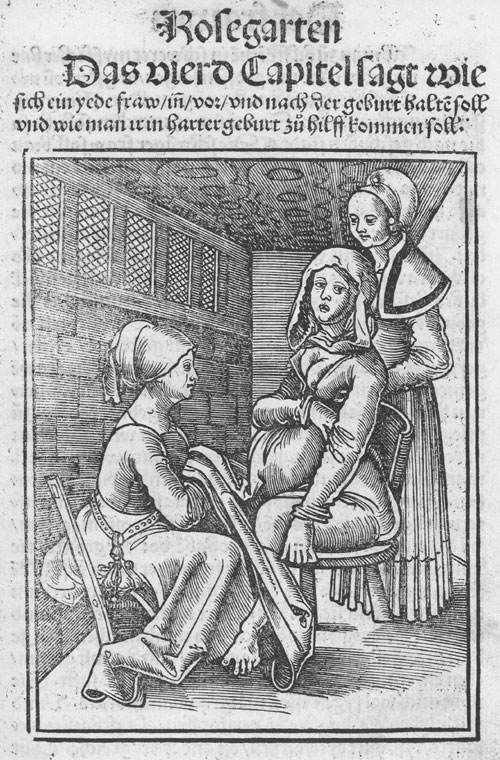
Credit: Eucharius Rösslin, via Wikimedia Commons (public domain)
The Aztecs of Mexico did much the same. Drawing on the 1500s records of Spanish friar Bernardino de Sahagún, National Geographic reports that "the woman squatted to give birth with the midwife behind her, holding her heels."
§ 10France changes the picture
The post says the change began in France. That part is confirmed in its outline, with one caution about a date.
Dundes wrote that the surgeon Jacques Guillemeau "had advocated reclining bed birthing in 1598." Guillemeau was a student and son-in-law of the famous surgeon Ambroise Paré. But the book Dundes cites is an English edition from 1612. The French original, "De l'heureux accouchement des femmes," was printed in Paris in 1609. We could not find a 1598 text with this advice. So the 1598 date is not yet confirmed.
In 1668, the Paris doctor François Mauriceau published his famous book on the diseases of pregnant women. Dundes wrote that he claimed lying back "would be both more comfortable for the parturient women as well as more convenient for the accoucheur," the person delivering the baby.
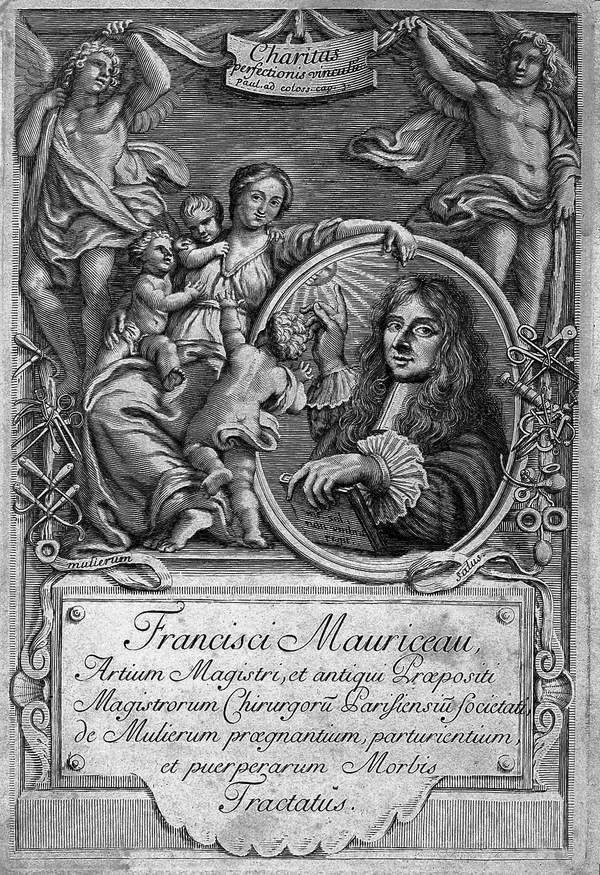
Credit: Wellcome Collection, via Wikimedia Commons (CC BY 4.0)
His own words are worth hearing. Some women, he wrote, give birth "on their Knees, as many in Country Villages; others standing upright." But "the best and surest is to be delivered in their Bed." He wanted the woman's "Head and Breast a little raised so that she be neither lying nor sitting."
That detail matters. Mauriceau did not ask for women to lie flat. Dundes wrote that the fully flat position "first began to be used in the United States." She tied it to Philadelphia doctor William Potts Dewees, around 1834. Dewees wrote that he "would recommend she should be placed upon her back, both for convenience and safety."
Dundes cited an 1884 book that compared countries. American women lay flat, French women lay back at a slant, English women lay on their left side, and German women still used the birthing chair. So the post's line about the 1800s United States fits the record.
§ 11The Louis XIV story
The post calls the tale about King Louis XIV "mostly myth." The story says the Sun King made women lie down so he could watch births.
Dundes was more careful than that. She wrote that "some scholars claim" the change was the king's "perverted caprice," meaning a strange whim. The story says he liked to watch births and could not see well when women sat on a stool. But she also wrote that "the influence of the King's policy is unknown." Then she added that his "purported demand for change did coincide with the changing of the position and may well have been a contributing influence."
The fact-checking site Snopes looked at the story in 2020. It called the claim that Louis forced the change largely false and pointed to Mauriceau instead.
So the post is right that the influence is "unknown." Calling it "mostly myth" goes a step further than the 1987 paper went. The paper left the door open.
§ 12What modern trials show
The post's numbers from the 2017 Cochrane review check out. The review, led by Janesh Gupta of the University of Birmingham in England, looked at women giving birth without an epidural, a numbing shot in the back. Thirty trials with 9,015 women gave usable results.
Compared with lying on the back, upright positions came with about 25 percent fewer episiotomies. That is a surgical cut to widen the birth opening. They also came with about 25 percent fewer births needing forceps or a vacuum tool. Pushing time was a little shorter, by about six minutes on average.
There were costs. Upright births had more cases of blood loss over 500 milliliters, about two cups. There may also have been more second-degree tears, though the authors said "we cannot be certain of this."
The authors warned that the trials were uneven in quality. They wrote that "further trials using well-designed protocols are needed."
The post ends by saying the advice is to give birth in whatever position feels best. The review's summary that we read does not contain that line. The World Health Organization's 2018 birth guidance says something close to it. As quoted by Snopes, it says a woman should be "encouraged and supported to adopt any position that she finds most comfortable."
§ 13The bottom line
The @ShiningScience post gets the big picture right. For thousands of years, from Egypt to Rome to Mexico, women mostly gave birth kneeling, squatting, sitting or standing. Lying back spread from France in the 1600s and went fully flat in America in the 1800s. Two details need care. The famous "Cleopatra at Esna" carving appears to come from Cleopatra's lost birth-house at Armant, and it may show a goddess. The Babylonian chair date has no object behind it that we could find. Modern trials show both gains and risks. And the oldest records leave a simple picture: a woman on her knees or on two mud bricks, with helpers in front and behind.
Watch & Listen
Hear this entry read aloud. Coming soon — the channels are not live yet.
Sources
Books
- Cleopatra: Last Queen of Egypt, by Joyce Tyldesley. ISBN 9780465018925
- The Gods of the Egyptians, Vol. 1, by E. A. Wallis Budge. ISBN 9780486220550
- Designing Motherhood: Things That Make and Break Our Births, by Michelle Millar Fisher and Amber Winick. ISBN 9780262044899
Articles and records
- Shining Science (@ShiningScience), post on X, November 18, 2026. x.com
- Shining Science, profile on X. x.com/ShiningScience
- Lauren Dundes, "The evolution of maternal birthing position," American Journal of Public Health 77(5):636–641, May 1987. pmc.ncbi.nlm.nih.gov
- Gupta, J. K., Sood, A., Hofmeyr, G. J., and Vogel, J. P., "Position in the second stage of labour for women without epidural anaesthesia," Cochrane Database of Systematic Reviews 2017, Issue 5, CD002006. pmc.ncbi.nlm.nih.gov and pubmed.ncbi.nlm.nih.gov
- Naroll, F., Naroll, R., and Howard, F. H., "Position of women in childbirth. A study in data quality control," American Journal of Obstetrics and Gynecology 82:943–954, 1961 (abstract record). pubmed.ncbi.nlm.nih.gov
- G.-J. Witkowski, Histoire des accouchements chez tous les peuples, Paris, 1887 (Wellcome Library copy), page 344, figure 218. archive.org
- Susanne Töpfer, "The physical activity of parturition in ancient Egypt: textual and epigraphical sources," Dynamis 34(2):317–335, 2014. scielo.isciii.es
- Christophe Thiers, "The Lost Temple of Armant," Egypt Exploration Society, April 2, 2026. ees.ac.uk
- Chris Naunton, "Cleopatra: Tomb, Baths & Birth-House – links & further reading." chrisnaunton.com
- E. A. Wallis Budge, The Gods of the Egyptians, Vol. 1 (1904), chapter "The Companions of the Gods," online text. wisdomlib.org
- Penn Museum, "Penn Museum Archaeologists Uncover 3700 Year Old 'Magical' Birth Brick at Mayor's Residence Just Outside Abydos, Egypt" (release dated July 1, 2002). penn.museum
- "The Magical Birth Brick," Expedition magazine, Penn Museum. penn.museum
- Kevin McGeough, "Birth Bricks, Potter's Wheels, and Exodus 1,16," Biblica 87 (2006): 305–318. scholar.ulethbridge.ca
- Himetop, "Kom Ombo Temple and the Surgical Instruments Scene." himetop.unicampus.it
- Filip Coppens and Hana Vymazalová, "Medicine, mathematics and magic unite in a scene from the Temple of Kom Ombo (KO 950)," Anthropologie (Brno) 48(2):127–131, 2010. (Publisher's site returned a server error on November 18, 2026, so it is not linked.)
- Wellcome Collection, "Egyptian wall relief, taken 1989" (Kom Ombo). wellcomecollection.org (returns 403 to automated checks, likely bot blocking)
- Michelle Millar Fisher and Amber Winick, "Birthing Furniture: An Illustrated History," The MIT Press Reader, April 28, 2022. thereader.mitpress.mit.edu (returns 403 to automated checks, likely bot blocking)
- Isabel Bueno, "Call the Aztec Midwife: Childbirth in the 16th Century," National Geographic. nationalgeographic.com
- Birthing Tales, "Jacques Guillemeau" (texts from De l'heureux accouchement des femmes, 1609). birthingtales.org
- Madison Dapcevich, "Did Louis XIV's Birth Fetish Change Modern Obstetrics?," Snopes, December 2, 2020. snopes.com
- World Health Organization, "WHO recommendations: intrapartum care for a positive childbirth experience," 2018. who.int
Read next

More in Ancient Civilization
A Steppe Lord's Giant Tomb in Mongolia Held a Glass Cup That May Have Come From Rome
Deep under a pine forest in eastern Mongolia, archaeologists have finished digging the largest tomb of the Xiongnu ever found in that country. The Xiongnu were horse-riding nomads who built an empire about 2,000 years ago. At the bottom of the tomb, about 48 feet down, lay a clear glass cup with a handle. The team thinks it may have been made in the Roman Empire, thousands of miles to the west. Next to it were carved jade pieces in a Chinese style and silver horse gear like pieces found in Korea. Together, the finds hint at how far one steppe noble's world reached.

More in Ancient Civilization
Spaceships, Star Maps or Sacred Walks? The Many Theories Behind Peru's Nazca Lines
About 2,000 years ago, people in a Peruvian desert drew a monkey, a spider and a hummingbird so large that they are best seen from the sky. They left no writing to say why. For nearly a century, people have offered answers: a calendar of the stars, landing strips for visitors from space, balloon flights, maps of hidden water, and sacred walks. Now computers are finding hundreds of figures nobody knew were there, and the mystery keeps growing.

On the front page
Tesla Rolls Out FSD v15 as Italy Says Yes to Its Assisted Driving
Tesla says the new software handles dangerous moments 25 times better and redraws the road like a video game. A day earlier, Italy became the biggest European country to approve the system, with a driver still in charge.