UAP
Judge Rules for Pentagon in David Grusch's Records Lawsuit
By Darrell Wallen
Would you prefer to listen?
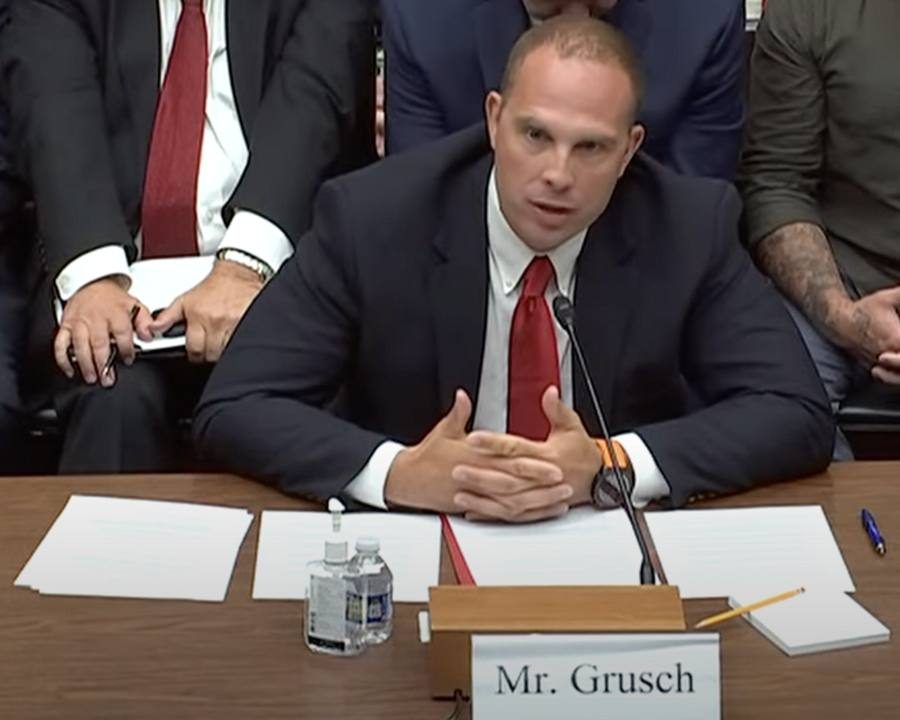
Credit: U.S. House Subcommittee on National Security, the Border, and Foreign Affairs (video still), public domain, via Wikimedia Commons
A federal judge in Virginia has ruled against UFO whistleblower David Grusch in his fight to get records from the Pentagon. After a short hearing on Friday, November 20, 2026, Judge Leonie Brinkema sided with the Department of Defense and closed the case. The fight was not about alien craft. It was about a smaller question: did the Pentagon look hard enough for papers about a 2023 report that Grusch may have shared secrets? For now, the court says yes.
§ 1What Happened in Court
The hearing took place in Courtroom 700 of the federal courthouse in Alexandria, Virginia. It was set for 10:00 a.m. Eastern time. The court's own minutes say it ran from 10:28 to 10:38 a.m. That is about ten minutes.
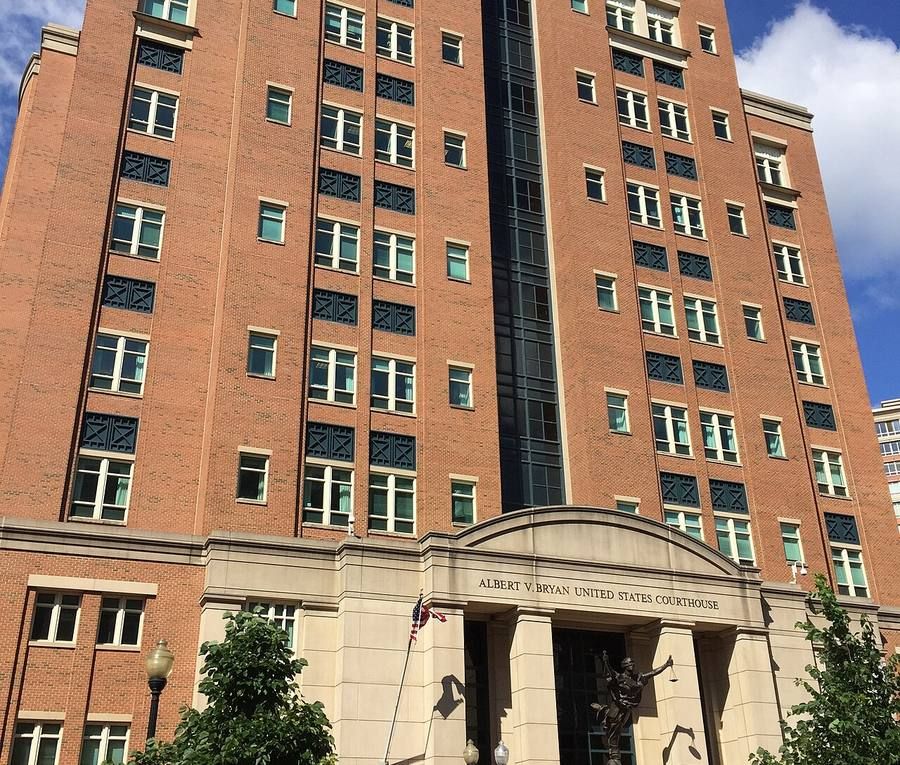
Credit: Photo: Antony-22, CC BY-SA 4.0, via Wikimedia Commons
Three lawyers came for Grusch: Huntington Willis, Basil Al-Qaneh and Anthony Shin. One lawyer came for the government: Matthew Mezger, an assistant U.S. attorney. The minutes say both sides argued.
Each side had asked the judge to rule in its favor without a trial. This is called "summary judgment." It means a judge decides the case on the papers when the main facts are not in dispute.
Judge Brinkema granted the government's motion. She denied the motion from Grusch. The court docket, the public list of filings in the case, shows the result on the same day.
Later that day, the judge signed a one-page written order. It says she ruled "for the reasons stated in open court, and for good cause shown." The order tells the court clerk to enter judgment for the Department of Defense and to "close this civil action." The clerk entered that judgment on November 20.
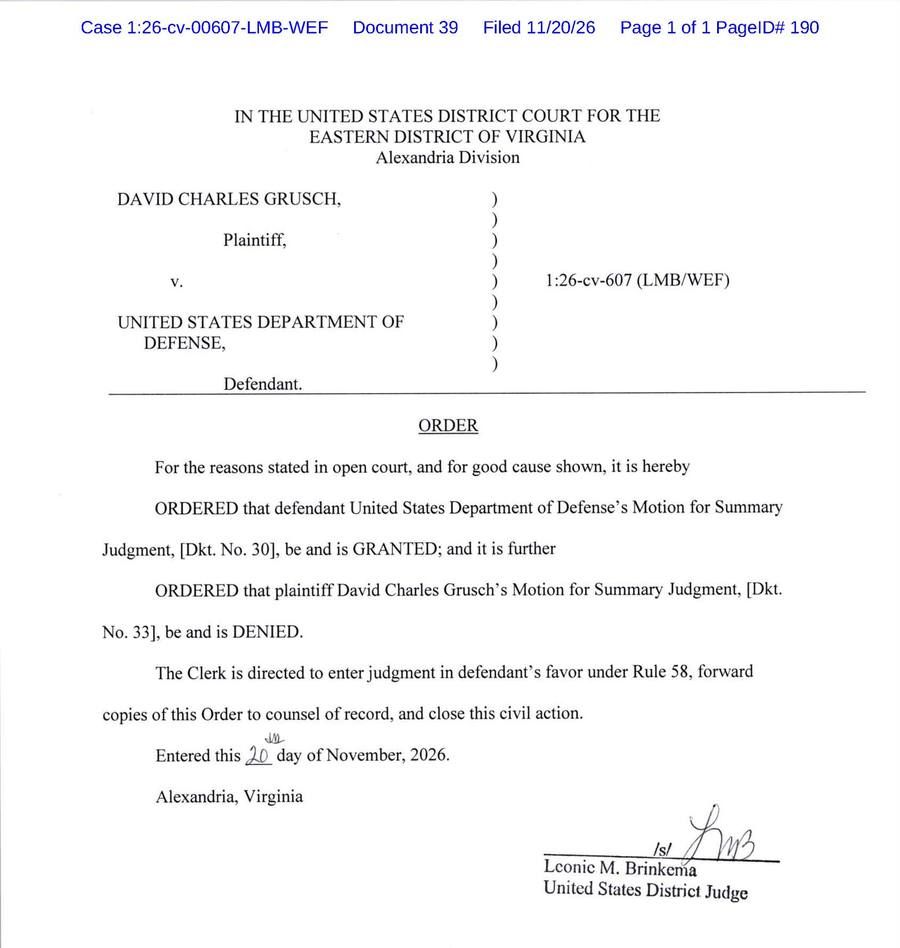
Credit: U.S. District Court for the Eastern District of Virginia, public court record; copy as posted by D. Dean Johnson on X
So far, the judge's reasons have not been written down for the public. She gave them out loud in the courtroom. No transcript of the hearing had been posted as of Friday night. Researcher D. Dean Johnson, who has followed the case closely, wrote on X that he was not in the courtroom. "I don't know what she said," he posted.
§ 2The Request That Started It All
The case began with a single records request. On September 30, 2024, Grusch asked the Pentagon for documents under the Freedom of Information Act. That law, often called FOIA, lets anyone ask the federal government for its records. The government must make "reasonable efforts" to search for them.
Grusch asked for two kinds of records. Both were tied to the office of the Senior Intelligence Oversight Official. That office watches over the Pentagon's spy work to make sure it follows the rules. At the time, it was led by an official named Mark Dupont.
The first part of the request asked for any "unauthorized disclosure complaint" about Grusch. An unauthorized disclosure means sharing secret information without permission. The request covered April 1 through December 31, 2023.
The second part asked for any such complaints that used the words "UAP" or "UFO." UAP stands for unidentified anomalous phenomena. It is the government's newer name for UFOs.
The timing matters. Grusch went public with his claims in June 2023. In July 2023, he testified under oath before a House subcommittee. He said he was told of "a multi-decade UAP crash retrieval and reverse engineering program." He said he was denied access to it. He also told lawmakers he had "suffered retaliation" for speaking up. The window in his records request covers the months around that testimony.
Grusch's lawyers say he waited about 504 days with no records at all. On March 2, 2026, he sued.
§ 3What the Pentagon Found
Once the case was filed, both sides agreed to pause it. That gave the Pentagon time to finish working on the request.
In its court papers, the Department of Defense laid out how it searched. The oversight office first looked through its shared computer folders. It used search words such as "Grusch," "UAP" and "UFO." On October 7, 2024, it reported finding nothing about any unauthorized disclosures by Grusch.
The office also explained that it does not usually handle that kind of case. It said leaks of secrets are "generally information security matters." In other words, a different part of the Pentagon would normally deal with them.
Next, the department searched the email accounts of two officials. One was Mark Dupont. The other was Joo Chung, who led the larger office above him. Both their regular and classified email accounts were checked.
That email search turned up 22 records that might fit the request. Together, they ran to 6,632 pages. After review, the department released 40 pages on May 18, 2026.
That gap has drawn a lot of attention online. But the court papers do not describe 6,632 pages of withheld UFO files. The larger number is simply what the first computer search pulled up. The department says it then sorted out which pages actually matched the request. Grusch did not challenge the black-outs, or redactions, in the 40 pages he got. His lawyers say he received the same 40 pages again on June 26, 2026, with some extra redactions. By then, both sides agreed the only question left was whether the search itself was good enough.
§ 4The Letter at the Center of the Fight
Grusch's case leaned heavily on one page in that release. It is a letter dated November 1, 2023. Mark Dupont sent it to Congressman Tim Burchett of Tennessee.
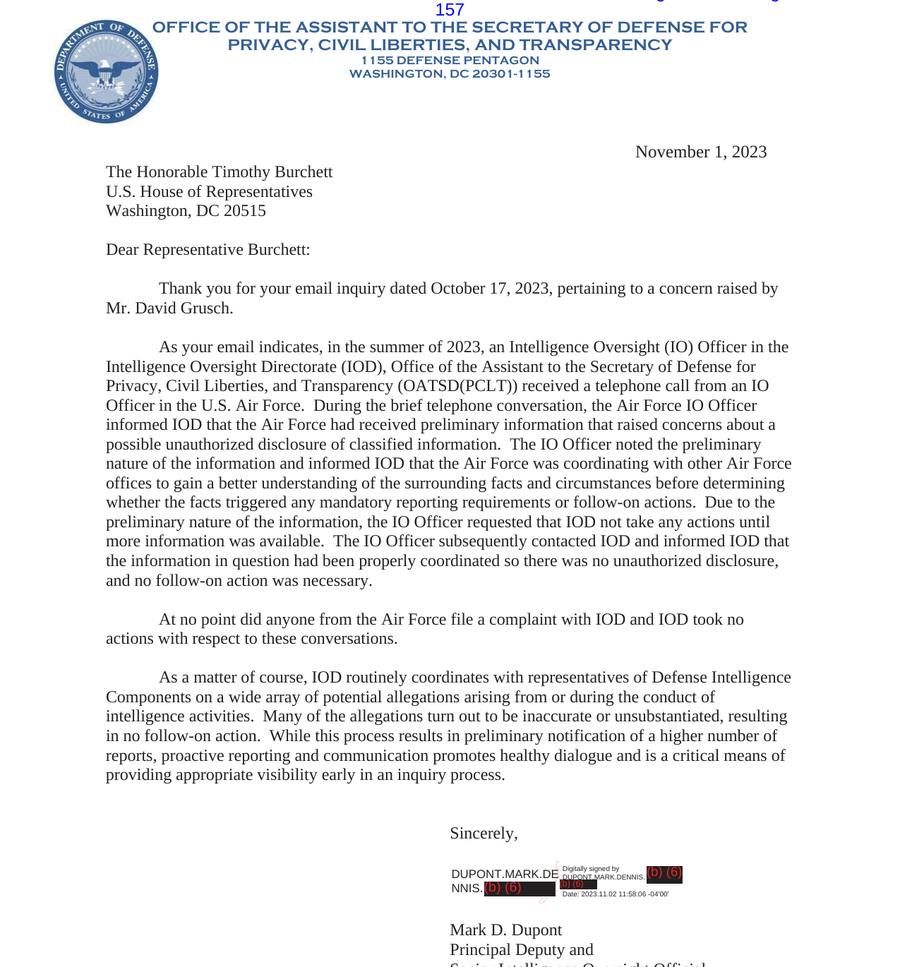
Credit: U.S. Department of Defense record, public court filing, E.D. Va. Case 1:26-cv-00607
Burchett's office had asked about the matter in October 2023. Grusch's lawyers say that inquiry named him as a whistleblower who believed he faced retaliation.
Dupont's letter told a short story. In the summer of 2023, an oversight officer in the Air Force called Dupont's office. The caller said the Air Force had "preliminary information" that "raised concerns about a possible unauthorized disclosure of classified information." The Air Force officer asked Dupont's team to hold off while the facts were checked.
Then the Air Force officer called back. According to the letter, the officer said the information "had been properly coordinated so there was no unauthorized disclosure, and no follow-on action was necessary."
The letter goes on: "At no point did anyone from the Air Force file a complaint with IOD and IOD took no actions with respect to these conversations." IOD is the Intelligence Oversight Directorate, the team inside Dupont's office.
§ 5Grusch's Side: Follow the Trail
To Grusch's lawyers, that letter proved something important. It showed that the Air Force really did raise a concern about him with Dupont's office. If that happened, they argued, someone likely made a record of it.
They put it plainly in their October 12 brief. "How else would he later be able to describe the referral incident to Congress with such specificity?" they wrote.
The lawyers pointed to a rule from other federal courts that some call "follow the trail." It says that when a search turns up a clear lead, the agency should chase it. That could mean checking other files or systems where the records might be.
They also said Grusch could not know how Dupont's office kept its notes. Maybe the person who took the call made an electronic note or a file. Maybe a record sat in a system the search never touched. The lawyers said the government's sworn statement, from FOIA official Virginia Burke, never spoke to this lead at all.
They asked the judge to order a new search. They also wanted the Pentagon to file a new sworn statement explaining exactly where it looked.
§ 6The Pentagon's Side: The Search Was Fair
The government saw things very differently. Its lawyers said the law asks for a reasonable search, not a perfect one.
They said the department did what Grusch asked. It searched the office he named. It searched the official he named, Dupont. It even added a second official, Chung, because she was expected to have related emails. It used the very search words Grusch listed in his request.
In an October 30 filing, the government added more detail. Burke said the email searches also used the phrase "unauthorized disclosures." She said the search terms were set up so that a match on any one of them would count. That, she said, would have caught anything that fit either part of the request.
The government leaned on a 2009 ruling from the Fourth Circuit, the federal appeals court over Virginia. In that case, called Rein, the appeals court said agencies are not "required to chase rabbit trails" that show up in documents found during a search.
The government also offered Grusch a way forward. If he found new leads in the released pages, it said, he can pursue them "through a second FOIA request." In other words, he can ask again, with a new and wider request.
The public docket lists the government's two final filings from October 30. It does not show a written reply from Grusch before the hearing.
§ 7Reaction Pours In
News of the ruling spread fast on X on Friday. Johnson was one of the first to post it. He noted that Grusch, in a May 5, 2026 interview, had described the Air Force filing "an unauthorized disclosure Espionage Act complaint" against him. Johnson wrote that, in his view, the Dupont letter "described an incident markedly less dramatic." Researcher John Greenewald of The Black Vault also shared the news with his followers.
Grusch's supporters pushed back just as quickly. Dennis Asberg wrote that Grusch "stepped into the spotlight knowing the personal and professional risks." He added: "A FOIA ruling does not erase his testimony. We owe him a serious investigation, not dismissal."
The account UAP Files agreed Grusch had lost but questioned how the story was being told. It noted that the only thing the Dupont letter actually calls brief is the phone call. "Anyone who's worked in a big organisation knows a five-minute call can keep an email chain on life support for months, sometimes years," the post said. It also said the judge "only had a records dispute in front of her." Grusch's bigger claims about UAP programs and retaliation, it said, were outside the ruling.
On that point, even Johnson agreed in part. He wrote that a ruling on one office's search "does not speak to his core allegations regarding captive alien technology and alien cadavers." He added that, in his view, none of those claims have been backed by an official body, an authenticated document or a credible living firsthand witness.
Grusch and his lawyers had not commented in public on the ruling as of Friday night, based on a search of news reports and social media.
§ 8What Comes Next
The judge's ruling closes this case in the trial court. It does not end the larger story.
Grusch could appeal to the Fourth Circuit. In cases where the U.S. government is a party, federal court rules give each side 60 days to file a notice of appeal. The public docket showed no appeal as of Friday evening.
He could also do what the government suggested and send in a new records request. Johnson made a similar point on X. He wrote that Grusch and his lawyers "are free to file more FOIA requests, directed at as many other offices & agencies as desired."
A transcript of the hearing may also become public in time. If it does, readers will finally hear the judge's reasons in her own words.
One more detail stands out in the court papers. The Pentagon now often calls itself the Department of War, and its FOIA official uses that name in her sworn statement. The lawsuit still carries the older name, the Department of Defense.
§ 9The Bottom Line
David Grusch asked the Pentagon to find any records of a 2023 complaint that he leaked secrets. The Pentagon searched, found 40 pages it says fit his request, and handed them over. Grusch said a letter in those pages pointed to more records the search missed. On Friday, a federal judge sided with the Pentagon and closed the case, with her full reasons given only out loud in court. The ruling settles one narrow question about one search. Grusch's bigger claims about hidden UFO programs were never part of this case, and they remain as open, and as hotly debated, as ever.
Watch & Listen
Hear this entry read aloud. Coming soon — the channels are not live yet.
Sources
- 1. Grusch v. United States Department of Defense, No. 1:26-cv-00607 (E.D. Va.), docket, including minute entry (Dkt. 38), order (Dkt. 39) and judgment, Nov. 20, 2026 – CourtListener
- 2. Grusch v. U.S. Department of Defense case page – PacerMonitor
- 3. Defendant's Memorandum in Support of Summary Judgment (Dkt. 31), Sept. 21, 2026 – via Umbralog
- 4. Declaration of Virginia E. Burke (Dkt. 31-1), Sept. 2026 – via Umbralog
- 5. Defendant's Notice of Hearing (Dkt. 32), Sept. 21, 2026 – via Umbralog
- 6. Plaintiff's Memorandum in Support of His Motion for Summary Judgment (Dkt. 33-1), Oct. 12, 2026 – via Umbralog
- 7. Plaintiff's Exhibit 1, released DoD records incl. Mark D. Dupont letter to Rep. Tim Burchett, Nov. 1, 2023 (Dkt. 33-2) – via Umbralog
- 8. Defendant's Opposition and Reply (Dkt. 37) and Supplemental Burke Declaration (Dkt. 37-1), Oct. 30, 2026 – via PDF Host
- 9. D. Dean Johnson, "Grusch Loses FOIA Lawsuit Against Defense Department," X, Nov. 20, 2026
- 10. D. Dean Johnson, post on the written order, X, Nov. 20, 2026
- 11. D. Dean Johnson, reply on core allegations, X, Nov. 20, 2026
- 12. D. Dean Johnson, reply on new FOIA requests, X, Nov. 20, 2026
- 13. Dennis Asberg, post on the ruling, X, Nov. 20, 2026
- 14. UAP Files, "Grusch lost his FOIA case. What did the paperwork actually say?", X, Nov. 20, 2026
- 15. John Greenewald Jr. (The Black Vault), post on the ruling, X, Nov. 20, 2026
- 16. Edge State, post on the ruling, X, Nov. 20, 2026
- 17. House Oversight Committee, "Unidentified Anomalous Phenomena: Implications on National Security, Public Safety, and Government Transparency," hearing page, July 26, 2023
- 18. David Grusch, written statement to the House subcommittee, July 26, 2023 – docs.house.gov
- 19. House Committee Repository, hearing record for July 26, 2023
- 20. 5 U.S. Code § 552, Freedom of Information Act – Cornell Legal Information Institute
- 21. Federal Rules of Appellate Procedure, Rule 4 (time to appeal) – Cornell Legal Information Institute
- 22. U.S. District Court for the Eastern District of Virginia
- 23. CosmicGravity, "David Grusch's FOIA Lawsuit Hinges on Where the Pentagon Searched," Nov. 15, 2026
- 24. BrokenUFO, "An Air Force Call and 40 Pages of 6,632: What the Papers in Grusch's Lawsuit Against the Pentagon Say"
- 25. Aliens newsroom, "Court to Decide Whether the Pentagon's Document Search Was Adequate," Nov. 6, 2026
- 26. Wikimedia Commons, David Grusch giving testimony on 26 July 2023 (image)
- 27. Wikimedia Commons, Albert V. Bryan Federal Courthouse 2019 (image)


Read next
More in UAP
Carl Sagan's Old House Will Watch the Sky: Galileo Project Plans a Radar-Guided UAP Observatory in Ithaca
The cliffside house where astronomer Carl Sagan once lived and worked is getting a new job. Harvard astrophysicist Avi Loeb and businessman Adam Weitsman plan to turn it into an observatory that hunts for unexplained objects in the sky.

More in UAP
Three Close Calls, No Answers: What Britain's Air Safety Board Could Not Identify Near Its Airliners
Three airliner crews over England this summer saw strange objects flash past their planes at about 9,000 feet or higher.
On the front page
A 'Crypto-Wolf' at Skinwalker Ranch, and the Phones That Open Themselves
A biologist who works at Utah's Skinwalker Ranch made a striking claim this week. He says a dead wolf-like animal found on the land was mostly an unknown kind of wolf.