UAP
Three Close Calls, No Answers: What Britain's Air Safety Board Could Not Identify Near Its Airliners
By Darrell Wallen
Would you prefer to listen?
Three airliner crews over England this summer saw strange objects flash past their planes at about 9,000 feet or higher. One looked like a shiny white capsule. Two looked like small black triangles. Britain's official air safety board studied all three and said it could not tell what they were. It rated one of the encounters at its highest level of collision risk.

§ 1A New Batch of Official Reports
The UK Airprox Board is the group that studies near misses in British skies. An "Airprox" is its word for a time when a pilot thinks something came too close to the plane. The board meets every month. It looks at each report, decides what likely happened, and rates how close the call really was.
On November 13, 2026, the board posted the reports from its October 14 meeting. One part is a summary sheet for drones, balloons, model aircraft and "unknown objects." That sheet covers 13 reports from late June to early August 2026.
The board called seven of them likely drones. It said it could not decide what the other six were. Three of the 13 got the board's top risk rating, called Risk A. Three more got Risk B, the next level down.
Three cases stand out. They involve big passenger planes, and in each one the crew described something that did not look like an ordinary drone.
§ 2Not That Tic Tac
First, a quick note to avoid a mix-up. One of these pilots used the words "tic-tac shaped." That phrase may remind readers of the famous 2004 "Tic Tac" case. In November 2004, U.S. Navy pilots from the USS Nimitz group saw a little white "Tic Tac-looking object" off the coast near San Diego, as CBS News' 60 Minutes reported in 2021.
This is a different event. It happened over the English county of Kent in July 2026. The pilot simply used the name of a small, white breath mint to describe a shape. Nothing in the British report links the two cases.
§ 3Case One: The White Capsule Over Kent
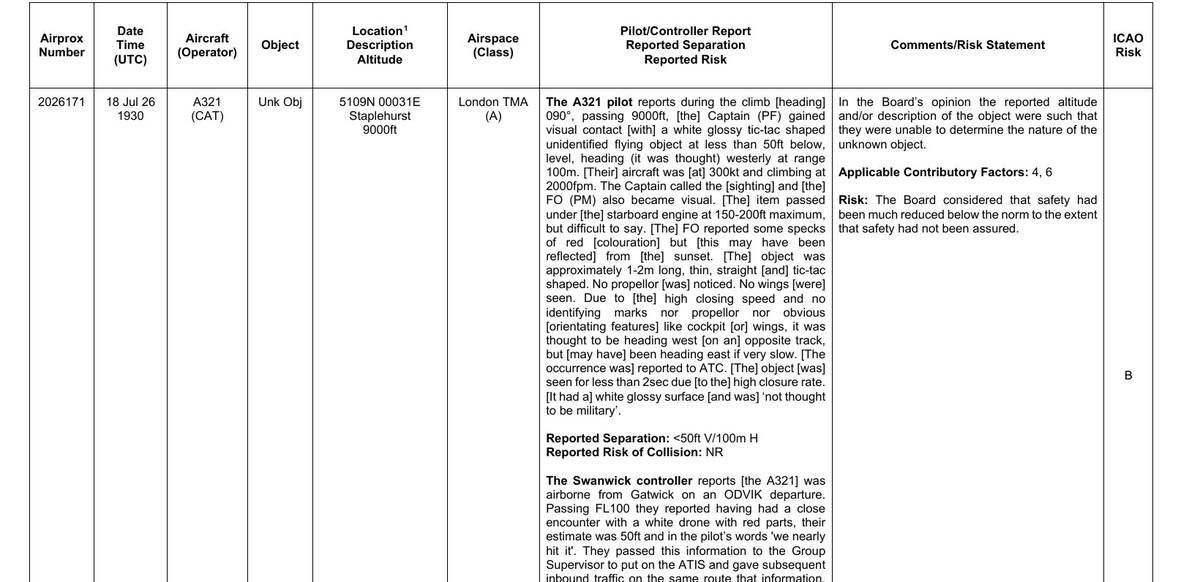
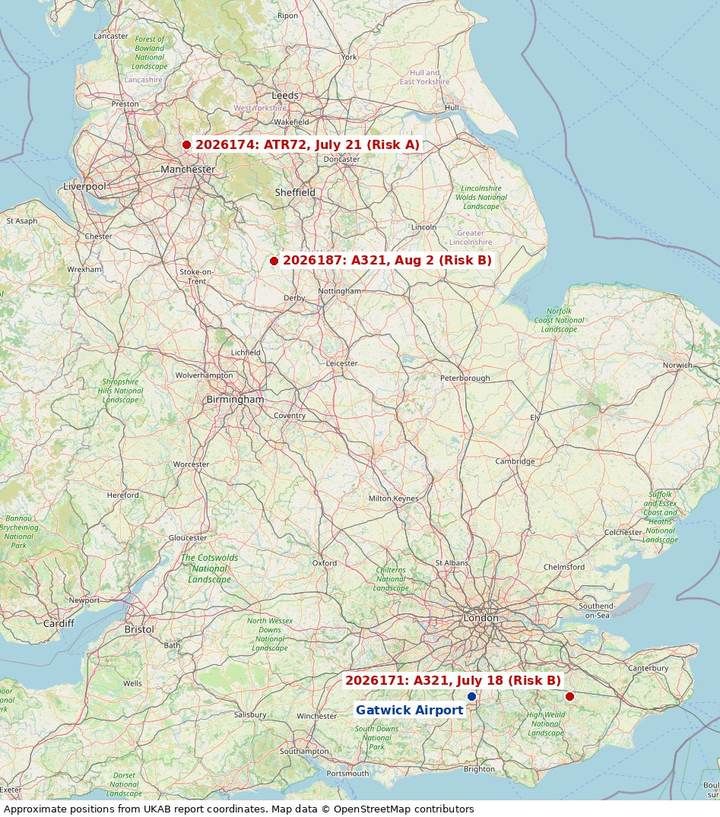
The first case is Airprox 2026171. It happened on July 18, 2026, at 7:30 in the evening by the world clock the reports use. That was 8:30 p.m. in Britain, close to sunset.
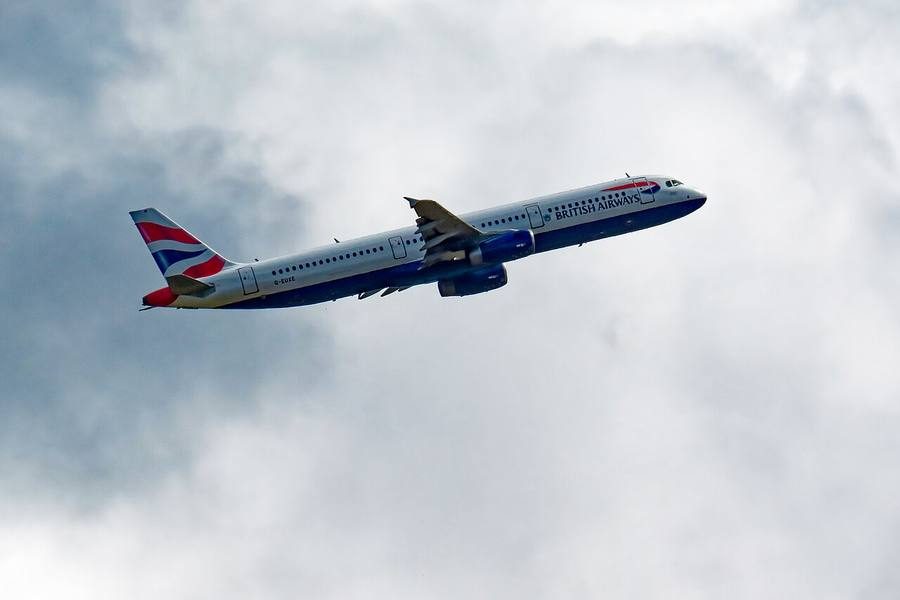
An Airbus A321 had just taken off from London Gatwick Airport. The A321 is a common single-aisle passenger jet. It was heading east and climbing fast, near the village of Staplehurst in Kent. It was passing 9,000 feet and moving at about 300 knots, or roughly 345 miles per hour.
The captain was flying. Suddenly, the captain saw "a white glossy tic-tac shaped unidentified flying object." It was less than 50 feet below the plane and about 100 meters away. The captain called it out, and the first officer, the co-pilot, saw it too.
The object passed under the right engine. The crew guessed it was 150 to 200 feet away at most, "but difficult to say." They saw it for less than two seconds because the two were closing so fast.
The crew described it carefully. It was about 1 to 2 meters long, or roughly 3 to 6 feet. It was "thin, straight" and shaped like a tic-tac. They saw no propeller and no wings. They saw no cockpit or other features that would show which way it faced. The co-pilot noticed some "specks of red," but said that may have been the sunset reflecting off it. The crew said it was "not thought to be military."
§ 4"We Nearly Hit It"
Air traffic controllers at Swanwick, the main center that guides planes over southern England, also filed a report. They said the pilot described "a white drone with red parts" about 50 feet away. In the pilot's words, "we nearly hit it."
Then the pilot said something pilots rarely say. "We'd like to declare a PAN on that one, I'm not really sure." A PAN is an urgent call for help or attention. It is one step below a Mayday.
The controllers acted quickly. They put a warning on the airport's automatic radio broadcast for departing planes. They also kept later planes on the same route a little higher than normal, to keep them away from the spot. No other pilot reported the object.
Investigators then checked the radar. They found no radar contacts at all linked to the sighting. The object, whatever it was, did not show up.
§ 5Case Two: The Black Triangle by the Left Wing
The second case is Airprox 2026174. It happened three days later, on July 21, early in the morning. The plane was an ATR72, a twin-propeller airliner used for shorter flights. It was coming down toward Leeds Bradford Airport in northern England.
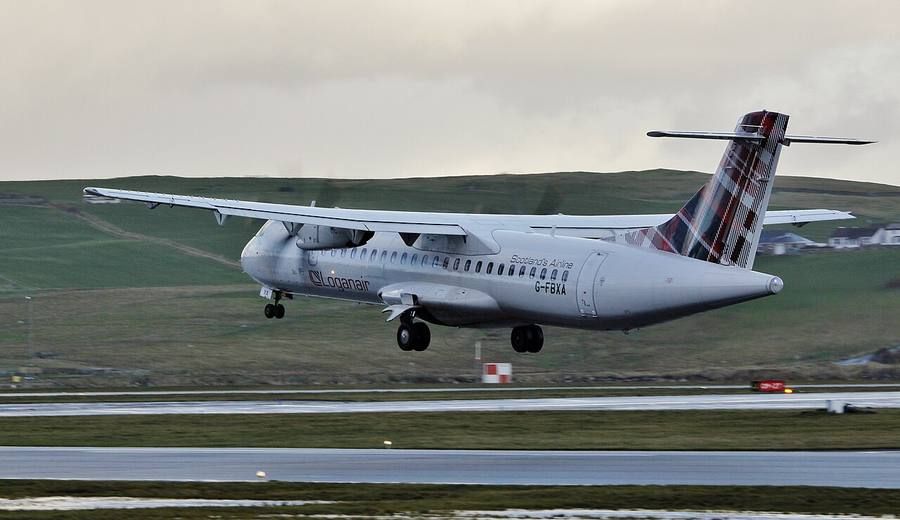
The crew had leveled off at 9,000 feet, about 25 nautical miles southwest of the airport, near the town of Bury. Then they saw something coming toward the plane. At first, it "looked like a black bird."
It passed at the same height as the plane, "really, really close" to the left wing. As it went by, the crew could clearly see a red light on the back of it. To them it looked "like a black triangular drone."
NATS, the company that runs Britain's air traffic control, also filed a report. It quotes the pilot saying, "It first appeared like a bird, but it had some red lights on the rear, so it was a drone, really really close to the aircraft."
A controller warned the crew of another airliner heading into Manchester. That crew was told a plane below them had seen a drone on their path about 5 to 6 miles ahead, and to keep a good lookout. Once again, investigators found no radar contacts linked to the object.
§ 6Case Three: The Tiny Stealth Fighter
The third case is Airprox 2026187. It happened on August 2, 2026, in the afternoon. Another Airbus A321 was descending over Derbyshire, in the middle of England, near a radio navigation beacon known as TNT.
The plane was passing about 11,500 feet. Then a black triangular object passed right overhead. The crew said it was "shaped like a small stealth fighter." They added that they assumed it was a drone.
The crew said it passed about 100 feet above them and slightly to the right, maybe 20 meters away. It was heading in the opposite direction. The crew rated the risk of collision as high.
When a NATS investigator asked what it looked like, the pilot gave a vivid answer, according to the report. "It looked like a stealth fighter if that makes sense, but obviously tiny, that's the sort of shape it was." The pilot also said, "it was certainly pretty close." The controller's report used a slightly different phrase, "like a mini stealth bomber."
Controllers warned the next planes coming in for 30 minutes. No one else saw it. The incident was reported to the police through 999, Britain's emergency number. Radar again showed nothing linked to the object.
§ 7How the Board Decides: "Drone" or "Unknown"
So why did the board call some objects drones and others unknown? The answer is in the board's own rules.
The board says these encounters are usually "fleeting." Pilots often get only a quick look, so they can give only a rough outline. Because of that, the line between a drone, a model plane and an unknown object often comes down to the words the pilot uses.
The board's policy is simple. If the pilot clearly describes something with drone features, such as "4 rotors," the board takes that "at face-value as a drone." If the pilot can only describe "an object," the board files it as an unknown object.
That shows up in the October sheet. When the board thinks a drone is likely, it writes that the description was "sufficient to indicate that it could have been a drone." For all three airliner cases here, it wrote something else. It said the description of the object was "such that they were unable to determine the nature of the unknown object."
The board is also open about its limits. It says it is "likely that some reported 'Model Aircraft' or 'Unknown Object' incidents were probably drones, and vice versa." In other words, the labels are a best judgment, not a final answer.
§ 8What Risk A and Risk B Mean
Each report also gets a risk letter, from A to E. The letter rates how close the call was. It does not say what the object was.
Risk A is the most serious. For the ATR72 case, the board wrote that "providence had played a major part in the incident and/or a definite risk of collision had existed." In plain words, luck played a big part in keeping the planes safe.
Risk B is one step down. For both A321 cases, the board wrote that "safety had been much reduced below the norm to the extent that safety had not been assured." That means the margin of safety was gone, even if a crash was not likely.
Risk C means safety was reduced, but there was no risk of collision. Risk D means there was not enough information to judge. Risk E means normal safety was kept.
The board also lists factors that helped cause each event. For the three airliner cases, it listed two. One is that the pilot had "no, generic, or late" warning of the object. The other is a near collision with an "unpiloted airborne object," such as an unknown object or a balloon.
§ 9The Drone Explanation
There are strong reasons to think drones may explain some of these sightings. Even the pilots used the word. The A321 crew in Kent told controllers about a "white drone with red parts." The ATR72 pilot said "it was a drone." The crew over Derbyshire said they "assume a drone."
Drones are also a real and growing problem near British airports. The same October sheet shows how serious that can be. On July 11, 2026, pilots landing at London Heathrow reported a drone near the runway again and again. One drone passed about 40 feet to the side of an A321. Heathrow stopped landings on that runway for 10 minutes and sent several planes around.
Drones can carry small lights, so a red light on the back, like the one the ATR72 crew saw, could fit a drone. Not every drone looks like a little helicopter, either. The board notes that many fixed-wing drones, shaped more like small planes, are hard to tell apart from model aircraft.
If these were drones, they broke the rules. The board notes that a drone flying in these places would have been above 400 feet and inside controlled airspace without permission. British rules generally keep drones below 400 feet.
§ 10The Case for a Real Mystery
Still, the board itself would not call these drones. And the pilots' own descriptions raise questions that are hard to wave away.
The Kent crew saw no propeller, no wings and no features of any kind. They saw a glossy, smooth shape. A typical drone has spinning rotors, arms and a camera. Both trained pilots in the cockpit saw it.
All three objects were at around 9,000 to 11,000 feet. That is far above the 400-foot limit that applies to most drone flying. And in all three cases, radar picked up nothing linked to them.
Other reports on the same sheet add to the puzzle. On July 23, an ATR72 crew over Wales described a white or silver object that was "more rectangular." The captain said it "was not the typical shaped drone normally seen." On July 13, another ATR72 crew saw a "quite large" white object near Birkenhead. A second pilot reported it again 14 minutes later. The board could not identify either one.
This is not the first time the board has heard about odd shapes near Gatwick. In August, Metro reported on an earlier case from April 29, 2026. In that case, an Airbus A319 pilot saw a disc or "flying saucer" type object pass close to the plane south of Gatwick. The board said it could not determine what that object was, either.
Gary Heseltine, editor of UFO Truth Magazine, told Metro that the April report sounded like a "credible case." He said British pilots still have "no set procedures" for reporting UAP, which stands for unidentified anomalous phenomena. He called for Britain to follow recent steps in the United States.
Metro also quoted Nick Pope, who looked into UFO reports for Britain's Ministry of Defence in the 1990s, about his own work. He said most sightings turned out to be mistakes. But about 5% stayed unknown. "That 5% doesn't mean extraterrestrial," he said, "but as I always remind people, neither did we rule that out. It means unknown, no more, no less."
§ 11What the Reports Do Not Say
The board does not hunt for UFOs. Its job is air safety. Britain's Civil Aviation Authority, which funds the board, told Metro that the reports are issued in the name of safety. "We do not add further commentary or analysis to individual airprox reports," it said.
The reports also leave out some details. They do not name the airlines or the flight numbers. They do not include photos or video, because none were taken. Everything we know comes from what the crews and controllers wrote down.
That means each case rests on a few seconds of human sight. Trained pilots saw something, reported it fast and described it in detail. But without radar tracks or pictures, no one can check those descriptions against hard data.
§ 12What It Means
Three airline crews flying over England this summer saw objects that came very close to their planes. One was a smooth white capsule. Two were small black triangles. Radar showed nothing, and Britain's air safety board said it could not tell what any of them were. Drones may explain some or all of them, and the pilots themselves raised that idea. But the official record leaves the question open, and readers can weigh the pilots' words for themselves.
Watch & Listen
Hear this entry read aloud. Coming soon — the channels are not live yet.
Sources
- UK Airprox Board, Monthly meeting October 2026 (assessed reports and summary tables from the Oct. 14, 2026 meeting): airproxboard.org.uk
- UK Airprox Board, Consolidated Drone/Balloon/Model/Unknown Object Summary Sheet for UKAB Meeting on 14th October 2026 (PDF; Airprox 2026132 to 2026193, including 2026171, 2026174 and 2026187): airproxboard.org.uk
- UK Airprox Board, News, "October reports are now available," Nov. 13, 2026: airproxboard.org.uk/news
- UK Airprox Board, Drones: small unmanned air system (SUAS) assessment policy: airproxboard.org.uk
- Metro (Josh Milton), "Pilot spots 'flying saucer' from cockpit of plane near London Gatwick Airport," Aug. 2, 2026: metro.co.uk
- CBS News, 60 Minutes, "UFOs regularly spotted in restricted U.S. airspace, report on the phenomena due next month," May 16, 2021 (background on the 2004 Nimitz "Tic Tac" case): cbsnews.com
Read next

More in UAP
Carl Sagan's Old House Will Watch the Sky: Galileo Project Plans a Radar-Guided UAP Observatory in Ithaca
The cliffside house where astronomer Carl Sagan once lived and worked is getting a new job. Harvard astrophysicist Avi Loeb and businessman Adam Weitsman plan to turn it into an observatory that hunts for unexplained objects in the sky.
More in UAP
Judge Rules for Pentagon in David Grusch's Records Lawsuit
A federal judge in Virginia has ruled against UFO whistleblower David Grusch in his fight to get records from the Pentagon.

On the front page
A 'Crypto-Wolf' at Skinwalker Ranch, and the Phones That Open Themselves
A biologist who works at Utah's Skinwalker Ranch made a striking claim this week. He says a dead wolf-like animal found on the land was mostly an unknown kind of wolf.