Science
Scientists Find Giant Viruses Hiding in the Guts of Millions of People
By Darrell Wallen
Would you prefer to listen?
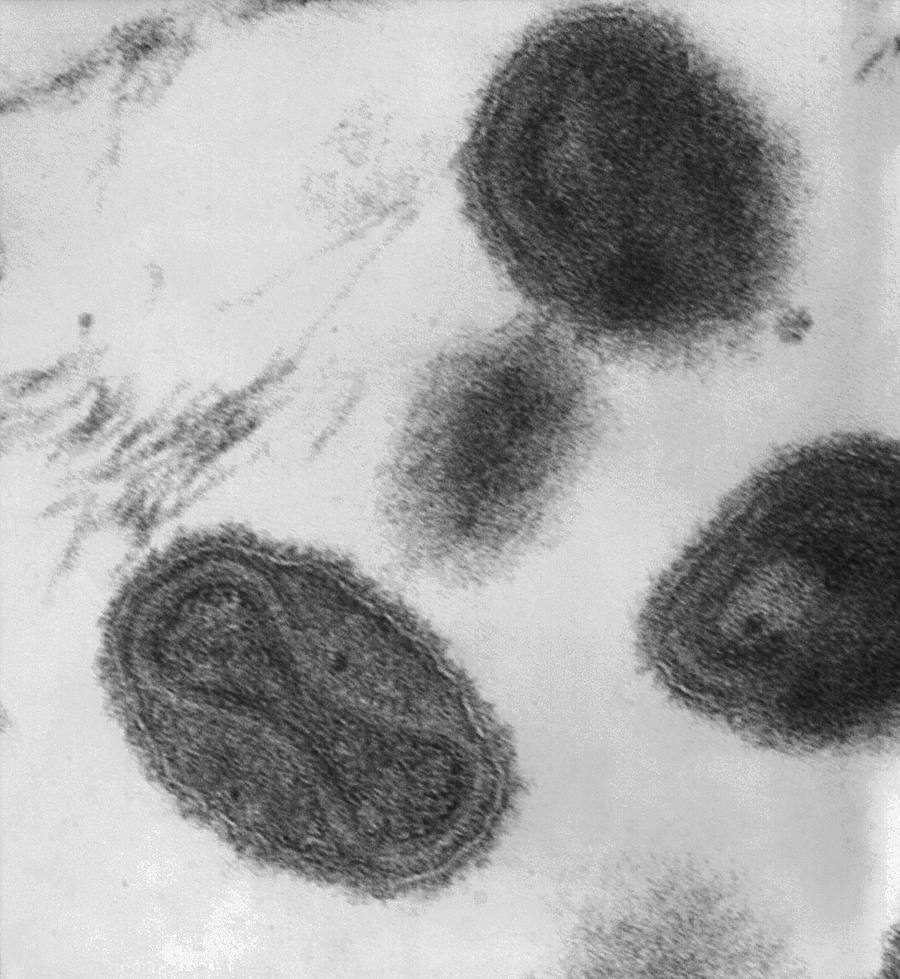
Image: CDC/Dr. Fred Murphy and Sylvia Whitfield, via Wikimedia Commons (Public domain)
Scientists have found a whole new group of giant viruses living in the human gut. The viruses are so common that the study projects they sit inside the digestive systems of roughly 180 million people around the world. They turned out to be the closest known relatives of the poxviruses, the family that includes smallpox and mpox. The team named the new group egoviruses. The work was published in the journal Nature on November 18, 2026. There is no sign that these viruses make people sick. But the find may help solve an old mystery about where poxviruses came from.
The study was led by Tom Delmont, a microbial ecologist at the French National Centre for Scientific Research, known as the CNRS, in Paris. Morgan Gaïa, a researcher at France's Alternative Energies and Atomic Energy Commission, known as the CEA, was a lead author with him. The work came out of the Genoscope, a French gene-sequencing center. Many other scientists took part, including researchers at the U.S. National Institutes of Health.
First, a word on what "giant viruses" are. Most viruses are tiny, far too small to see with an ordinary microscope. Giant viruses are different. They are large viruses with big, complex sets of DNA, the molecule that carries genetic instructions. Some giant viruses are so big you can spot them under a simple light microscope, the kind used in a school classroom. Scientists have mostly found them in the environment, in places like seawater and soil. They were almost never seen in the gut. That is part of why finding a whole group of them living there came as a shock.
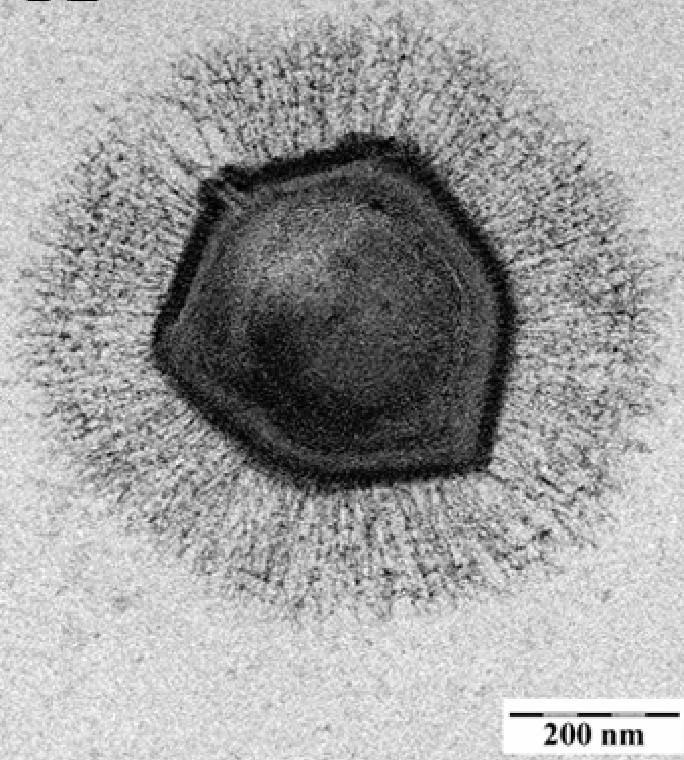
Image: Ghigo E. et al., PLoS Pathogens (2008), via Wikimedia Commons (CC BY 2.5)
§ 1A new family tree branch
Giant viruses belong to a large group with a long scientific name: Nucleocytoviricota. Most members of this group infect single-celled living things, such as the amoebas found in pond water. They had rarely been found living in the guts of animals. So the new result was a surprise.
The team found a cluster of viruses that no one had described before. The viruses were common in the gut. The researchers propose giving them their own new branch on the viral family tree, a group they call Egovirales. The individual viruses are the egoviruses. The names are provisional, meaning other scientists still have to agree on them.
These are true giants. The biggest egovirus genome the team found was about 467,000 DNA "letters" long. The average was around 229,000. For comparison, many common gut viruses carry only a few thousand letters. The team put together 12 complete egovirus genomes and more than 200 partial ones.
The scientists also made a prediction about the shape of the virus. From its genes, they expect each egovirus to be built as a many-layered ball with many flat sides, a shape called icosahedral. That is different from the poxviruses, which are shaped more like bricks. The team thinks the ball shape is the older, more original form. If so, the brick shape of poxviruses came later.
§ 2How they found them without a microscope
The scientists did not find these viruses by looking through a lens. They found them by reading DNA. The method is called metagenomics. In plain words, researchers take a sample, such as stool, and read all the genetic material in it at once. They do not have to grow anything in a dish first. That matters, because no one has grown an egovirus in a lab yet.
The search was huge. The team scanned more than 85,000 sets of genetic data, drawn from many kinds of samples. Within them, they sorted through close to two million copies of one key gene that most giant viruses carry. That gene acts like a fingerprint. Checking it again and again, they kept finding the egoviruses in gut samples.
This is an important point to keep clear. The viruses were found as DNA in samples. No one has yet seen an egovirus under a microscope. No one has grown one in a lab. So some details about them are based on the DNA alone, not on a direct look at the virus itself.
§ 3Common, and all over the world
The egoviruses were not rare. The team found their DNA in gut samples from people on several continents. The samples came from the Hadza, a hunter-gatherer group in Tanzania, and from people in Europe, the United States and South America. The viruses showed up in people of different ages and places.
How many people carry one? The estimates are careful, and they are estimates, not exact counts. The paper reports that one egovirus group is present in more than 1 percent of people worldwide. Using world population figures, the team projects the viruses into the guts of roughly 180 million people in all. They were detected in more than 2 percent of the human gut samples studied. The journal Nature's news report gave the same rough figure of 180 million people.
The viruses also seem to be long-term residents, not quick visitors. Studies that follow the same person over time found that one egovirus group can stay in that person's gut for long stretches. The team even spotted a related egovirus in samples from the mouth. That suggests these viruses settle into the body and stay, rather than just passing through with food or water.
The researchers also found egoviruses in many animals. The viruses were most common in water buffalo. The team estimates that a large share of the world's roughly 200 million buffalo may carry them. Egoviruses also turned up in pigs, goats, cows and chickens. Among wild animals, the team found them in bamboo rats, a lemur, a baboon and a rhinoceros. That wide spread, across many species and continents, suggests egoviruses have lived with animal guts for a very long time.
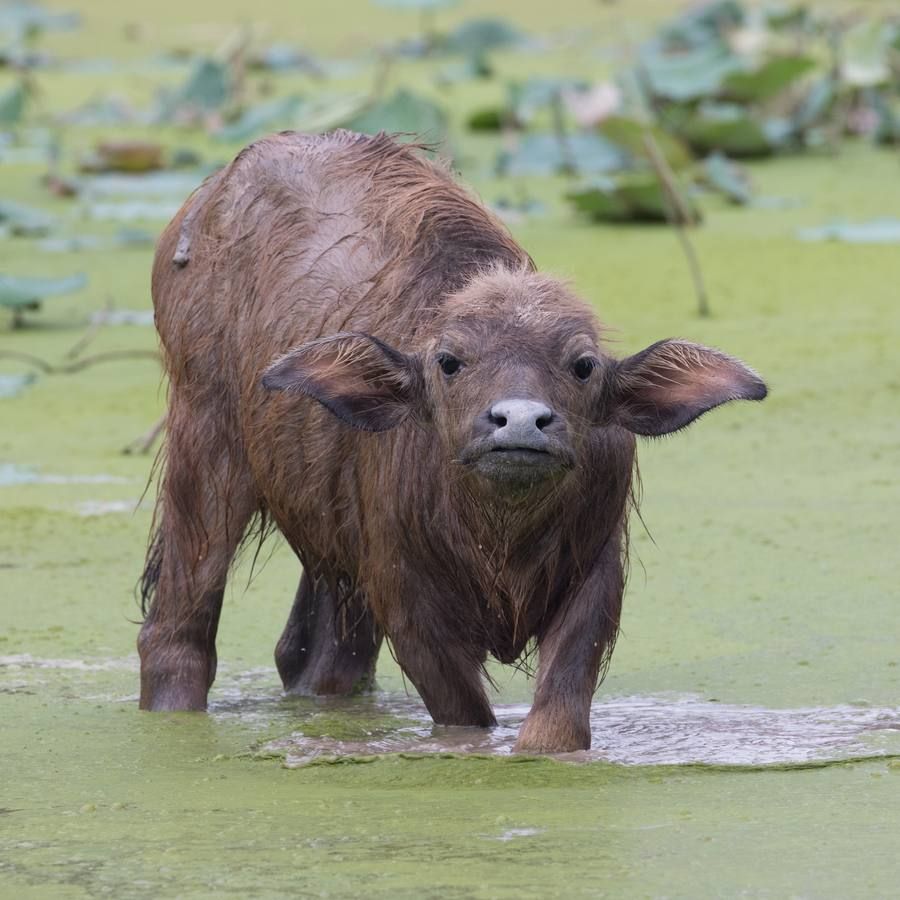
Photo: Basile Morin, via Wikimedia Commons (CC BY-SA 4.0)
§ 4The link to smallpox
Here is why the find matters beyond the surprise. Egoviruses are the closest known relatives of the poxviruses. Poxviruses are a well-known family. They include the virus that caused smallpox, a disease that was declared wiped out in 1980 after a global vaccination drive. Before that, smallpox was one of history's great killers. By the paper's estimate, it killed about half a billion people over the course of a century. The family also includes the mpox virus, once called monkeypox, which still infects people now and then.
Poxviruses have long puzzled scientists. Most giant viruses infect single-celled organisms, not animals. But poxviruses break that rule. They infect animals and people directly. How a virus made that jump has been a mystery. "Poxviruses are an outlier in the giant-virus world because they can directly infect humans and animals and their origin is a mystery," Fasséli Coulibaly, a structural biologist at Monash University in Australia, told Nature. He said egoviruses could be the "evolutionary bridge" between the giant viruses that infect microbes and the poxviruses that infect us.
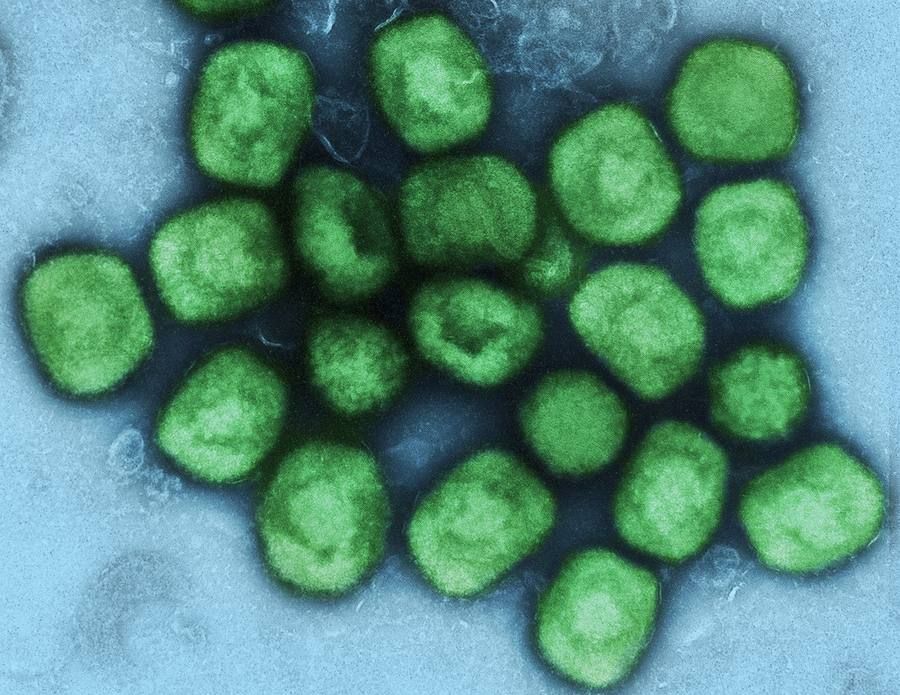
Image: NIAID, via Wikimedia Commons (CC BY 2.0)
The team lays out a possible story for how that bridge formed. They stress it is a proposed scenario, drawn from comparing genes, not a proven history. Animals first appeared roughly 700 million years ago. The guts of those early animals were full of single-celled microbes. The idea is that an ancestor of both egoviruses and poxviruses lived inside those gut microbes. Over a very long time, one line of these viruses gained the ability to infect animal cells directly. That line, the idea goes, became the poxviruses. In this view, the animal gut may have been the cradle where poxviruses got their start.
§ 5What the viruses actually infect
If egoviruses are so common in our guts, a fair question follows. Do they infect us? The evidence so far says no, not our own cells. The team looked for clues about which living things the viruses target. They did this by checking which genes the viruses share with other organisms. Over long spans of time, viruses and their hosts tend to swap genes, and that leaves a trail.
The trail pointed not to human cells but to tiny single-celled organisms that live in the gut. Two groups stood out. One is a set of single-celled creatures called ciliates that help animals like cows break down their food. The other is a group that includes Trichomonas vaginalis, a single-celled parasite that can infect people. So the best guess is that egoviruses prey on these gut microbes, not on us. They appear to be lodgers that feed on our other lodgers. This also fits the bigger idea in the study. If egoviruses infect single-celled gut dwellers today, their distant ancestors may have done the same inside the first animals, long ago.
Scientists not involved in the work called it important. "This is a really groundbreaking study," Subir Sarker, a molecular virologist at James Cook University in Australia, told Nature. The find shows that giant viruses are more varied, and live in more places, than researchers had thought. Gaïa, one of the lead authors, said it was the first time giant viruses had been found so widely spread through the guts of humans and so many animals.
§ 6What is confirmed, and what is not
It is worth separating what is solid from what is still open. It is confirmed that the team found a large, widespread group of new viral DNA in gut samples from many humans and animals around the world. It is confirmed that, by their genes, these viruses sit closest to the poxviruses on the family tree. Those findings rest on a careful, large-scale search of genetic data.
Several things are not yet settled. No one has seen an egovirus under a microscope or grown one in a lab, so some of its features, like its shape, are predicted from DNA rather than observed. The story of how poxviruses arose from gut viruses is a proposed scenario, not proven fact. And the team is clear that the viruses' effects on human or animal health are simply unknown for now. There is no evidence that they cause disease, but no one has ruled it out either.
The discovery adds a large, hidden piece to the picture of life inside the gut. For years, the human gut was thought to hold few of these big DNA viruses. Now scientists know that giant viruses, close cousins of smallpox, are quietly common there. They do not seem to harm us, and they may instead feed on other tiny gut dwellers. Studying them could help explain how one of history's deadliest virus families first came to be.
Watch & Listen
Hear this entry read aloud. Coming soon — the channels are not live yet.
Sources
- Gaïa, M., Guyet, U., Ruscheweyh, H.-J. et al. "Closest relatives of poxviruses prevail in human and animal guts worldwide." Nature, November 18, 2026. nature.com/articles/s41586-026-11283-z
- Fieldhouse, R. "Meet 'egoviruses': the surprise microbes living in the guts of millions of people." Nature (news), November 18, 2026. nature.com/articles/d41586-026-03766-w
- "Poxviruses probably evolved in the digestive system of animals." Nature (research briefing), November 18, 2026. nature.com/articles/d41586-026-03436-x
- "Présents dans nos intestins, ces virus géants éclairent les origines du virus de la variole." CEA press release, November 19, 2026. cea.fr/presse/Pages/actualites-communiques/sante-sciences-du-…
- "New egovirus giant virus estimated in intestines of 180 million people worldwide." Dong-A Science, November 2026. dongascience.com/en/news/80970
Read next
More in Science
Texas Sets a Sea Turtle Record as the World's Most Endangered Sea Turtle Keeps Coming Back
The smallest and most endangered sea turtle in the world just had its best year ever on the Texas coast. Wildlife teams found 697 Kemp's ridley sea turtle nests on Texas beaches in 2026.

More in Science
A Blood Test for CTE? Two New Studies Find a Warning Sign in the Blood
For the first time, scientists have found a sign of the brain disease CTE in blood taken from people while they were still alive.

On the front page
Tesla Rolls Out FSD v15 as Italy Says Yes to Its Assisted Driving
Tesla says the new software handles dangerous moments 25 times better and redraws the road like a video game. A day earlier, Italy became the biggest European country to approve the system, with a driver still in charge.