Space
Webb Reads the Chemistry of Interstellar Comet 3I/ATLAS, and Finds Record Heavy Hydrogen in Its Methane
By Darrell Wallen
Would you prefer to listen?
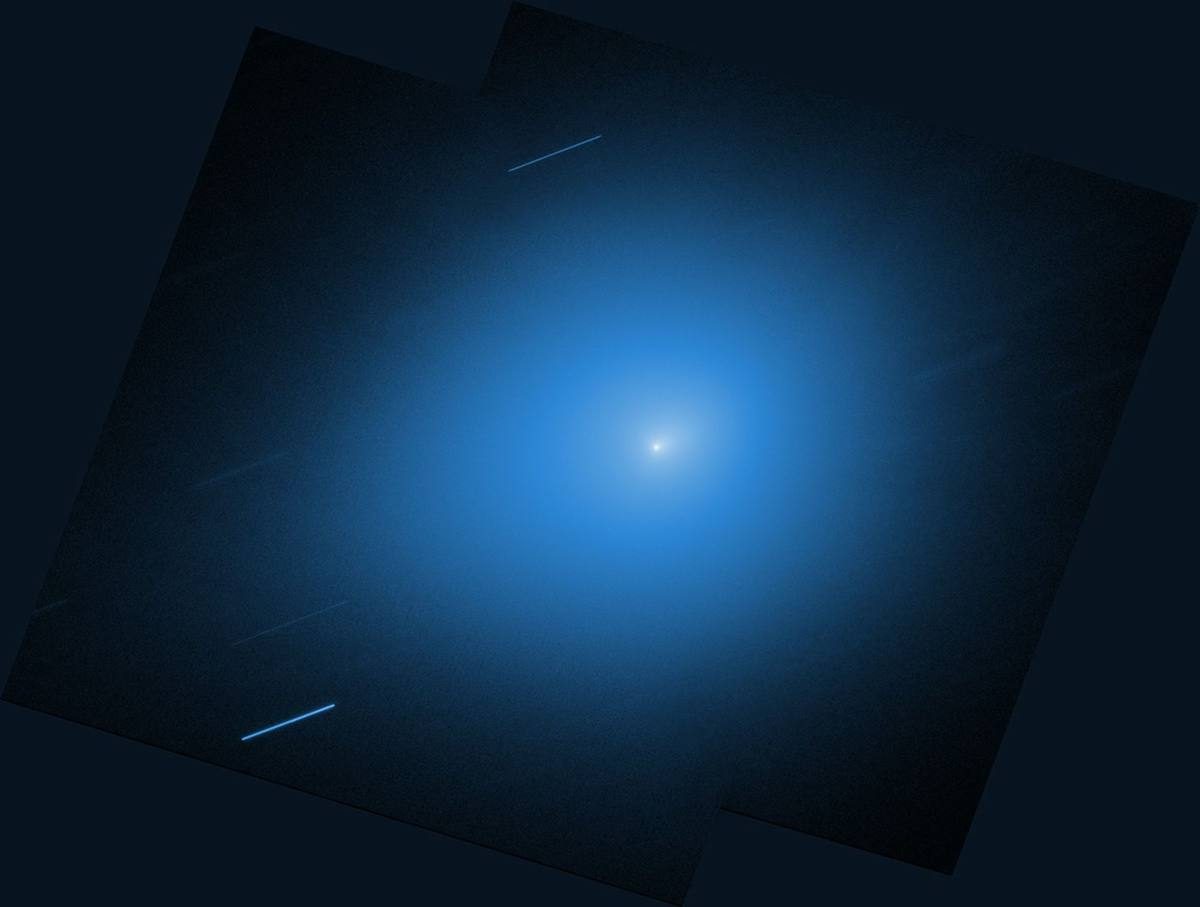
The methane streaming off interstellar comet 3I/ATLAS carries more heavy hydrogen than any methane ever measured in our solar system. That is the headline finding of a peer-reviewed study published October 23, 2026, in the journal Nature Astronomy, based on observations from NASA's James Webb Space Telescope. A second Webb study, published three days later in The Astrophysical Journal Letters, found that the comet's ice grains are unusually dusty. Together, the two papers add detail to a picture that has been building for more than a year: 3I/ATLAS is a natural comet that formed around another star, in conditions colder and very likely older than the ones that produced our own planets.
§ 1The heavy hydrogen result
Most hydrogen atoms have a single proton in the nucleus. A small fraction carry an extra neutron. That heavier form is called deuterium, and astronomers track it with a number called the D/H ratio, the share of deuterium compared with ordinary hydrogen. Deuterium is a useful clue because very cold conditions tend to concentrate it in molecules, while warmth tends to wash the signal out. A high D/H ratio points to a frigid birthplace.
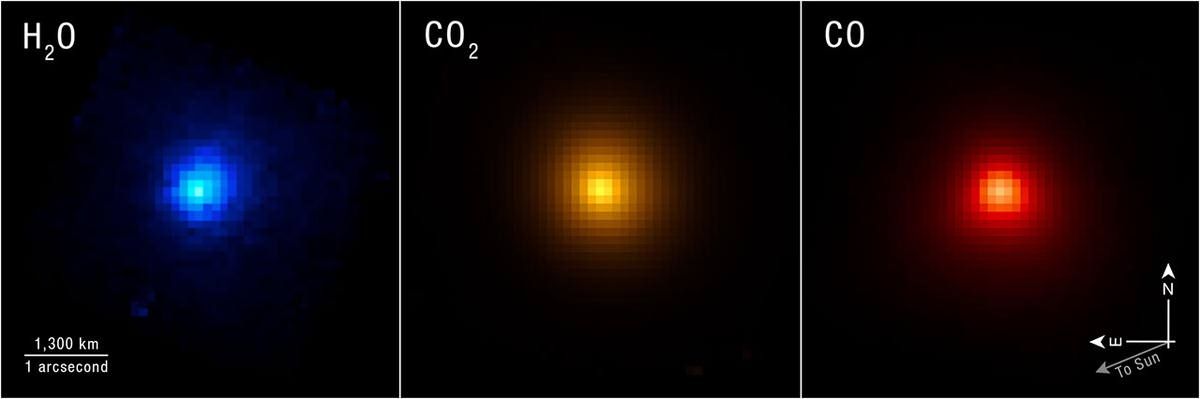
The Nature Astronomy team, led by Nathan X. Roth of NASA's Goddard Space Flight Center and American University, pointed Webb's Near-Infrared Spectrograph at the comet on December 22 and 23, 2025. At that time 3I/ATLAS was about 2.4 times as far from the Sun as Earth is, and heading out of the solar system. The instrument split the light of the comet's coma, the glowing cloud of gas around its nucleus, into its component colors.
The team found ordinary methane and its heavier twin, methane with one deuterium atom in place of hydrogen. From the two, they measured a D/H ratio of 3.18 percent, with an uncertainty of plus or minus 0.30 percent. In the paper's words, "This D/H ratio exceeds any other value for methane measured in the Solar System." It is about 13 times higher than the value the European Space Agency's Rosetta spacecraft measured in comet 67P/Churyumov-Gerasimenko, the only other comet in which deuterated methane has been detected.
Webb also picked up several other gases in the same observations. The paper lists carbon monoxide, methanol, ethane, formaldehyde and water. Carbon monoxide was the most abundant molecule in the coma at the time, which is unusual.
The methane result also lines up with an earlier measurement of the comet's water. A study published in Nature on June 22, 2026, led by Martin Cordiner of NASA Goddard and the Catholic University of America, used the same Webb data to measure heavy hydrogen in the comet's water. That ratio was already far above what is seen in solar system comets. NASA said the deuterium level was about 30 times higher than in comets from our own system. According to Phys.org's summary of the new paper, the methane ratio is about three times the water ratio. The researchers suggest the methane may have formed somewhat later than the water ice, after the surrounding chemistry had more time to concentrate heavy hydrogen.
§ 2Where the comet may have formed
The Nature Astronomy paper says the high methane D/H ratio "is consistent with the hypothesis that its ices formed in a cold, low-metallicity interstellar or protostellar environment under a high cosmic ray irradiation rate." To an astronomer, low metallicity means a place with relatively few elements heavier than hydrogen and helium.
That wording matters. "Consistent with" is not the same as proven. Phys.org noted that the result offers a plausible history rather than a uniquely identified birthplace. The authors themselves wrote that it is uncertain whether current models of star formation or planet-forming disks can reproduce the number, and that new models are needed.
The age estimate comes from the June study. Along with heavy hydrogen, Webb found only small traces of carbon-13 compared with the more common carbon-12. Galaxies build up carbon-13 over time, so a low share hints at an early origin. On that basis, the research team estimated that 3I/ATLAS could have formed as long as 10 to 12 billion years ago, during a period astronomers call cosmic noon, when star formation across the universe was at its height. Our Sun and planets formed about 4.5 billion years ago. The 10-to-12-billion-year figure is an estimate drawn from chemistry, not a measured age, and it should be read that way.
"This was a unique opportunity to study an ancient object from the distant galaxy, probably pre-dating our Sun and solar system," Cordiner said in NASA's June release.
§ 3Dusty ice grains
The second new study looked at the solid material in the coma rather than the gas. It was led by Silvia Protopapa of the Southwest Research Institute in Boulder, Colorado, and published in The Astrophysical Journal Letters, with a release from the institute on October 26. The team observed 3I/ATLAS with the same Webb spectrograph three times between August 2025 and April 2026, before and after the comet's closest pass by the Sun.
Water ice leaves fingerprints in infrared light. There is a deep dip near 3 microns and two weaker dips near 1.5 and 2.0 microns. Most icy comets show all three. In 3I/ATLAS the 3-micron feature was strong, but the two shorter ones were very weak or missing. "That combination was a puzzle," Protopapa said in the release.
Computer models of how light scatters off small particles explained the pattern best with grains about a micron across or smaller, made of water ice mixed with a lot of dust. In grains that small and that dusty, light passes through only a short stretch of ice, which weakens the shorter-wavelength fingerprints. "The grains of 3I/ATLAS are about the same size as those in our own comets," Protopapa said. "What seems to set them apart is how much dust is mixed into the ice."
The grains also seemed to change. By April 2026, as the comet moved away from the Sun, the data favored an additional group of larger, more ice-rich grains, still around a micron in size. Michael Kelley of the University of Maryland, the paper's second author, said the team cannot yet tell whether that change came from the Sun heating the grains differently at each visit or from fresh material exposed as the comet's surface wore away. "Both are possible," he said.
Then came a twist. When the team compared 3I/ATLAS with Webb spectra of trans-Neptunian objects, the icy bodies that orbit beyond Neptune, the comet no longer looked strange. Several groups of those distant worlds also lack the shorter water-ice bands. "At first glance, 3I/ATLAS looks different from the icy comets we know," Protopapa said. "But when we placed it alongside distant icy worlds in our own solar system, it no longer looked out of place." The team suggests that the building blocks of planets, here and around other stars, may share a common range of ice grain types, from fairly pure to quite dusty, with 3I/ATLAS toward the dusty end.
§ 4How 3I/ATLAS was found
The comet was first reported on July 1, 2025, by a telescope of the NASA-funded Asteroid Terrestrial-impact Last Alert System, or ATLAS, in Rio Hurtado, Chile. Astronomers then found earlier images of the comet in the archives of other ATLAS telescopes and Caltech's Zwicky Transient Facility at Palomar Observatory, reaching back to June 14, 2025.
Astronomers knew it came from outside the solar system because of its speed and path. NASA says it was moving at about 137,000 miles per hour when found, too fast for the Sun's gravity to hold. Its path was hyperbolic, an open curve rather than a closed loop. It came in from the direction of the constellation Sagittarius, toward the center of our galaxy.
Hubble images in the summer of 2025 showed a teardrop-shaped cocoon of dust around a nucleus too small to see directly. Based on Hubble data from August 20, 2025, NASA estimated the nucleus at no less than about 1,400 feet and no more than 3.5 miles across. "No one knows where the comet came from," said David Jewitt of the University of California, Los Angeles, who led the Hubble observations. "It's like glimpsing a rifle bullet for a thousandth of a second."
§ 5The trip through our solar system
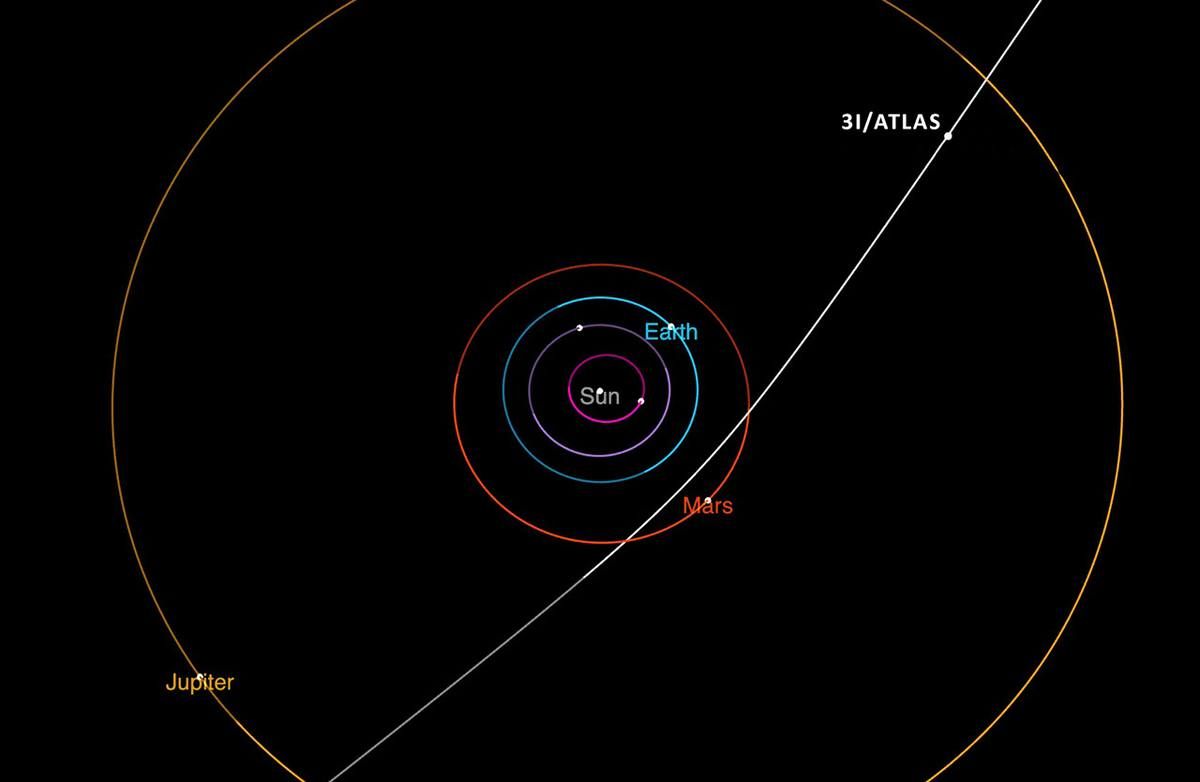
The comet made its closest approach to the Sun on October 30, 2025, at about 130 million miles, or 1.4 times Earth's distance from the Sun. It sped up to about 153,000 miles per hour at that point. The comet never came closer to our planet than about 170 million miles, nearly twice the distance to the Sun. NASA says it posed no danger.
Because it was hidden in the Sun's glare from Earth for part of the fall, more than a dozen NASA and ESA spacecraft, from Mars orbiters to solar probes, helped fill the gap. The comet passed Mars in early October 2025 and went by Jupiter in March 2026 on its way out.
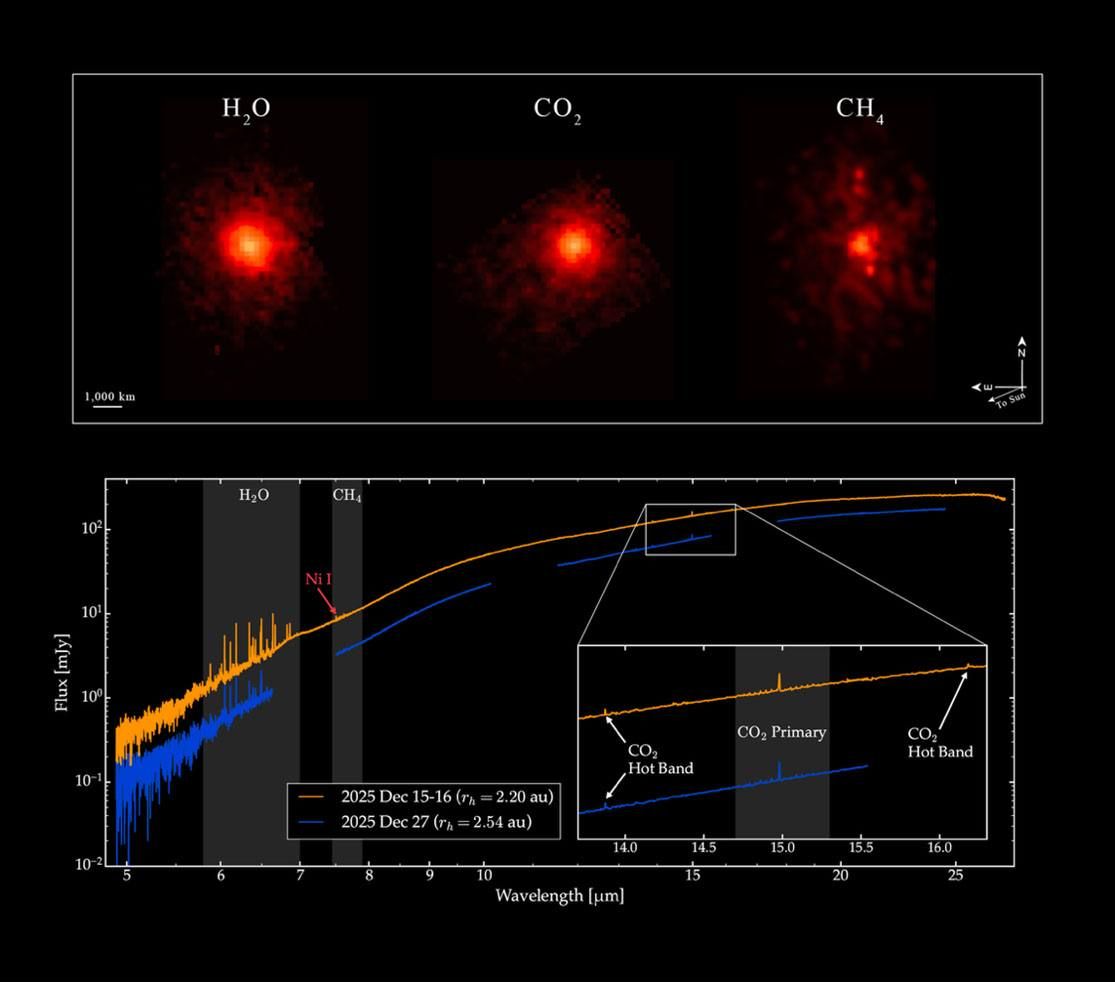
On its way out of the inner solar system, Webb's mid-infrared instrument found methane gas in December 2025, the first time methane had been directly detected on an interstellar visitor. NASA said its late appearance suggests the methane was buried below the surface until the Sun's heat reached deeper layers. Webb also confirmed that the comet released far more carbon dioxide relative to water than typical solar system comets.
§ 6The two earlier visitors
3I/ATLAS has only two known predecessors. The first, 1I/'Oumuamua, was discovered on October 19, 2017, by the Pan-STARRS1 telescope in Hawaii. It showed no visible dust or gas, and NASA describes it as highly elongated, perhaps 10 times as long as it is wide, which no known asteroid or comet matches. It also sped up slightly as it left, which NASA says is a sign it behaved more like a comet.
The second, 2I/Borisov, was found on August 30, 2019, by Crimean amateur astronomer Gennady Borisov. Unlike 'Oumuamua, it was plainly active, wrapped in dust like a normal comet. NASA estimated it at about 3,200 feet across. 3I/ATLAS is the second clearly cometary interstellar object, and by far the best studied.
§ 7What went viral, and what holds up
As the Webb papers came out, 3I/ATLAS was trending again on X, often framed as a mystery. Some posts went further.
On November 2, 2026, the X account UFO & Alien Secrets (@ufoaliensecrets) posted that "NASA trajectory adjustments" showed "a mysterious shift in its Jupiter flyby and anomalous outgassing," and raised the question of whether the comet's path was "a cosmic coincidence or an intelligently guided course." The post did not cite a NASA source for any trajectory adjustment. NASA's own fact page says that, like other comets, 3I/ATLAS had small changes in its path from outgassing, and that "these perturbations were indeed small and compatible with this process." It also says the comet left the solar system at the same speed it came in.
The idea of guidance did not start on that account. Harvard astrophysicist Avi Loeb has written for more than a year about what he calls anomalies in 3I/ATLAS, including how closely its path lined up with the plane of the planets and the distance of its Jupiter pass. In a March 10, 2026, post, Loeb lowered his own rating of the object and described its behavior as natural and cometary, accompanied by what he considers unexplained anomalies.
The most widely shared post was a video. On November 3, 2026, the same account posted a 30-second clip of a glowing, slipper-shaped object drifting against a dark, speckled background, captioned "3I/ATLAS was not a comet!" By November 5 the post had more than 100,000 views. It does not show the comet. A nearly identical clip circulated in October 2025, and the fact-checking site Lead Stories traced it then. Jack Gilbert, a microbiologist at the Scripps Institution of Oceanography, identified the organism in that clip as "a paramecium," a single-celled creature filmed under a microscope. When a user asked whether the new post was real, X's Grok assistant replied that it was not, and that the footage showed a paramecium passed off as 3I/ATLAS.
Not every viral post was false. A November 3 post by the account UNIVERSE Now (@UniverseNow00), with about 17,000 views, summarized the dusty ice grain study accurately, although it wrapped the result in "mystery" language and a UFO hashtag.
§ 8Confirmed and not confirmed
Confirmed in peer-reviewed papers: Webb measured a methane D/H ratio of 3.18 percent, plus or minus 0.30 percent, in 3I/ATLAS, the highest ever measured for methane and about 13 times that of comet 67P; Webb detected carbon monoxide, methanol, ethane, formaldehyde and water in the same observations; and the comet's ice grains are about a micron or smaller and heavily mixed with dust. Also confirmed by NASA: the comet was discovered by ATLAS on July 1, 2025, passed closest to the Sun on October 30, 2025, posed no threat to Earth, and followed a path consistent with a natural comet.
Not confirmed: the 10-to-12-billion-year age, which is an estimate based on chemistry; formation in a cold, low-metal environment, which the authors describe as consistent with the data rather than proven; and the idea that ice grain types are shared across planet-forming disks, which needs more observations. Not supported by any evidence: claims that the comet followed an intelligently guided course, and the microscope video presented as new footage of 3I/ATLAS.
With its chemistry now on record, 3I/ATLAS is fading on its way back into interstellar space, and it will not return.
Watch & Listen
Hear this entry read aloud. Coming soon — the channels are not live yet.
Sources
Research papers
- Nature Astronomy, Roth et al., "An enriched methane D/H ratio in the interstellar object 3I/ATLAS" (Oct 23, 2026): nature.com/articles/s41550-026-03002-5
- The Astrophysical Journal Letters, Protopapa et al., "JWST Reveals Refractory-rich Water Ice in Interstellar Comet 3I/ATLAS" (2026): doi.org/10.3847/2041-8213/aea60d
Agency and institution releases
- Southwest Research Institute, "SwRI-led study uses Webb to compare interstellar comet 3I/ATLAS to icy bodies in our solar system" (Oct 26, 2026): swri.org/newsroom/press-releases/swri-led-study-uses-webb-com…
- NASA, "NASA's Webb Finds Clues to Ancient, Distant Origin of Comet 3I/ATLAS" (June 22, 2026): science.nasa.gov/missions/webb/nasas-webb-finds-clues-to-anci…
- ESA/Webb, weic2613 (June 22, 2026): esawebb.org/news/weic2613/
- NASA, "NASA's Webb Detects Methane on Interstellar Comet 3I/ATLAS" (June 1, 2026): science.nasa.gov/blogs/3iatlas/2026/06/01/nasas-webb-detects-…
- NASA, "Comet 3I/ATLAS": science.nasa.gov/solar-system/comets/3i-atlas/
- NASA, "3I/ATLAS Facts and FAQs": science.nasa.gov/solar-system/comets/3i-atlas/3i-atlas-facts-…
- NASA, "NASA Discovers Interstellar Comet Moving Through Solar System" (July 2, 2025): science.nasa.gov/blogs/planetary-defense/2025/07/02/nasa-disc…
- NASA, "As NASA Missions Study Interstellar Comet, Hubble Makes Size Estimate" (2025): science.nasa.gov/missions/hubble/as-nasa-missions-study-inter…
- NASA, "'Oumuamua": science.nasa.gov/solar-system/comets/oumuamua/
- NASA, "2I/Borisov": science.nasa.gov/solar-system/comets/2i-borisov/
News coverage
- Phys.org, report on the Roth et al. methane D/H study (Oct 2026): phys.org/news/2026-10-heavy-hydrogen-3iatlas-methane-frigid.html (site blocks automated checks)
- Space.com, "James Webb Space Telescope uncovers new clues about the origins of interstellar invader comet 3I/ATLAS" (Nov 2, 2026): space.com/astronomy/asteroids/james-webb-space-telescope-unco…
- Lead Stories fact check via Yahoo News, paramecium video falsely presented as 3I/ATLAS (Oct 2025): yahoo.com/news/articles/fact-check-video-does-not-071622552.html
Commentary and social posts
- Avi Loeb, Medium, "Q&A about 3I/ATLAS a week before its closest approach to Jupiter" (Mar 10, 2026): avi-loeb.medium.com/q-a-about-3i-atlas-a-week-before-its-clos… (site blocks automated checks)
- X, @ufoaliensecrets, trajectory post (Nov 2, 2026): x.com/ufoaliensecrets/status/2117115511506927967
- X, @ufoaliensecrets, "3I/ATLAS was not a comet!" video (Nov 3, 2026): x.com/ufoaliensecrets/status/2117641795840454675
- X, @grok, reply identifying the paramecium (Nov 3, 2026): x.com/grok/status/2117768188947468343
- X, @UniverseNow00, ice grain post (Nov 3, 2026): x.com/UniverseNow00/status/2117560878174523574
Read next
More in Space
ULA's Vulcan Rocket Fails on Its First Amazon Launch, and 40 Satellites Are Lost
A Vulcan rocket built by United Launch Alliance failed on Sunday, November 15, 2026, about 10 minutes after it left Florida.
More in Space
NASA Asks Industry How to Save Hubble Before It Falls
NASA wants to know if a private company can save the Hubble Space Telescope. On October 29, 2026, the agency asked companies how they might catch Hubble, push it higher, fix it, or guide it safely down into the atmosphere. Answers are due at 3 p.m. Eastern on Monday, November 30. NASA is not buying a mission yet. It wants to learn what companies can do and what it might cost. Hubble is slowly sinking, and NASA says any rescue would need to fly by 2032.
On the front page
Frozen Inca Mummies Reveal What Children Were Given Before Mountaintop Sacrifices
More than 500 years ago, Inca priests led children up some of the highest volcanoes in the Andes. There, the children were sacrificed to the mountain gods. Now, a new lab study of eight frozen mummies shows what those children were given in their final weeks. Every hair sample tested held traces of coca, the sacred leaf. Some children also drank alcohol. One famous girl, known as Juanita, carried a chemical tied to ayahuasca, a drink made from an Amazon vine. The results suggest the ritual was not the same everywhere. Each mountain may have had its own recipe.