Space
Voyager 1 Will Reach One Light-Day From Earth on November 18
By Darrell Wallen
Would you prefer to listen?
NASA's Voyager 1 spacecraft is about to reach a distance that no human-made object has ever reached. On Wednesday, November 18, 2026, at 5:16:07 a.m. Eastern Time, the probe will be one light-day from Earth. That is how far light can travel in 24 hours: 16.094 billion miles, or 25.902 billion kilometers. A radio message sent from Earth will take a full day to arrive, and the spacecraft's reply will take another day to come home.
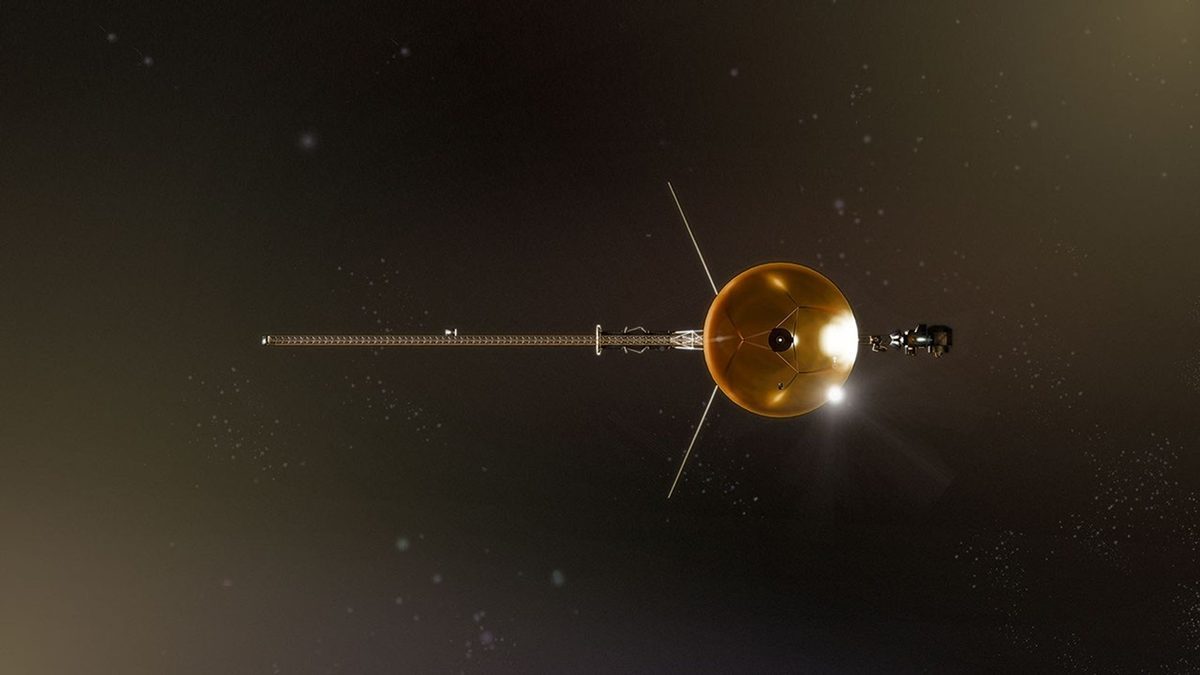
The crossing is still a week away. Some posts online have already treated it as done. NASA's own clocks say otherwise. The agency has named the exact minute, and it has invited people around the world to mark the moment the night before.
§ 1A measure of distance, not of time
A light-day is a way to talk about distance. It is not a length of time. Nothing we know of moves faster than light. Light covers about 186,000 miles every second. In one day, that adds up to 16,094,799,096 miles, or 25,902,068,356 kilometers.
Everyday miles stop being helpful at this scale. NASA uses light-times to make the gaps easier to picture.
The Moon is about 238,855 miles from Earth, on average. Light makes that trip in 1.3 seconds. Sunlight takes about eight minutes and 20 seconds to cross the 93 million miles from the Sun to Earth.
The gap between Earth and Mars keeps changing as both planets go around the Sun. A radio signal can take from three minutes to 22 minutes to travel between them. Neptune, the most distant planet, averages about 2.8 billion miles from Earth. That is four hours and 10 minutes at the speed of light. Voyager 2, moving at about 35,000 miles per hour, needed 12 years to get there.
A light-year, the more familiar unit, is how far light travels in a year: about 5.88 trillion miles. The nearest neighboring solar system, around the star Proxima Centauri, is about 4.24 light-years away.
Voyager 1 is not yet anywhere near those stars. After nearly 50 years of flight, it is only now reaching one light-day.
§ 2A two-day hello
The practical change is about talking to the spacecraft, not about a new wall in space. Radio waves travel at the speed of light. When Voyager 1 crosses the mark, a command from Earth will take 24 hours to reach it. The reply will take another 24 hours to return.
"If you want to say 'hello' to Voyager, you send your message and then you go home and you wait two days before you finally get a response," said Suzanne Dodd, the Voyager project manager at NASA's Jet Propulsion Laboratory, or JPL, in Southern California.
NASA says the spacecraft itself will not feel a change when it passes this point. Nothing on board will switch because of the milestone. The probe will not enter a new kind of space at that minute. The meaning is the distance, and the fact that a machine built in the 1970s is still working out there.
JPL put the probe's speed at 38,000 miles per hour, or 61,155 kilometers per hour. That is fast in human terms. Compared with light, it is a crawl. NASA says Voyager 1 will have taken 49 years, two months and 11 days to travel one light-day from Earth.
Its twin, Voyager 2, took a longer path so it could visit Uranus and Neptune. NASA says Voyager 2 should reach one light-day from Earth in November 2035.
§ 3A long road from Florida
Voyager 1 left Earth on September 5, 1977, from Cape Canaveral, Florida, on a Titan IIIE-Centaur rocket. The spacecraft weighed 1,592 pounds, or about 722 kilograms. Voyager 2 had launched two weeks earlier, on August 20, 1977. Voyager 1 flew a faster route and passed its twin on December 15, 1977.
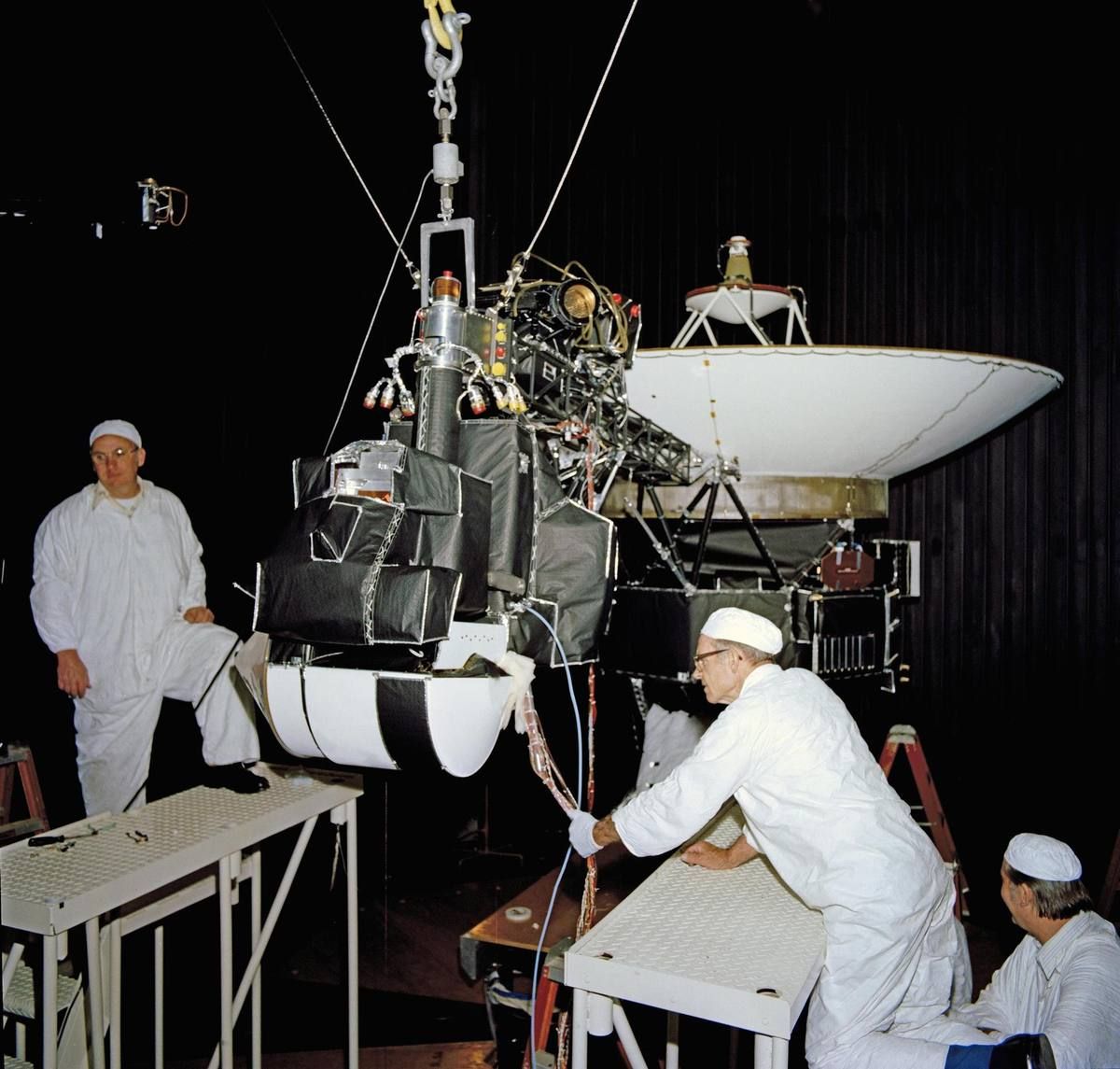
Both probes were built to take advantage of a lineup of the outer planets that happens only once every 176 years. Voyager 1's job was to fly by Jupiter and Saturn.
It began studying Jupiter in April 1978. Its closest pass came on March 5, 1979, at a range of 174,000 miles, or 280,000 kilometers. NASA says the spacecraft found a faint ring around Jupiter and two new moons, Thebe and Metis.
The closest pass of Saturn came on November 12, 1980, at about 78,000 miles, or 126,000 kilometers. Voyager 1 found five new moons and a new ring, called the G-ring. It also studied Titan, Saturn's largest moon. Images showed a thick haze that hid the ground. NASA says Titan's air was about 90 percent nitrogen, with methane and other carbon-rich gases mixed in.
After Saturn, Voyager 1 was aimed north, out of the flat plane of the planets, so it could fly close to Titan. That choice meant it would not go on to Uranus and Neptune. It has been heading outward ever since.
On February 17, 1998, Voyager 1 became the most distant human-made object when it passed NASA's earlier probe, Pioneer 10. It still holds that title.
§ 4A last look home
On February 14, 1990, the mission told Voyager 1 to look back. The team planned to shut off the cameras to save power. Before that happened, the spacecraft took a set of images that NASA later called the "Family Portrait of the Solar System."
Those frames included six planets. Mercury and Mars did not show up in the views. One frame became famous as the "Pale Blue Dot." It was taken at 4:48 GMT, from about 3.7 billion miles, or 6 billion kilometers, from the Sun. Earth appears as a soft blue speck, smaller than a single pixel, caught in a ray of sunlight scattered inside the camera. Thirty-four minutes later, Voyager 1 turned its cameras off for good.
The popular name comes from a 1994 book by Carl Sagan, a member of the Voyager imaging team. NASA says Sagan originated the idea of using the cameras to photograph the distant Earth, and that he played a key role in making the family portrait happen. In 2020, for the photo's 30th anniversary, JPL released a cleaned-up version of the same view. The new processing used newer tools and tried to stay true to the original data.
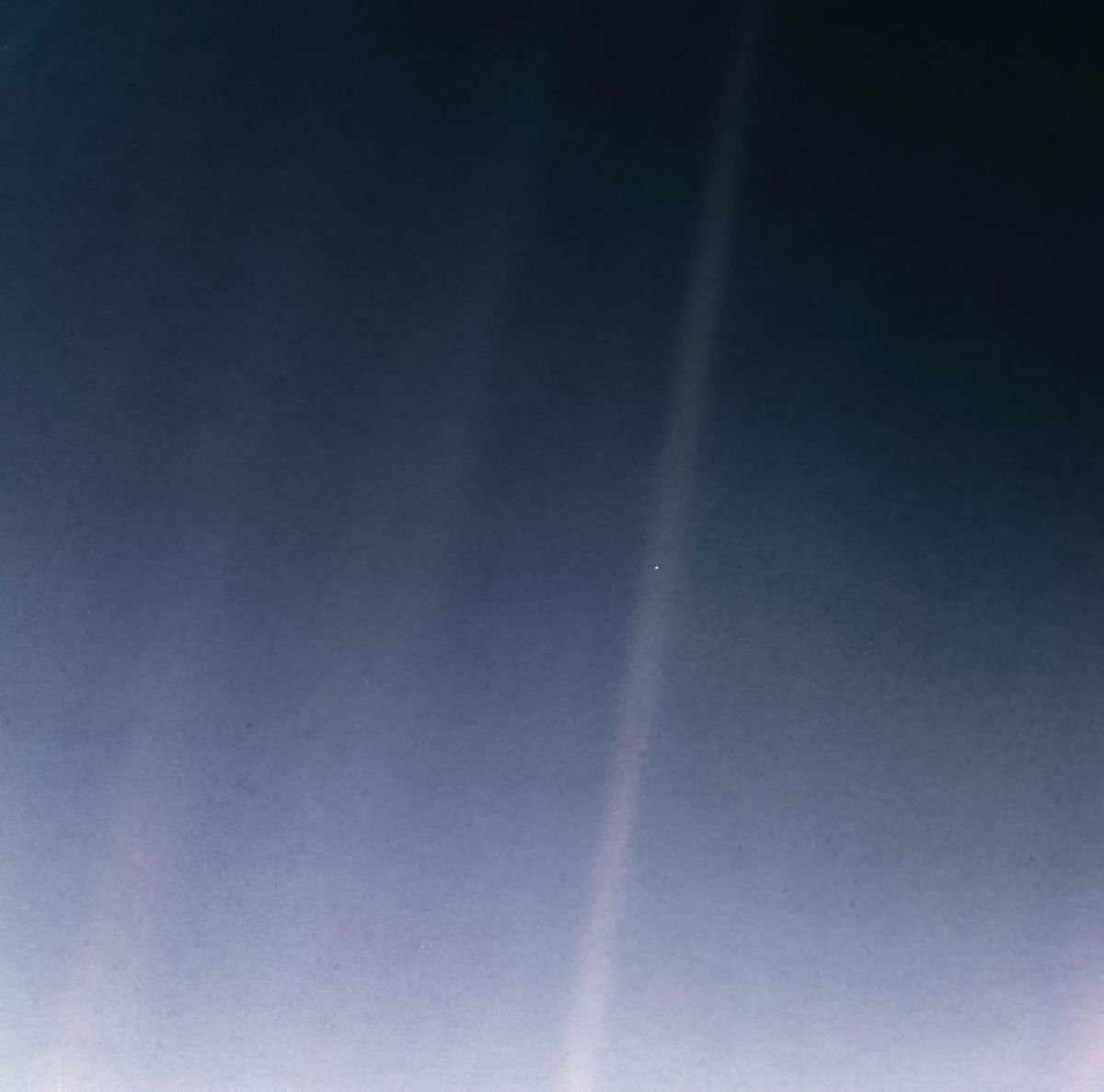
The picture is a reminder of how far the spacecraft had already gone by 1990.
§ 5Into the space between the stars
The Sun blows out a huge bubble of particles and magnetic fields. Scientists call that bubble the heliosphere. Beyond it lies interstellar space, the thin gas and magnetic fields between the stars.
Voyager 1 crossed that boundary on August 25, 2012. It was the first human-made object to do so. Voyager 2, on a different path, followed on November 5, 2018. NASA says the two Voyagers are still the only spacecraft that have studied this region up close.
The probes no longer take pictures. They still listen. They measure the magnetic field and the waves that move through the thin gas around them. No other working craft is out there with them.
Voyager 1 is now headed toward a faint star more than 17 light-years away. The star is called AC +79 3888, or Gliese 445, in the constellation Ursa Minor, the Little Dipper. NASA says the spacecraft should pass within about 1.7 light-years of that star in 40,000 years. It will only drift by, still carrying a message from home.
§ 6Power, heat and a close call
Each Voyager gets its electricity from devices called radioisotope thermoelectric generators. They turn heat from decaying plutonium into power. The plutonium is slowly used up. NASA says each probe loses about four watts of power every year. After almost 50 years, the margin is thin.
The two spacecraft launched with 10 science instruments each. Many were turned off after the planet flybys. In recent years, the team has had to shut down more of them to keep the probes alive.
On April 17, 2026, engineers at JPL sent commands to turn off Voyager 1's Low-energy Charged Particles experiment, known as LECP. That instrument had been running almost without a break since 1977. It measured ions, electrons and cosmic rays, and it helped map the space beyond the Sun's bubble.
The team did not make that choice in a rush. Years earlier, the science and engineering groups had agreed on the order in which parts would be switched off. A sudden drop in power during a planned roll on February 27 raised a risk. The spacecraft's own safety system might have started shutting things down by itself. The team acted first.
"While shutting down a science instrument is not anybody's preference, it is the best option available," said Kareem Badaruddin, the Voyager mission manager at JPL, in NASA's April report. He said Voyager 1 still had two science instruments working: one that listens to plasma waves and one that measures magnetic fields. Plasma is a thin, electrically charged gas.
A small motor on the LECP, which uses only 0.5 watts, was left on. NASA said that gave the team the best chance of turning the instrument back on later if extra power could be found. NASA has not said that the instrument has been turned back on.
In early September, the team finished a larger power-saving job it nicknamed the "Big Bang." Engineers turned off three devices on Voyager 1 and replaced them, all at once, with three that use less power. The same swap had been done on Voyager 2 about six weeks earlier. The six devices help keep the spacecraft warm enough to work in the deep cold of space. NASA said the swap had to happen all at once so the heat would still be spread evenly around the craft.
Without that change, NASA said, the team would have needed to turn off another Voyager 1 instrument as early as the summer of 2027. The Big Bang is meant to let the two remaining instruments keep running longer than before.
§ 7A silence that lifted itself
The spacecraft still surprises the people who fly it. On October 18 and 19, NASA's Deep Space Network could not hear Voyager 1. The network is a set of large antennas at three sites around the world. It is how Earth talks to probes at the Moon and far beyond. Two scheduled attempts, 24 hours apart, found no signal. At the time, JPL said the spacecraft was 16 billion miles from Earth.
The signal came back on its own on October 20, before the team sent commands to troubleshoot. Engineers have kept contact since then. They are still investigating the cause. They have determined that one set of thrusters went offline and that backup thrusters turned on. That swap is supposed to happen automatically if the spacecraft's computers sense a problem. NASA calls this fault protection. It puts the craft into a stable state and pauses normal work so engineers can figure out what went wrong.
"This is the first time we've seen the spacecraft do something like this, but we are also at a point in the mission where we have to expect the unexpected," Badaruddin said in JPL's October 29 report. "We're relieved to be back in contact with Voyager 1 and are eager to understand what happened."
As of that report, the team had not announced a final cause. The quiet two days were a reminder that contact at this distance is never guaranteed.
§ 8A golden record, and a night of lights
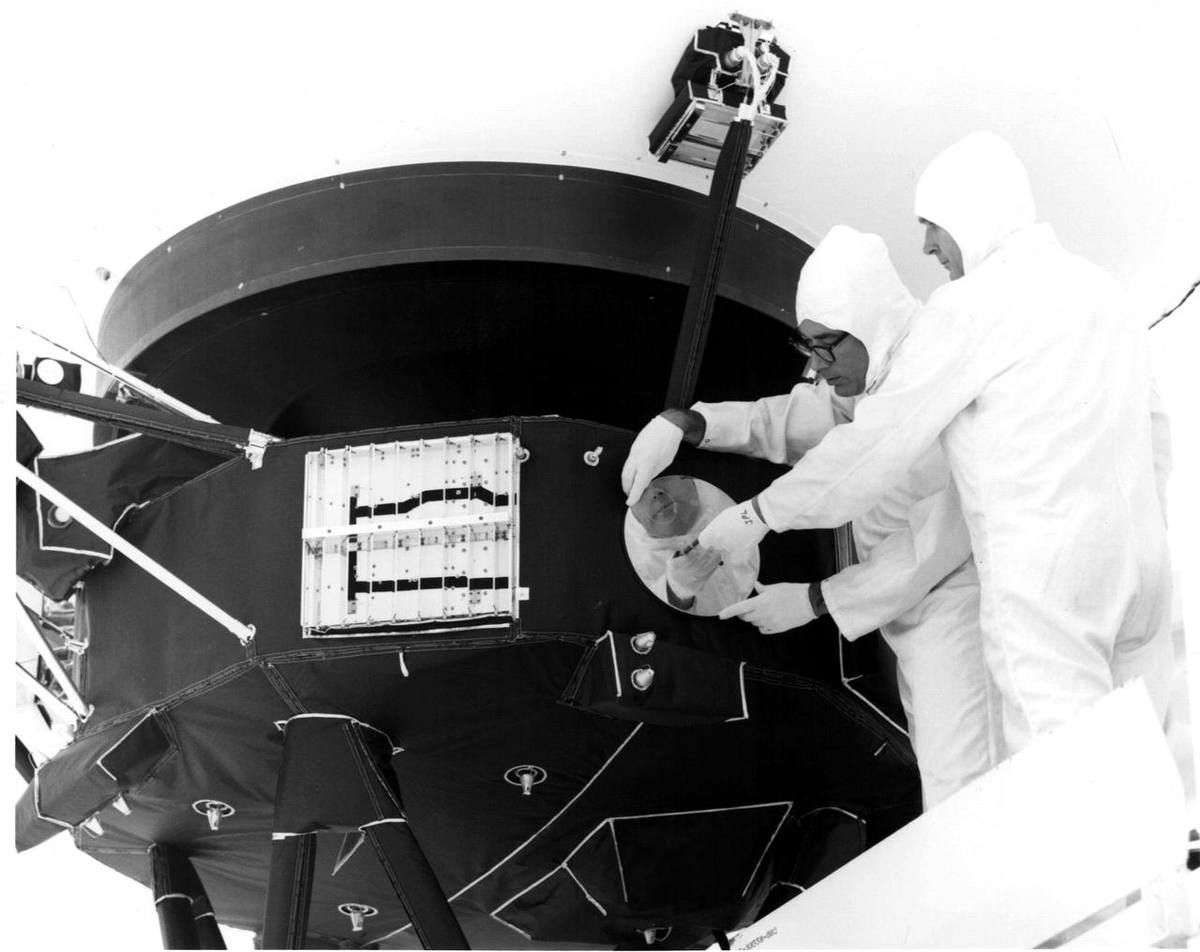
Both Voyagers carry a gold-plated copper disc about 30 centimeters, or 12 inches, across. It is known as the Golden Record. It is a greeting card for anyone, or anything, that might find the spacecraft in the distant future. NASA says the disc includes greetings in 55 languages, 35 sounds from Earth, about 90 minutes of music, and 115 images of life on this planet. It also holds recorded greetings from then-President Jimmy Carter and then-United Nations Secretary-General Kurt Waldheim.
NASA says the record already includes a Morse code phrase, the Latin line "Ad astra per aspera," which means "through struggle to the stars."
On Tuesday, November 17, after sunset, NASA is inviting people everywhere to take part in an event called "Shine Bright for Voyager's Light-Day." The idea is a symbolic wave of golden light around the Earth. People can point a phone, a flashlight or even a building's lights at the sky. Then they flash the letters V-G-R, Voyager's call sign, in Morse code.
In Morse code, V is three short flashes and one long one. G is two long flashes and one short one. R is a short flash, a long flash, and a short flash. NASA has also built a web page that flashes the code automatically on a phone or tablet. The page is at go.nasa.gov/shinebright. NASA asks people to repeat the signal for about a minute and to share photos or video, tagging @NASA.
This is a celebration, not a real message to the spacecraft. A flashlight beam will not reach Voyager 1. NASA calls the act symbolic. The real messages still go out as radio waves through the Deep Space Network, and they will soon take a full day to arrive.
On Thursday, November 19, at 12 p.m. Eastern Time, JPL will host a public discussion in its von Kármán Auditorium, the hall that held Voyager briefings during the planet flybys. NASA says the speakers will include Nicky Fox of the Science Mission Directorate, JPL chief scientist Jonathan Lunine, Suzanne Dodd, Kareem Badaruddin, and Jamie Rankin of Princeton University. There will be questions from the media and the audience. NASA also plans a preview of a NASA+ Voyager film for 2027, the mission's 50th year. The event will be carried on NASA's live video page.
§ 9What this mile marker means
Voyager 1 will not ring a bell when it reaches one light-day. The Sun will still be a bright star behind it. The two remaining instruments will keep listening to the space between the stars, for as long as the fading power supply allows. The Golden Record will stay bolted to the spacecraft, a quiet copy of voices, music and pictures from Earth.
The milestone is a human one. A machine launched in 1977, built for a flyby of two planets, is still talking to the people who sent it, from 16 billion miles away. NASA has set the clock for 5:16:07 a.m. Eastern Time on November 18. The reply to any greeting sent at that moment will not be back until the next day.
That is what one light-day means. It is a distance so large that even light, the fastest thing there is, needs a full day to cross it. Voyager 1 is about to become the first thing we have ever built to get there, and it is still on the job.
Watch & Listen
Hear this entry read aloud. Coming soon — the channels are not live yet.
Sources
Books
- Pale Blue Dot: A Vision of the Human Future in Space, by Carl Sagan. ISBN 9780345376596
NASA and JPL
- NASA Science, "Voyager 1: What Is a Light-Day" (milestone time, exact light-day distance, comparisons, destination, and travel time): science.nasa.gov/mission/voyager/voyager-1/voyager-1-what-is-…
- NASA Science, "Where Are Voyager 1 and 2 Now?": science.nasa.gov/mission/voyager/where-are-voyager-1-and-voya…
- NASA, "NASA Invites Media, Public to Join Voyager 1 One-Light Day Activities" (Nov 10, 2026): nasa.gov/news-release/nasa-invites-media-public-to-join-voyag…
- NASA Science, "Shine Bright for Voyager's Light-Day" (Nov 17 event, Morse code, Golden Record Morse phrase): science.nasa.gov/mission/voyager/voyager-1/shine-bright-for-v…
- NASA Shine Bright flasher and how-to: go.nasa.gov/shinebright
- NASA JPL, "NASA's Voyager 1 Conserves Power, Resolves Brief Communications Pause" (Oct 29, 2026): jpl.nasa.gov/news/nasas-voyager-1-conserves-power-resolves-br…
- NASA Science, "NASA Shuts Off Instrument on Voyager 1 to Keep Spacecraft Operating" (Apr 17, 2026): science.nasa.gov/blogs/voyager/2026/04/17/nasa-shuts-off-inst…
- NASA Science, "Voyager 1: The Farthest Spacecraft" (launch, flybys, interstellar crossing, Golden Record contents): science.nasa.gov/mission/voyager/voyager-1/
- NASA Science, "Voyager 1's Pale Blue Dot" (photo date, distance from the Sun, and family portrait): science.nasa.gov/mission/voyager/voyager-1s-pale-blue-dot/
- NASA Scientific Visualization Studio, "NASA Interview Opportunity: NASA's Iconic Voyager Mission Reaches New Interstellar Milestone": svs.gsfc.nasa.gov/15111
- NASA live video: nasa.gov/live
- NASA/JPL Photojournal, PIA21839, "Voyager in Deep Space (Artist Concept)": photojournal.jpl.nasa.gov/catalog/PIA21839
- NASA/JPL Photojournal, PIA21737, "Voyager Testing": photojournal.jpl.nasa.gov/catalog/PIA21737
- NASA/JPL Photojournal, PIA21740, "Voyager: Installing the Golden Record": photojournal.jpl.nasa.gov/catalog/PIA21740
- NASA/JPL Photojournal, PIA23645, "Pale Blue Dot Revisited": photojournal.jpl.nasa.gov/catalog/PIA23645
News coverage
- EarthSky, "Celebrate as Voyager 1 reaches 1 light-day from Earth! Here's how": earthsky.org/space/voyager-1-1-light-day-from-earth-november-…
- Popular Science, "Join NASA's worldwide Voyager 1 celebration on Tuesday, November 17": popsci.com/science/voyager-1-nasa-shine-light-morse-code/
Read next
More in Space
ULA's Vulcan Rocket Fails on Its First Amazon Launch, and 40 Satellites Are Lost
A Vulcan rocket built by United Launch Alliance failed on Sunday, November 15, 2026, about 10 minutes after it left Florida.
More in Space
NASA Asks Industry How to Save Hubble Before It Falls
NASA wants to know if a private company can save the Hubble Space Telescope. On October 29, 2026, the agency asked companies how they might catch Hubble, push it higher, fix it, or guide it safely down into the atmosphere. Answers are due at 3 p.m. Eastern on Monday, November 30. NASA is not buying a mission yet. It wants to learn what companies can do and what it might cost. Hubble is slowly sinking, and NASA says any rescue would need to fly by 2032.
On the front page
Frozen Inca Mummies Reveal What Children Were Given Before Mountaintop Sacrifices
More than 500 years ago, Inca priests led children up some of the highest volcanoes in the Andes. There, the children were sacrificed to the mountain gods. Now, a new lab study of eight frozen mummies shows what those children were given in their final weeks. Every hair sample tested held traces of coca, the sacred leaf. Some children also drank alcohol. One famous girl, known as Juanita, carried a chemical tied to ayahuasca, a drink made from an Amazon vine. The results suggest the ritual was not the same everywhere. Each mountain may have had its own recipe.